dailynewsnblog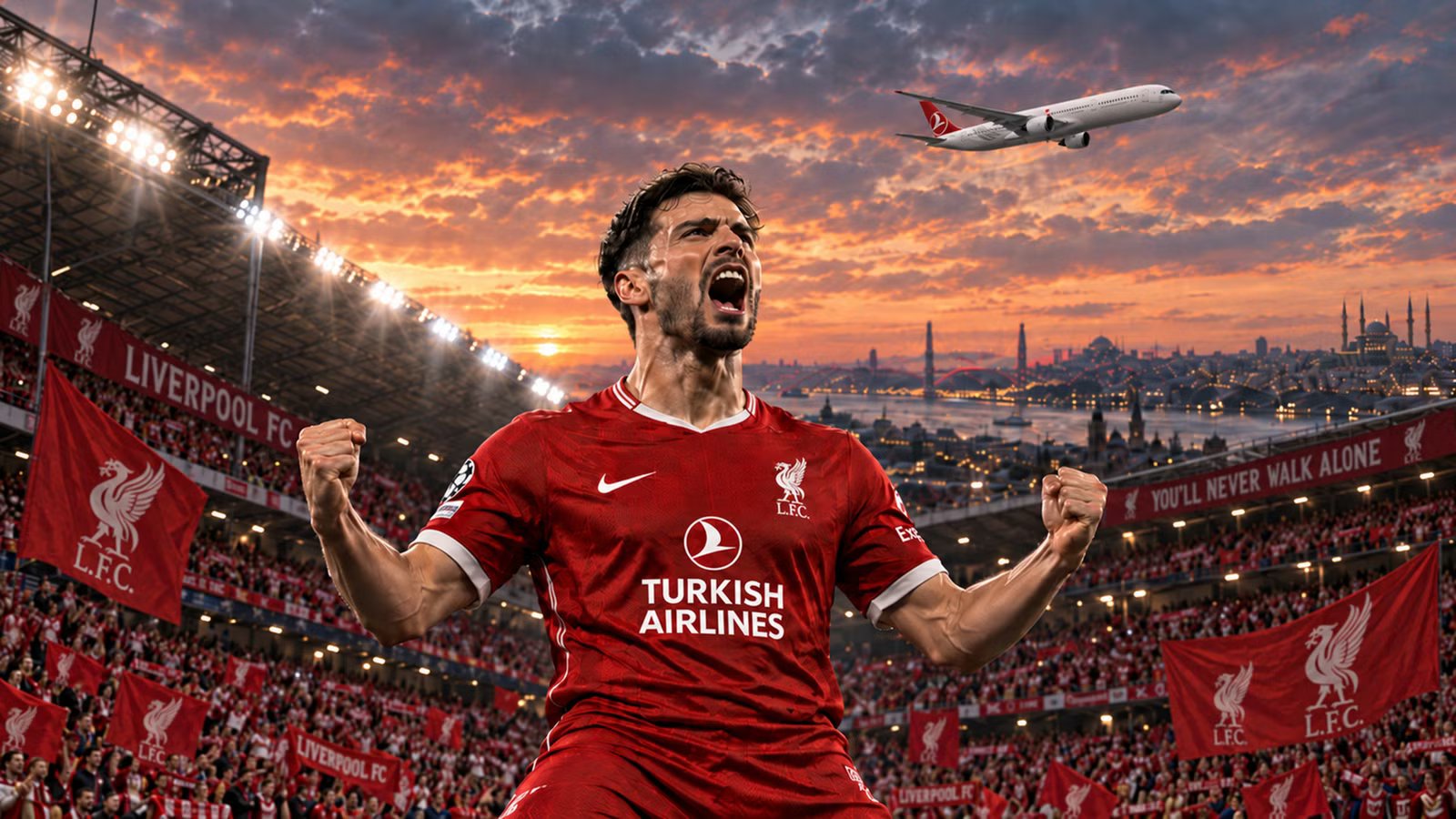
 Turkish Airlines will become Liverpool Football Club’s main sponsorship partner from June 1, 2027, placing its branding on the front of the men’s, women’s, and academy match shirts from the beginning of the 2027/28 season. Financial terms were not disclosed by either party, but Reuters states that the five-year agreement is reported to be worth more than £300 million ($406 million), equivalent to more than $80 million annually.
The agreement gives Turkish Airlines one of the most recognizable advertising spaces in global sport, and ends an unusually long era at Anfield. Standard Chartered has been Liverpool’s principal shirt partner since 2010 and will remain in place throughout 2026/27 before becoming a Global Partner. Yet there is also an intriguing aviation angle to the replacement: Turkish Airlines operates a huge UK network, but does not currently fly to Liverpool John Lennon Airport (LPL).
Turkish Airlines Takes Over Liverpool’s Shirt After 17 Years

Liverpool says Turkish Airlines will become only the sixth sponsor in a short line of brands entrusted with the front of its famous red shirt. Standard Chartered followed Carlsberg in 2010, and has subsequently been present for Liverpool’s Premier League, Champions League, FA Cup and League Cup successes. The change in 2027 will therefore be Liverpool’s first principal-partner switch in 17 years.
Liverpool Main Shirt Sponsor | Years |
|---|---|
Hitachi | 1979–1982 |
Crown Paints | 1982–1988 |
Candy | 1988–1992 |
Carlsberg | 1992–2010 |
Standard Chartered | 2010–2027 |
Turkish Airlines | 2027– |
The size of the new agreement illustrates how much that space is now worth. Reports put Standard Chartered’s existing arrangement at around £50 million ($68 million) annually, while Turkish Airlines will reportedly pay more than £60 million ($81 million) a year. That would put the five-year value above $400 million and make it the Premier League’s richest standalone front-of-shirt agreement.
That “standalone” distinction matters.  Emirates‘ newly extended relationship with Arsenal, for example, includes the front of the playing shirt, training kit and Emirates Stadium naming rights through 2033. Manchester City’s relationship with
  Etihad Airways is similarly much broader than a logo on a jersey. Liverpool’s new arrangement therefore provides an unusually clean indication of how valuable the shirt itself has become.
Liverpool Chief Commercial Officer Ben Latty also highlighted an emotional connection between the new partner and the club, referring to “special memories back in 2005.” That was, of course, the year Liverpool produced its extraordinary comeback against AC Milan in Istanbul to win the UEFA Champions League. That night is now referred to the “Miracle in Istanbul,” and gives the Turkish airline an unusually natural story around which to build the partnership. Latty went on to say:
“The front of the Liverpool shirt holds a special place in the history of our club. Turkish Airlines is a globally recognized organization with an extensive international network, and we look forward to beginning our partnership and building a strong relationship together, with already strong foundations built from those special memories back in 2005.”
Turkish Airlines Doesn’t Even Fly To Liverpool

Despite that connection, Liverpool itself is conspicuously absent from Turkish Airlines’ UK route map. The carrier’s 2026 summer network instead covered six UK airports from  Istanbul Airport (IST), including three separate London gateways after
  London Stansted Airport (STN) was added back in the spring. At the highest regular summer frequencies, Turkish offers nearly 150 weekly departures from Turkey to the UK, showing that this sponsorship is hardly being undertaken by an airline with a marginal presence in the country.
Istanbul Route | Peak Frequency | Aircraft Used |
|---|---|---|
London Heathrow | 41 weekly | A321neo, A330-200/-300, A350-900, 777-300ER, 787-9 |
London Gatwick | 28 weekly | A321neo |
London Stansted | 15 weekly | A321/A321neo, 737-800/-900, 737 MAX 8/9 |
Manchester | 28 weekly | A321/A321neo, A330-200/-300, 737 family, 787-9 |
Birmingham | 21 weekly | A321neo, 737-800/-900, 737 MAX 8/9 |
Edinburgh | 14 weekly | A321/A321neo, 737-800/-900, 737 MAX 8/9 |
The absence of Liverpool reinforces what Turkish Airlines is really purchasing. A supporter seeing the airline’s name in Seoul, San Francisco, São Paulo or Singapore is just as commercially valuable to Turkish Airlines as someone sitting at Anfield. The airline’s Istanbul hub is built around connecting passengers between regions, while its network now stretches to well over 350 destinations; recent expansion has included Santiago’s Comodoro Arturo Merino Benítez International Airport (SCL) as the carrier continues growing its footprint in the Americas.
That makes Liverpool particularly attractive. Rather than advertise individually in hundreds of markets, Turkish Airlines can attach itself to a club whose fan base already reaches every continent. Liverpool explicitly described its supporter base as global, while Turkish Airlines says it flies to more countries than any other airline — making the overlap considerably more important than whether an Istanbul-Liverpool route exists. Ahmet Olmustur, Turkish Airlines CEO, confirmed this when he said:
“Liverpool Football Club is one of the world’s most recognized and respected football clubs, with an exceptional heritage and a truly global community of supporters. We are very pleased that Turkish Airlines will become the club’s main club partner and that our name will take its place on one of the most iconic shirts in world sport.”

Turkish Airlines is entering sponsorship territory that has long been occupied by the Gulf carriers, its fiercest rivals. Emirates has assembled a portfolio including Real Madrid, Arsenal, AC Milan, Benfica and Lyon;  Qatar Airways is on Paris Saint-Germain’s shirt; and Etihad has become deeply associated with Manchester City for many years.
Airline | Club | Main Asset | Reported Annual Value |
|---|---|---|---|
Etihad Airways | Manchester City | Shirt / wider partnership | $139 million |
Emirates | Real Madrid | Shirt / wider partnership | $86 million |
Turkish Airlines | Liverpool | Front of shirt | $81 million |
Qatar Airways | Paris Saint-Germain | Front of shirt | $70 million |
Emirates | Arsenal | Shirt + training + stadium | $68 million |
Riyadh Air | Atlético Madrid | Shirt + stadium | $46 million |
Emirates | AC Milan | Front of shirt | $41 million |
Emirates | Lyon | Front of shirt | $23 million |
Emirates | Benfica | Front of shirt | $9 million |
United Airlines | Wrexham | Front of shirt | $8 million |
 Riyadh Air demonstrates how aggressively airlines can use soccer to create recognition. It became Atlético Madrid’s shirt sponsor before even beginning commercial operations, and subsequently added the Riyadh Air Metropolitano stadium name through 2033. As the airline has moved from brand-building toward an expanding scheduled network, Atlético has effectively provided millions of consumers with years of advance familiarity with the Riyadh Air name.
 United Airlines‘ recently ended Wrexham shirt deal also shows that an airline does not necessarily need a Real Madrid or Liverpool to attract global attention. United reportedly paid around £6 million ($8 million) annually to sponsor a club that was in the lower divisions when the relationship began. Yet Welcome to Wrexham, its celebrity owners and social media transformed the Welsh club into an international entertainment property, taking the United brand on an implausible journey with a global audience.
The numbers show why that sponsorship strategy works. Wrexham generates nearly 60% of its revenue from outside the UK, principally North America. Welcome to Wrexham has now been renewed for an eighth season, echoing the way Drive to Survive helped Formula 1 reach audiences far beyond traditional motorsport fans. Airlines can therefore pay extraordinary sums for an established global giant such as Liverpool — or hunt for the next club whose biggest asset is not trophies, but eyeballs.