dailynewsnblog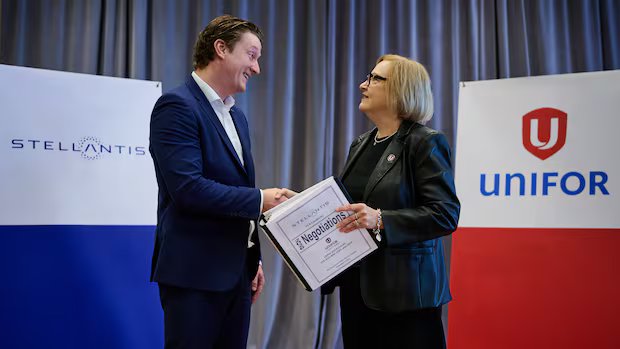
The union representing workers at Stellantis warned the U.S. automaker not to take Canadian employees for granted as Unifor and the company began contract talks Tuesday.
The negotiations mark the final round of Unifor’s bargaining with the Detroit Three automakers. The union typically uses pattern bargaining for its auto sector negotiations, setting terms it hopes to replicate with other companies.
Despite ratifying new collective agreements with Ford Motor Co. and General Motors in Canada earlier this summer, Unifor’s greatest challenge lies ahead, national president Lana Payne said.
“I would say we have defied a few odds, given the moment, given the uncertainty, given the tariffs and Trump’s trade war, given all the massive headwinds against us,” she told a news conference.
“But I’m not going to sugar-coat things. We expect this round of negotiations to be our most difficult and challenging yet, possibly ever.”
The parties are working toward a Sept. 11 deadline to reach a new deal. The union’s key concern, it said, surrounds job security after more than 2,000 workers were laid off from Stellantis’ Brampton, Ont., assembly plant, which has been idled since 2023.
Last month, the union said it received notice that Stellantis was considering the closure and sale of the plant. The facility had been slated to be retooled for Jeep production, a process that began early in 2024, before the company paused the plan in early 2025.
It later announced it was moving production of the Jeep Compass to the U.S., in what the union called a violation of its current collective agreement, leaving the plant idled indefinitely.
Last month, Payne said the union was informed that Stellantis might close and sell the plant, though the company didn’t give the union a formal written notice — which would be required under the current collective agreement.

Unifor says it received information from Stellantis on Wednesday about plans to possibly close or sell the Brampton plant. CBC Dale Manucdoc breaks down what we know.
She reiterated Tuesday that production of the Jeep Compass “should never have left the Brampton plant,” calling it the “absolute wrong decision.”
“To be blunt, Stellantis has had a lot of work to do and will have a lot to do to repair relations with our members and with Canadians,” she said.
“It starts with making things right with our members at Brampton Assembly and that means putting them back to work building vehicles, not closing and not selling the plant.”
On Tuesday, Stellantis said labour talks with the union marked “an extremely important process” for its future.
“The industry is undergoing a transformation in terms of trade and regulatory environment, diverging what was a once very integrated marketplace here in Canada, and obviously we need to face those challenges head-on,” said Trevor Longley, chairman, president and CEO of Stellantis Canada.
Longley noted that the company has spent more than $8 billion across its Canadian operations since 2022. He said that investment has helped enhance the company’s manufacturing footprint and advance battery manufacturing technology in Ontario.
“I think it’s fair to say that in terms of … our investment long-term in Canada, this is an important market for us and will continue to be an important market for us in the future,” Longley told reporters on the sidelines of the negotiations.
“This is an important time for us. I think [negotiations will] be fair, responsible, and I think ultimately we’ll get to an agreement that works for us in a sustainable way.”
Tariffs put extra pressure on talks
The talks come against the backdrop of U.S. tariffs battering local automakers. A 25 per cent levy on all cars and trucks not built in the U.S. remains in place, excluding those that comply with the Canada-United States-Mexico Agreement (CUSMA).
U.S. President Donald Trump threatened last week on social media to hike tariffs on all vehicles, auto parts and steel from Canada to 50 per cent beginning Jan. 1.
Calling the current economic situation “an existential crisis for our auto industry,” Payne said it’s crucial that Canada holds firm on maintaining its auto sector footprint.
“The reality is — and Donald Trump knows this too — a 50 per cent tariff on cars and parts will shut down the entire North American auto industry, likely within a week or 10 days,” she said.
“What we’re dealing with right now is the same kind [of] threats that we have faced for 18 months in this country, and the only way you can deal with those threats is to push back.”
Larry Savage, a labour studies professor at Brock University, said Unifor is “fighting a battle on two fronts” at the moment.
“At the bargaining table, the union is pushing Stellantis to maintain vehicle production in Canada and accept the pattern agreement,” he said in an email.
“Meanwhile, in Ottawa, Unifor is pushing the federal government to oppose any new trade agreement that would sooner or later kill the auto industry in Canada.”

Car parts can cross international borders six, seven or even eight times before ending up in a vehicle. But amid a trade war, as both Canada and the United States raise tariffs up to 50 per cent, it’s getting more expensive — and complicated — to build cars. The CBC’s Acton Clarkin breaks it down.
He said current contract talks are about more than just Stellantis.
“The union is fighting to save the auto industry in Canada. Securing the pattern agreement won’t mean much if the federal government sacrifices the auto industry in trade war with Trump,” Savage said.
On Sunday, Unifor said its members at General Motors voted overwhelmingly in favour of ratifying new contracts with that automaker, with those in Oshawa, St. Catharines and Woodstock voting 80.5 per cent in favour, while members in Ingersoll were 96.5 per cent in support.
The three-year collective agreements increase wages for full-rate production members to $50.20 per hour and skilled trades workers to $62.71 an hour.
The union said its agreements with GM mirror the three per cent annual wage increases reached with Ford, which Unifor selected to kick off its pattern bargaining with the industry.