dailynewsnblog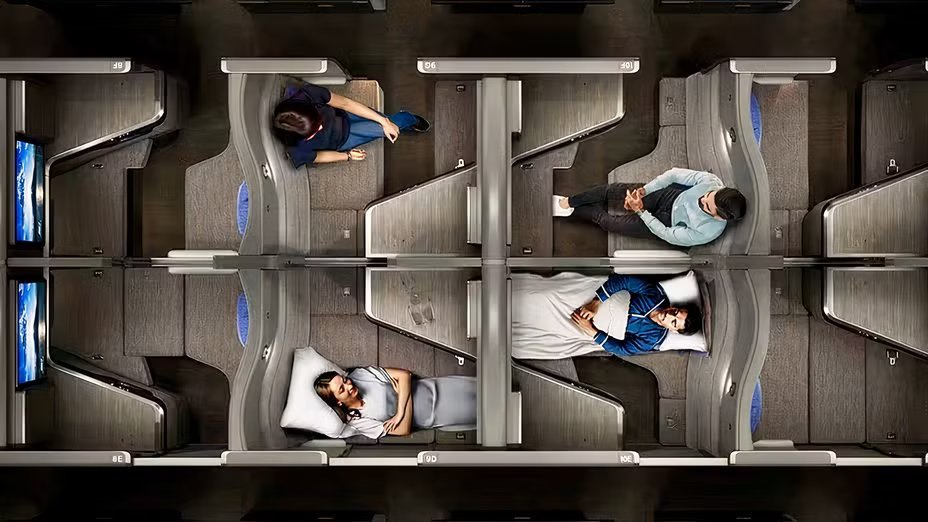
Long-haul business class has changed dramatically over the past decade. What was once defined primarily by a lie-flat seat, direct aisle access, and better food has increasingly become an exercise in personal space, with airlines building private rooms around passengers rather than simply adding wider seats to a cabin. For travelers facing 10, 12 or even 16 hours in the air, that distinction can make an enormous difference.
The following five products stand out because privacy is central to passenger well-being. Each uses doors, unusually high walls, enclosed shells, or exceptionally generous personal space to create a genuine sense of separation from the rest of the cabin. The list focuses particularly on Asian carriers, where privacy is highly valued; airlines such as  Qatar Airways, All Nippon Airways (ANA), Japan Airlines(JAL), and Cathay Pacific have invested heavily in privacy-focused premium cabins, while
  Singapore Airlines has also helped establish the region’s reputation for sophisticated, highly individualized long-haul seating.
5
Cathay Pacific Aria Suite
A private room built around a wraparound seat

Cathay Pacific’s Aria Suite represents the latest stage in the evolution of the airline’s Business Class product. Installed on selected Boeing 777-300ER aircraft, the suite features a wraparound design and a dedicated privacy door, creating a substantially more enclosed environment than the carrier’s previous Business Class seats. Cathay Pacific describes it as a “private haven” with a 24-inch 4K screen, a lie-flat bed, and a sliding partition that adds another layer of separation.
The biggest advantage is that the privacy comes from the seat’s architecture, not a small divider that can only block part of the view. Once the door is closed, the passenger is surrounded by walls on several sides, dramatically reducing the visual activity of the aisle and neighboring seats. That matters particularly on overnight flights, when the difference between seeing cabin movement and retreating completely into one’s own space can determine whether a passenger feels genuinely rested after landing.
Cathay Pacific has also approached the Aria Suite as more than a seat with a door. The wraparound structure creates a distinct personal environment, while the 24-inch 4K display, storage and lie-flat bed make the suite practical for both working and sleeping. It is still a business class seat rather than a hotel room in the sky, but the combination of a door, high shell and generous footprint puts the Aria Suite firmly among the products that can make the cabin almost disappear from view.
4
Japan Airlines’ A350-1000 Business Class Suite
Japan’s answer to the private Business Class room

Japan Airlines (JAL) has taken a particularly ambitious approach to business class privacy on its flagship Airbus A350-1000. The airline introduced doors to business class for the first time with this aircraft, describing the product as an enclosed private suite. The 1-2-1 configuration gives every passenger direct aisle access, while the suite has a maximum seat width of approximately 22 inches (56 centimeters) and a bed length of approximately 78 inches (198 centimeters).
Catch what other flight trackers miss
Emergency squawks, holds, NOTAMs — live signals, no signup.
Open tracker
Catch what other flight trackers miss
Emergency squawks, holds, NOTAMs — live signals, no signup.
Open tracker
The structure’s height enhances the sense of privacy. JAL lists the suite wall height at approximately 52 inches (132 centimeters), meaning that passengers are not simply separated by a small shoulder-level divider. The doors can be closed to create a genuinely individualized environment, while an electric privacy partition remains available for passengers traveling together. A personal wardrobe and dedicated storage also mean more objects normally scattered around a Business Class seat can be kept inside the suite.
JAL’s design is particularly interesting because it combines privacy with an unusually open-feeling interior when passengers want it. The airline has positioned overhead storage exclusively on the window side, helping create a less cluttered cabin, while each suite gets a 24-inch screen and a fully flat bed. JAL itself says the doors were introduced to ensure privacy, and its current A350-1000 product therefore represents one of the clearest examples of an Asian airline turning Business Class into a genuinely private room.
3
ANA THE Room FX
The next-generation suite that turns a 787 seat into a room

ANA’s THE Room FX is perhaps the most intriguing product on this list because it adapts the enormous philosophy of the original THE Room to the smaller Boeing 787-9. Introduced in 2025 and progressively deployed from 2026, THE Room FX features a privacy door at every Business Class seat and uses an alternating forward- and rear-facing layout to create a remarkably large personal area. ANA says the design delivers a spatial experience comparable to a larger aircraft.
The dimensions explain why the seat feels more like a miniature room than a conventional airline chair. THE Room FX has a maximum width of approximately 41.5 inches (105 centimeters), a waist width of about 27 inches (69 centimeters) and a maximum length of 76.5 inches (194 centimeters). With 103 inches (2.6 meters) of seat pitch, a 24-inch display, seat-integrated storage, and a fully flat bed, the product uses space very differently from a conventional 1-2-1 Business Class seat.
THE Room FX also has a clever psychological element. ANA has slimmed the doors, backrests and seat dividers compared with the original concept, reducing weight without abandoning the enclosed architecture. The result is a private compartment that can open for interaction with the crew or the cabin, but can disappear behind a door when passengers want to work, sleep, or simply be left alone. As ANA begins introducing the product on long-haul 787-9 routes, it could become one of the most innovative business class upgrades in the medium-sized widebody market.
2
ANA THE Room
The Business Class seat that made the room concept famous

Before THE Room FX, ANA had already demonstrated how far business class could go with its original THE Room on the Boeing 777-300ER. The concept centers on an exceptionally wide seat enclosed by substantial walls, with a door that lets each passenger shut off the surrounding cabin. Unlike many privacy-focused business class products, the seat’s sheer dimensions are part of its appeal, creating an environment that feels substantially larger than the average airline suite.
THE Room also illustrates why Asian airlines have become so closely associated with high-end business class privacy. ANA did not simply take a conventional reverse-herringbone seat and add a door; it redesigned the space around the passenger, producing a wide lounge-like environment that can transition into a bed. The direct-aisle-access arrangement means passengers do not have to climb over anyone when the cabin is configured for sleeping, while the surrounding shell keeps neighboring passengers largely out of sight.
That philosophy places ANA in the same broader trend as Japan Airlines and Cathay Pacific, while Singapore Airlines has long emphasized wide, cocoon-like Business Class seating and direct aisle access on its long-haul fleet. Singapore’s 2017 Airbus A380 business class, for example, used a large carbon-fiber shell and a 25-inch seat designed to create a cocoon-like sense of privacy, though it lacked the full privacy door found on the suites above. The distinction is important: not every excellent Asian Business Class seat is a suite, but the region’s leading carriers have often pushed the market toward more individualized personal space.
1
Qatar Airways Qsuite
The Business Class suite that turned privacy into a category of its own

Qatar Airways’ Qsuite remains the benchmark against which enclosed business class products are often judged. Introduced in 2017, it was revolutionary thanks to its flexibility: the airline added doors, movable privacy panels, and a configuration that could transform four center seats into a shared private space, while individual passengers could also create a highly secluded suite of their own.
The most extraordinary feature is what happens when two passengers traveling together occupy the appropriate center seats. Movable panels can be repositioned to create a larger shared environment, and Qatar Airways developed the product with a fully lie-flat double bed in business class. That remains one of the most unusual features in commercial aviation because it transforms what is normally an individual airline seat into something resembling a small private bedroom for two.
For solo travelers, however, Qsuite’s greatest strength is simply the ability to close the door. Qatar Airways explicitly markets Qsuite as a private business class cabin, with dedicated doors and adjustable lighting, while the current product offers single, double, matrimonial and quad configurations depending on the seat arrangement. The combination of a door, high surrounding structure, direct access and the ability to create either complete solitude or a shared room explains why Qsuite remains number one for passengers who want Business Class to feel as though they are traveling in their own private aircraft.
Business Class product | Airline | Privacy feature | Standout feature |
Qsuite | Qatar Airways | Closing door + high walls | Double bed and quad configuration |
THE Room | ANA | Enclosed suite + door | Exceptionally wide personal space |
THE Room FX | ANA | Self-contained suite + door | 41.5-inch (105 cm) maximum width |
A350-1000 Business Class | Japan Airlines | Enclosed suite + door | 52-inch (132 cm) wall height |
Aria Suite | Cathay Pacific | Privacy door + wraparound shell | 24-inch 4K display |
The wider trend is difficult to miss. Qatar Airways may have popularized the fully enclosed business class suite, but most Asian airlines have always treated privacy as a central component of the premium experience rather than an optional extra. Japan Airlines’ A350-1000, ANA’s two generations of THE Room, and Cathay Pacific’s Aria Suite all show how modern cabins are moving toward doors, taller structures, and individualized living spaces. Even Singapore Airlines, whose long-haul Business Class generally does not use doors, has historically emphasized wide seats, large shells, direct aisle access, and a cocoon-like environment.