dailynewsnblog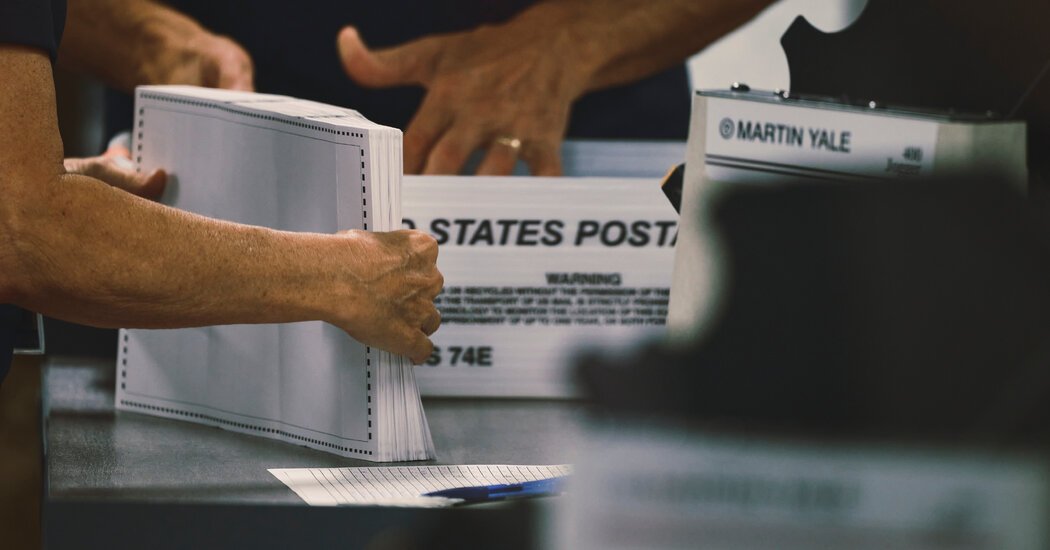
A federal judge on Thursday once again temporarily prohibited the U.S. Postal Service from putting in place a plan to restrict mail-in voting, put in place after a directive from President Trump.
Federal District Judge Indira Talwani had cleared the way for the Postal Service to forward just the day before, but on Thursday, she issued a new order concluding that the agency’s plan, released late on Friday, appeared to overstep its legal mandate and could spark chaos by changing rules fewer than 70 days before an election.
She wrote that a group of Democratic-led states that had sued “face irreparable harm where they are required to comply with a likely unconstitutional regulation for which compliance is practically impossible as to the 2026 midterm elections, now little more than two months away.”
“Most plaintiff states have already ordered their mail ballots, and some are required by state law to send them to eligible voters as early as next week,” she added.
She wrote that while the Supreme Court had “admonished” her on Monday that the Postal Service had not finalized any changes when the groups sued initially, making court action premature, the stakes had changed since then because of the step the agency took Friday to formalized its plan.
Her ruling marked the third court decision on the issue in less than a week, a whipsaw of action that threatened to confuse voters. But each delay has reduced the administration’s chances of clearing the legal hurdles to execute its logistically complicated mail-in ballot plan before the November election. She blocked the rule from taking effect for 14 days, and she had previously scheduled a hearing to discuss the legality of the rule on Sept. 3.
In her order, Judge Talwani explained that the prospect of the new rule suddenly taking effect carried “significant risk of their members’ disenfranchisement” for voting rights organizations, which had also sued, along with the states.
She ticked through a list of requirements that state election officials would be required to meet to ensure delivery of ballots, including receiving the agency’s approval for new envelope designs and submitting voters’ information into an online portal run by the Postal Service.
“Where a state or local election official does not obtain envelope and return envelope design approval, or does not upload voter information, or does not include unique intelligent mail bar codes on ballot envelopes, the U.S.P.S. will not mail ballots to voters,” she concluded.
In March, President Trump issued an executive order that required the Department of Homeland Security to create and circulate state-by-state citizenship lists to state officials. It further urged states to provide the U.S. Postal Service with their own lists of voters eligible to cast ballots by mail.
Multiple lawsuits were filed challenging the order, arguing that Congress and the states set rules for elections, not the executive branch. The challengers also argued that no federal law gives the Postal Service the power to make those kinds of election-related rules.
On Monday, the Supreme Court ruled that one suit, brought by a group of Democratic-led states, was premature because the administration had not started implementing its plans.
But late Friday, just before the court ruled, the Postal Service formally published a new plan to comply with the executive order. Under that plan, the service would not deliver mail ballots in states that do not share voter data with the agency and would only deliver ballots that meet certain criteria.
Lawyers for the Trump administration and the groups challenging the rule continue to clash over a straightforward issue: Whether or not the Postal Service’s plan would mean the agency would be taking on a new role verifying voters and potentially rejecting ballots in the midterm election in November.
In a filing on Thursday, the Postal Service denied that its proposal left room for the service to second-guess states on which voters were eligible to cast a ballot.
“U.S.P.S. will not scrutinize those decisions or alter that information in any way — instead leaving it entirely up to the states to accurately and lawfully identify its residents who are eligible to vote by mail,” the filing said. “The Postal Service will not determine voter eligibility, ballot content, mailing or receipt deadlines, or ballot-counting procedures.”
Instead, it described the changes as minor logistical improvements and streamlining, such as requiring voters to submit their addresses ahead of time to improve processing. It said the changes were designed “as a matter of the Postal Service’s own judgment.” Lawyers for the service argued it is authorized to adopt mail rules under statutes adopted by Congress.
The challengers argue that the Postal Service rule is an unconstitutional violation of the separation of powers, allowing the executive branch to intrude into elections. They say that no federal law permits such action by the agency, and they assert that the Trump administration’s actions are likely to sow confusion among voters and to lead to disenfranchisement.
The agency has repeatedly said that it would not attempt to impose the new requirements, unless it was explicitly allowed to by the courts.
A series of lawsuits in Massachusetts and the District of Columbia by different groups have challenged Mr. Trump’s effort to discredit and erect obstacles to mail-in voting. The lawsuits have challenged both Mr. Trump’s executive order and the Postal Service rule, focusing on their implementation this year and beyond.