dailynewsnblog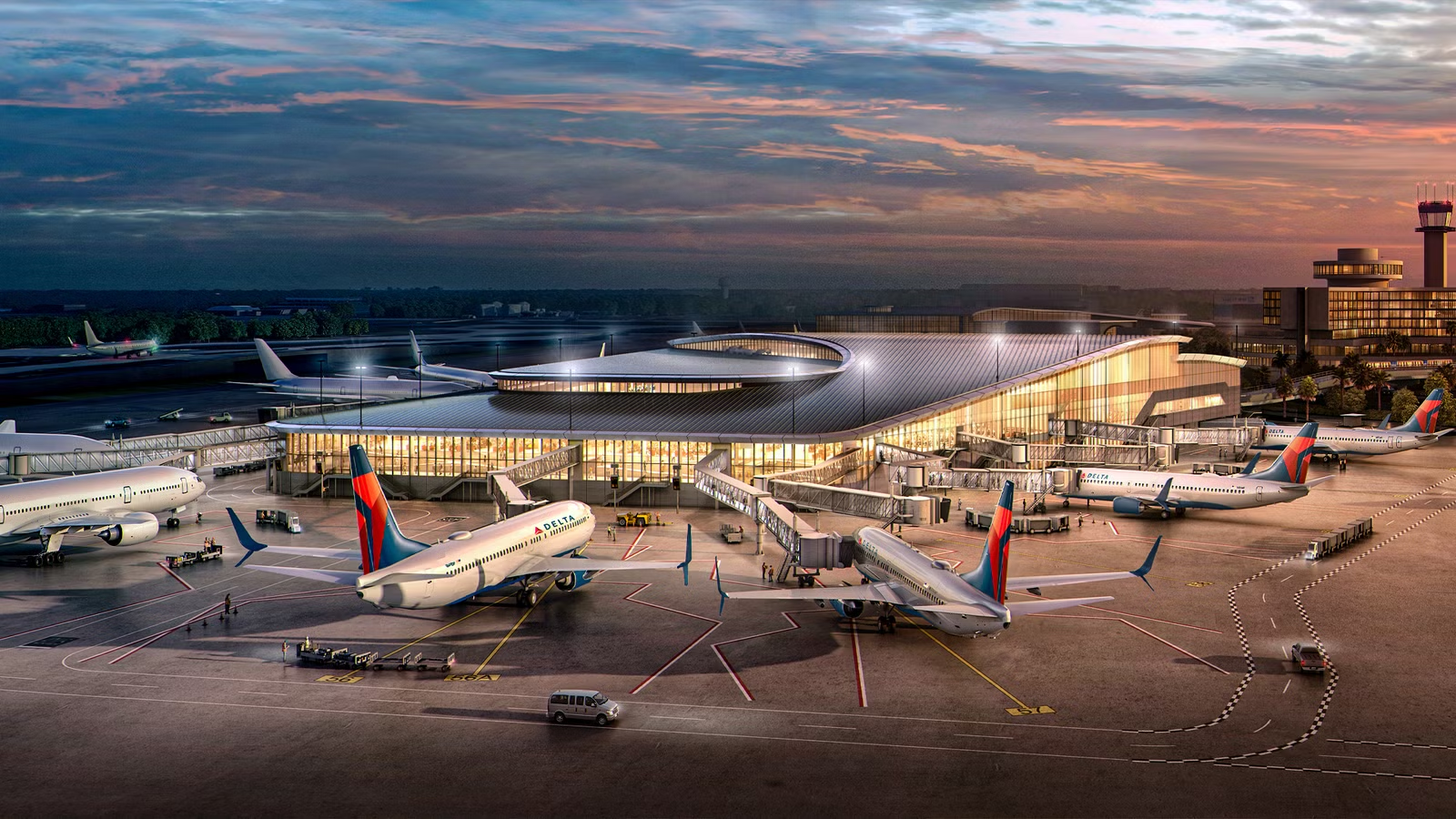
Tampa International Airport (TPA) is building a $1.528 billion terminal that will add 16 gates, a dedicated Federal Inspection Services area for international arrivals, and enough capacity to handle 35 million annual passengers by 2037. Structural steel will begin going up this Summer, with completion targeted for late 2028 and a public opening in 2029. It is the airport’s first new airside terminal in nearly 20 years.
 Delta Air Lines signed a 20-year anchor lease for at least six of those gates, including a purpose-built Delta Sky Club lounge. The commitment is the longest and most substantial terminal agreement Delta has made at any mid-size Florida airport, and it positions Tampa as a potential international gateway for the airline once the new Federal Inspection Services facility gives the airport the processing capacity to support widebody international arrivals.
What Tampa Is Building And How Far Along It Is

TPA is building its first new airside terminal in nearly 20 years. The Hillsborough County Aviation Authority Board approved the 100% final design for Airside D on February 5, clearing the project for full construction. The facility will be 600,000 square feet (55,742 sq meters) with 16 gates serving both domestic and international flights. It includes a new Federal Inspection Services area for processing international arrivals, an 8-lane security checkpoint, and a new checked baggage inspection system in the main terminal. The total project cost is $1.528 billion, including a $902 million supplemental contract approved in late 2025.
Construction is well underway. A 300-ton crane is erecting the structural steel framework, which consists of 6,200 tons of steel comprising over 7,300 individual pieces connected by 96,000 bolts and 212,000 inches of welding. Approximately 200 workers are on site daily, with that number expected to increase significantly as the project moves from structural work into mechanical, electrical, and interior fit-out phases. HNTB designed the project, the same firm that designed TPA’s existing main terminal and automated people mover system.
Completion is targeted for late 2028 with a public opening in 2029. Once operational, Airside D will increase TPA’s total gate count and expand the airport’s annual passenger capacity from its current 25 million to 35 million by 2037. The airport handled approximately 24 million passengers in 2024, meaning it is approaching the capacity limits of its existing terminal complex. Airside D provides the infrastructure to accommodate the growth TPA has been experiencing without the crowding and gate constraints that would otherwise limit airline expansion at the airport.
Delta’s 20-Year Anchor Lease And What It Includes

Delta was selected as the anchor tenant for Airside D in a decision announced by the Hillsborough County Aviation Authority. The lease covers at least six of the 16 gates on a 20-year term, giving Delta a dedicated presence in the new facility through approximately 2049. The agreement includes a mezzanine-level Delta Sky Club , the carrier’s first purpose-built lounge at TPA. The remaining 10 gates will be available for other carriers, with the airport authority retaining flexibility to assign them based on demand and airline interest.
A 20-year anchor lease at a mid-size airport is not a routine commitment. Delta operates from dozens of airports across the United States, but it signs long-term anchor agreements only at facilities where it intends to build or sustain a significant operation over multiple decades. The lease term matches the terminal’s useful life, meaning Delta is committing to Tampa for as long as Airside D operates. The Sky Club inclusion signals that Delta expects enough premium traffic at TPA to justify the capital investment and ongoing operating cost of a dedicated lounge, which the airline typically reserves for its largest hubs and busiest focus cities.
Delta currently operates approximately 90 daily departures from Tampa to destinations including Atlanta, Detroit, Minneapolis-St. Paul, Salt Lake City, New York-JFK, Boston, and Amsterdam. The Amsterdam route, operated on the Airbus A330-900neo, is Delta’s first year-round widebody international service from TPA and serves as a proof of concept for the kind of European flying the airline could expand from Airside D once the facility opens. The six-gate commitment in a terminal with a dedicated Federal Inspection Services area positions Delta to add additional international routes from Tampa without competing for gate space or customs processing capacity in the airport’s existing international facility.
Where Delta Currently Operates Hubs And Focus Cities

Delta operates the largest domestic hub-and-spoke network of any US carrier, built around hubs at Hartsfield-Jackson Atlanta Airport (ATL), Detroit Metropolitan Wayne County Airport (DTW), Minneapolis-St. Paul International Airport (MSP), Salt Lake City International Airport (SLC), Seattle-Tacoma International Airport (SEA), John F. Kennedy International Airport (JFK), Boston Logan International Airport (BOS), and Los Angeles International Airport (LAX). Atlanta is the largest by a wide margin, handling over 1,000 daily Delta departures and serving as the airline’s primary connecting hub for domestic and international traffic.
Delta’s existing Florida footprint is substantial but spread across multiple airports without a dominant hub presence at any single one. The airline operates from Orlando International Airport (MCO), Fort Lauderdale–Hollywood International Airport (FLL), Miami International Airport (MIA), Jacksonville International Airport (JAX), and TPA, among others. None of those airports functions as a Delta hub in the way that Atlanta or Detroit do. However, Orlando and Fort Lauderdale carry the highest Florida frequencies, driven by leisure demand from Delta’s Northeastern and Midwestern hubs.
The anchor tenant commitment does not make Tampa a hub. Delta is not building a connecting operation at TPA comparable to what it runs at Atlanta or Detroit. The lease establishes Tampa as a long-term focus city with dedicated infrastructure, a premium lounge, and the physical capacity to grow well beyond the 90 daily departures Delta currently operates. The distinction matters because a focus city with a 20-year lease and a purpose-built Sky Club receives a different level of investment and scheduling priority than a station where the airline operates from shared gates on short-term agreements.
Why The Federal Inspection Services Area Changes The Airport’s Role

TPA already handles international flights. Edelweiss serves Zurich, avianca recently launched daily service to Bogota, and Delta added year-round Amsterdam service. Caribbean and Canadian routes to destinations including San Juan, Toronto, Montreal, Cancun, and Santo Domingo operate from the existing terminal. The airport is not starting international service from zero. What it lacks is the capacity to grow it meaningfully beyond what the current Federal Inspection Services facility can process.
Airside D’s dedicated FIS area changes that constraint. The new facility will have its own Customs and Border Protection processing area capable of handling widebody international arrivals simultaneously with domestic operations on the same concourse. Delta’s six gates in a terminal with FIS capability give the airline the infrastructure to operate international flights from Tampa without competing for processing capacity in the airport’s existing international arrivals facility. Routes to London, Paris, or additional European destinations that require a full international arrivals hall become operationally feasible in a way they are not today from Delta’s current gate positions.
The most striking figure in the airport authority’s route development materials is the leakage rate. Approximately 50% of Tampa’s international origin-and-destination traffic currently uses other Florida airports, primarily MIA, MCO, and FLL. Tampa Bay area residents flying internationally drive to other airports because nonstop international options from TPA are limited. Airside D’s FIS capacity, combined with Delta’s anchor presence and the gate infrastructure to support widebody international service, is designed to recapture that leakage by giving Tampa the facilities to offer the international routes its local market already demands.
Tampa’s Growth & Why The Timing Makes Sense

The Tampa Bay metropolitan area is one of the fastest-growing regions in the US. The four-county metro area comprising Hillsborough, Pinellas, Pasco, and Hernando counties has added over 400,000 residents since 2010 and now exceeds 3.3 million people. The region’s economy has diversified beyond its traditional tourism and military base, with finance, healthcare, technology, and logistics sectors driving corporate travel demand alongside the leisure traffic that has historically defined Florida aviation. TPA handled 24.5 million passengers in fiscal year 2025, approaching the 25 million capacity ceiling the airport authority identified as the trigger point for Airside D.
The 2029 opening timing aligns with several fleet developments at Delta. The airline’s A321XLR deliveries, expected to begin in the late 2020s, will give Delta a narrowbody capable of serving European destinations from Tampa that the A321neo cannot reach nonstop. The A350-1000 deliveries beginning in late 2026 will free up A330-900neos and A350-900s that could be deployed on international routes from secondary hubs and focus cities including Tampa. Delta’s year-round Amsterdam service, launched on the A330-900neo, is a proof of concept for European widebody service from TPA. If the route performs well through 2027 and 2028, additional European destinations from Airside D’s gates become a natural extension of the strategy once the facility opens.