dailynewsnblog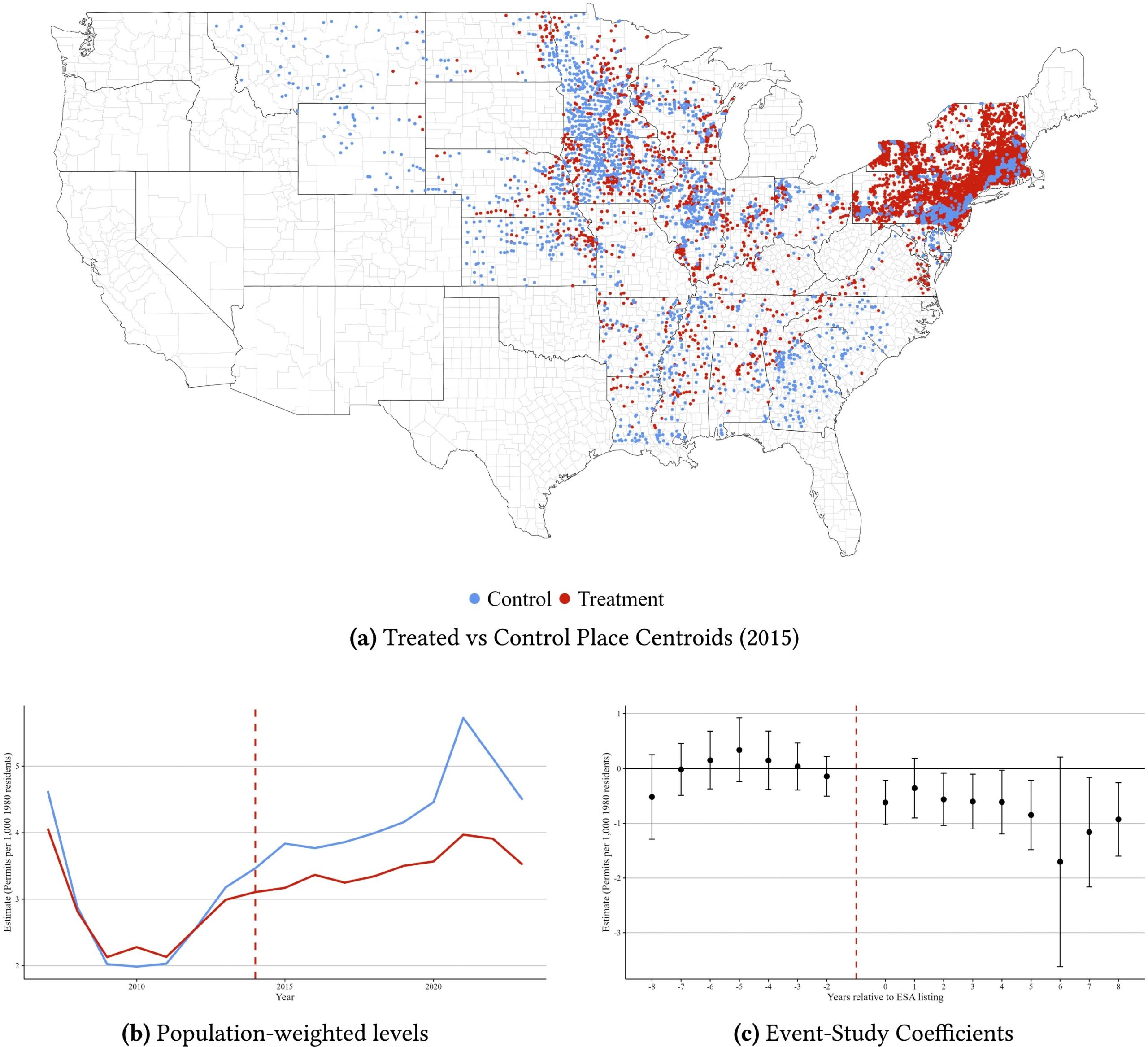
Max Tabarrok’s paper on the Endangered Species Act and housing (WP) has just been published in the Journal of Public Economics! It’s a clever paper: Max observed that the moment an animal is put on the endangered species list, developers face enhanced compliance costs and liability risk. But what’s important for an empirical economist is that this increased regulation isn’t national–it binds just where the species lives. Thus, the ESA creates many natural experiments, places where it binds and nearby places where it doesn’t and the list changes over time–there were 82 listings in 1970 and nearly 1500 today–and there are even some de-listings which reduce regulation.
Here, for example, is a picture of the habitat (red) and control areas (blue) for when the Northern Long Eared Bat was put on the endangered species list.
The bottom left panel measures annual housing permits per 1000 1980 pop in treatment (red) versus control (blue) areas. The bottom right is the event study coefficients. After the bat was put on the endangered species list, the number of new housing permits declined in areas where bats might live relative to control areas.
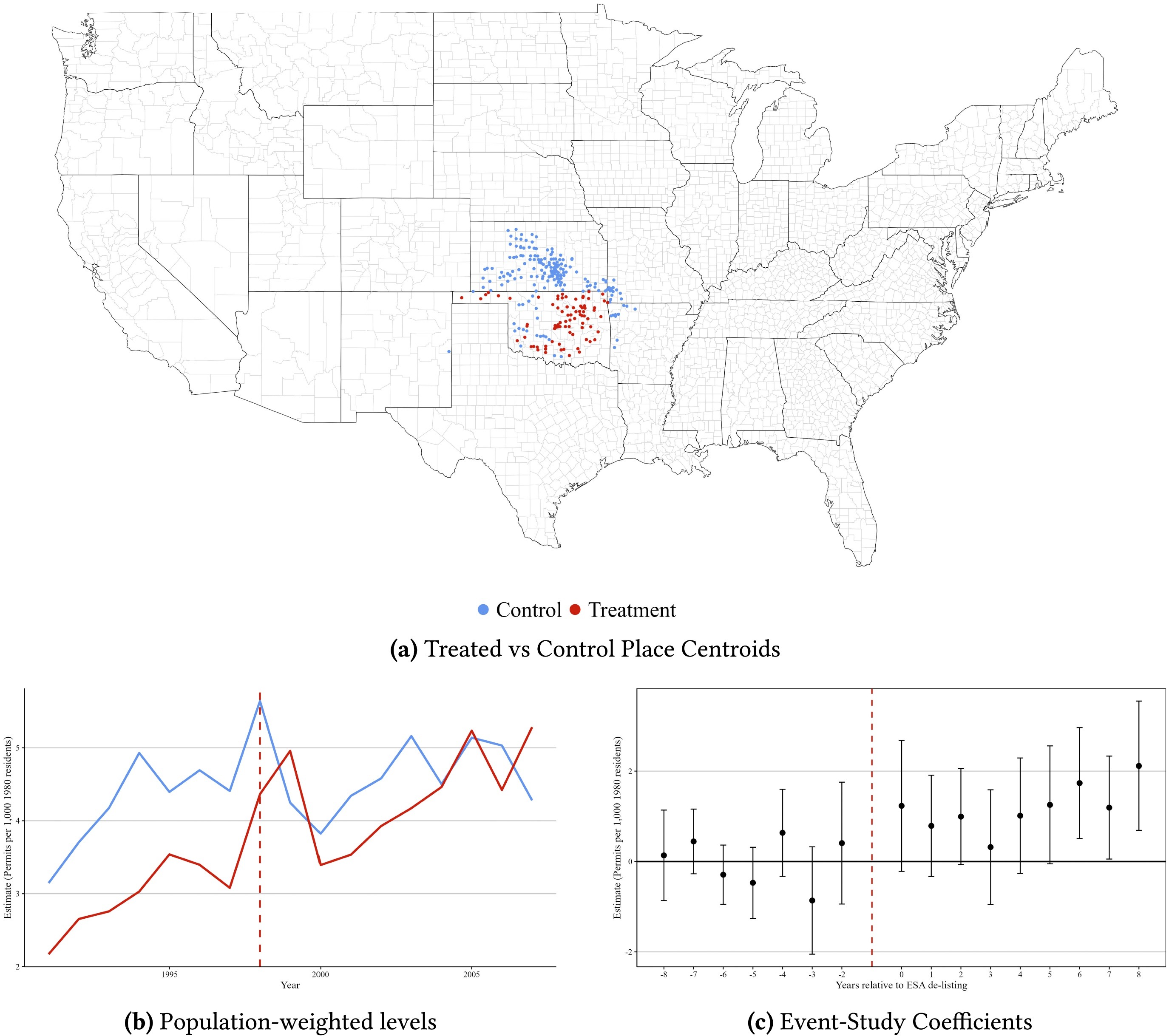
Here is what happened when the Peregrine falcon was delisted. Before the delisting, housing permits were lower in regions (red) where the falcon had habitat compared to controls areas but after the delisting the treatment areas caught up to the control areas.
Overall:
…this paper provides evidence that an additional endangered species listing reduces annual housing permit flows by 0.5 permits per thousand 1980 residents, about 10% of the average place’s permit flow. Accounting for spillovers and diminishing costs, my estimates suggest the aggregate effect of the ESA has been to reduce the national housing stock by…roughly 6.3 million missing units over 1980–2024, about 4% of the 2025 housing stock.
Now, you might say, ok this shows the ESA has costs. What about the benefits of the ESA? It’s hard to measure the benefits, of course, or even know if the ESA is effective. But Max shows using satellite data that there are quite a few places where the ESA binds on infill development.
…at the intensive margin of housing production, new developments are often replacing existing buildings or are filling in space in a highly developed area that could not host endangered species even if no new construction took place. On the intensive margin, the tradeoff with species protection does not bind, and may even be positive sum as it substitutes for less dense greenfield development. Therefore, whether and how much the ESA constrains development on the extensive vs intensive margin is relevant to the tradeoffs we face between housing production and species protection, and thus is relevant to the aggregate welfare effects of the law.
In this section I extend the main empirical specification of the paper to satellite data on land use from the National Land Cover Database (NLCD) (Multi-Resolution Land Characteristics Consortium, 2025) and to heterogeneity within the Building Permits Survey to assess where the effects of the Endangered Species Act are accruing.
The NLCD is a set of satellite images of the United States compiled and pre-classified by the U.S. Geological Survey. They classify 30-square-meter pixels into one of fifteen land use groups, including four levels of development, three types of forest, and two types of wetland. The NLCD has annual files going back to 1985. I overlap these pixels with the map of permit-issuing places in the BPS using constant 2024 borders, and track the changes to pixels within each place over time. The hazard rate of extensive margin or greenfield development is measured by the flow of non-developed pixels (e.g., forests or wetlands) into any of the four levels of developed land use, divided by the total area of greenfield land use.
He concludes:
The most urbanized 15% of places are responsible for 90% of total permit flows, while the highest-value endangered species habitat is well outside these developed areas. The Endangered Species Act seems to restrict infill development in these dense areas as much as it restricts greenfield development in exurban sprawl (Table 9, Table 10, Table 11). Relaxing the legal mechanism of the Endangered Species Act in already developed areas may increase permit flows in dense, energy- and land-efficient cities in California and on the East Coast at the expense of sprawling suburbs in the Sun Belt, increasing both housing supply and endangered species habitat.
The Trump administration is trying to limit the ESA, multiple lawsuits have already been filed. Max’s paper is thus timely and it points to a fix that might satisfy housing proponents and environmentalists: relax the ESA’s bite on infill and redevelopment in already-built-up areas, where the housing-versus-habitat tradeoff barely binds, rather than across the board.
Addendum: Obviously, I am pleased as punch to see this paper in print. Max began writing the paper before graduate school–he has only just finished his first year. He was fortunate to have had lots of great advice along the way, most notably from a superb pre-doc he did at Dartmouth under the auspices of Heidi Williams.