dailynewsnblog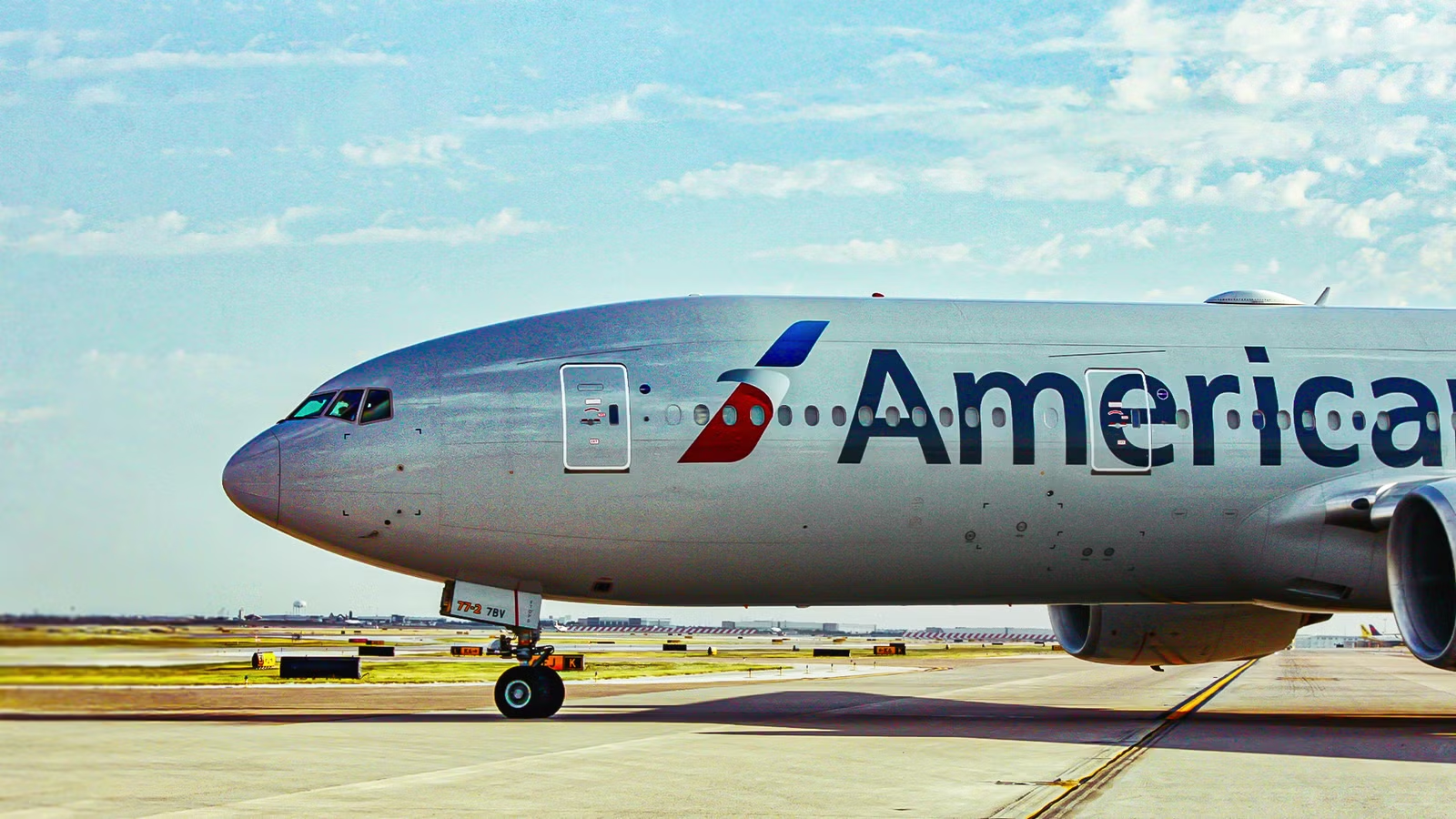
 American Airlines briefly halted departures across its entire network on Tuesday evening after a technology failure impacted its IT systems. The Federal Aviation Administration ( FAA) issued a ground stop at approximately 6:29 PM ET at American’s own request, preventing aircraft from leaving the gate until the airline restored the affected systems.
The ground stop was lifted at 7:18 PM ET, while American has stated that the total duration of the halt was 45 minutes. Although aircraft already in the air continued to their destinations as scheduled, the freeze hit during the peak evening rush and on a night when severe thunderstorms were already disrupting operations across the US East Coast.
American Airlines System Failure On Tuesday Evening

The carrier confirmed the outage on X, citing a “technology issue” impacting some of its systems on Tuesday evening. The airline said that flights had resumed once those systems came back online. An earlier post said its IT team was working to bring the affected systems back up as quickly as possible, which it successfully achieved within around 45 minutes. Footage at airports like  Chicago O’Hare International Airport (ORD),
  Dallas/Fort Worth International Airport (DFW) and
  Philadelphia International Airport (PHL) shows crowds of passengers waiting around in uncertainty, while departure boards rapidly filled with delays.
American has not clarified which system failed or what caused the failure, and has not suggested that the outage was due to a cybersecurity incident. According to the Air Traffic Control System Command Center, every airport in American’s network was impacted by the ground stop, while passengers reported being unable to log into American’s app and website. Simple Flying has reached out to American Airlines for comment, but a representative could not be reached before publication.
Over 1,300 Delays And 340 Cancellations

While the system outage was rectified within an hour, it understandably had a significant effect on American’s operations nationwide. According to data from FlightAware, the airline logged 1,387 delays on Tuesday, representing 38% of its mainline schedule, alongside 341 cancellations, or 9% of mainline flights.
Although the full-day figures cannot be attributed solely to the outage, it hit during the busy evening period amid American’s largest-ever summer schedule, when it will be operating close to 7,000 departures per day at peak times. It also coincided with stormy weather impacting airlines across the US East Coast, which had already triggered ground stops at New York, Newark, Washington and Baltimore before American’s systems went down.
In fact, rival airlines posted comparable cancellation and delay numbers without suffering an outage. FlightAware recorded 1,187 delays and 269 cancellations at  United Airlines, while
  Delta Air Lines saw 750 delays and JetBlue more than 300 delays. However, it was the regional operators that suffered the worst of it. Republic Airways, which flies for American Eagle as well as Delta Connection and United Express, canceled 522 flights — accounting for 40% of its schedule — while Delta subsidiary Endeavor Air canceled 285 flights.
IT System Vulnerabilities

The airline industry has suffered numerous notable IT meltdowns in recent years, highlighting how dependent the industry is on digital systems. Most recently, United suffered an outage of its SHARES reservation system on July 18, leaving it unable to process check-ins or print tickets. This outage lasted around an hour and 15 minutes and caused significant backlogs across United’s hubs.
American suffered a notable nationwide system outage on December 24, 2024, resulting in an hour-long ground stop during a busy Christmas Eve schedule. The carrier pinpointed a tech issue with DXC Technology, the third-party vendor maintaining its flight-operating systems (FOS), describing it as a network hardware-related issue.
The highest-impact meltdown in recent memory was the CrowdStrike outage in July 2024, affecting carriers across the globe. While most airlines were able to recover within 24 hours, Delta was affected more severely, canceling more than 7,000 flights over five days and ultimately impacting 1.3 million of its passengers.