dailynewsnblog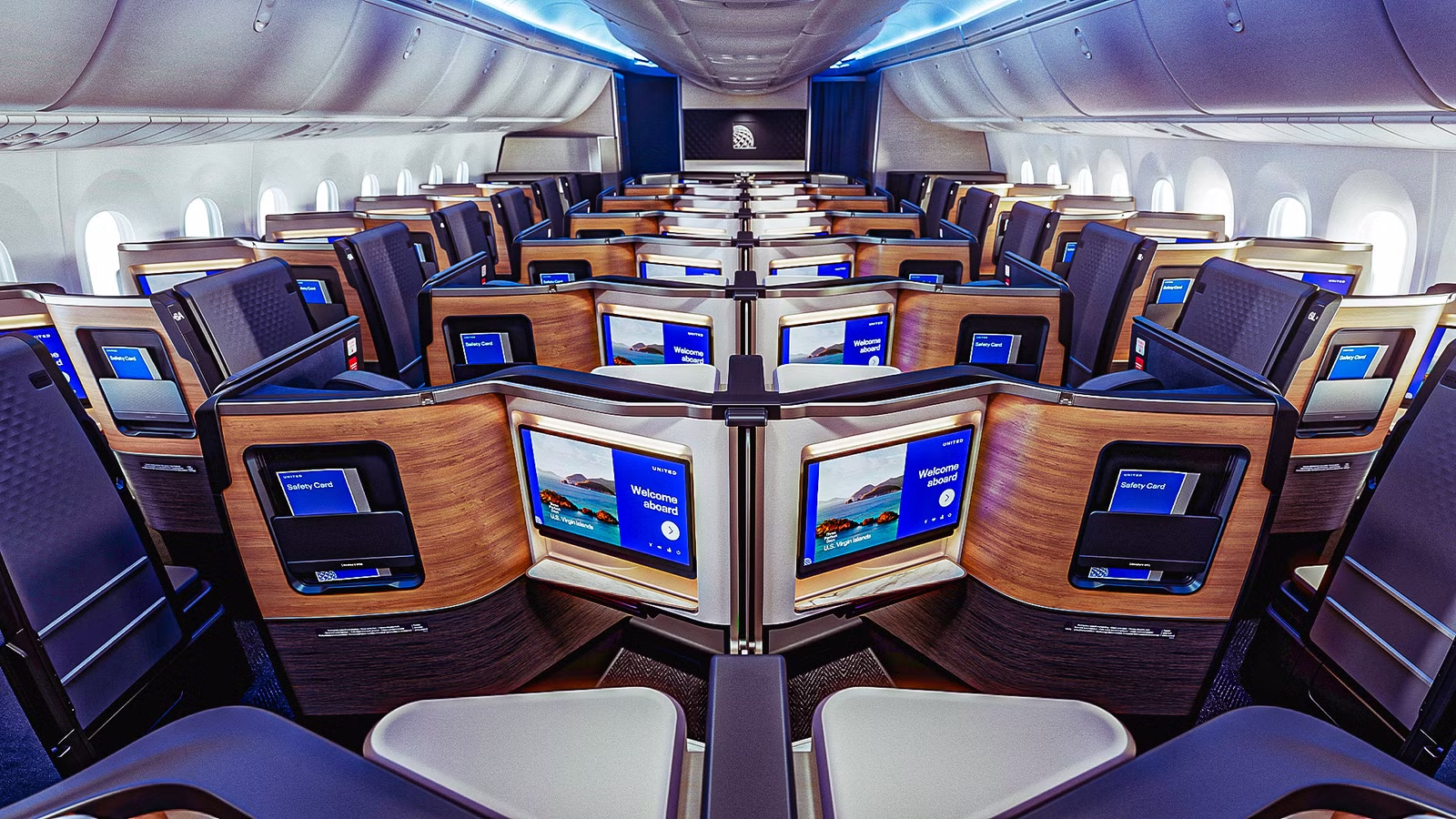
Airlines have spent billions of dollars redesigning premium cabins over the past decade. Sliding privacy doors, high-walled suites, wireless charging, and larger entertainment screens have become the defining features of modern business class, allowing carriers to compete for lucrative corporate and premium leisure travelers. But many passengers boarding the newest aircraft are discovering something strange: those expensive suite doors either cannot be closed, the business class seats cannot be temporarily purchased, or the entire cabin has no doors at all.
The explanation has little to do with manufacturing delays or airline cost-cutting. Instead, it reflects one of the aviation industry’s biggest certification and safety challenges. Regulators, including the Federal Aviation Administration (FAA) and European Union Aviation Safety Agency (EASA), are still adapting decades-old cabin safety rules to an era where business class resembles a collection of private rooms rather than conventional airline seats. As a result, airlines including KLM Royal Dutch Airlines,  Lufthansa,
  United Airlines,
  American Airlines, and JetBlue Airways have all been forced to adopt temporary workarounds while engineers, seat manufacturers, and regulators complete one of the most complex approval processes in commercial aviation.
A Luxury Feature That Regulations Never Anticipated

The race to build the world’s best business class has accelerated dramatically since Qatar Airways introduced Qsuite in 2017. Today, privacy doors have become almost an expected feature on premium long-haul aircraft, with airlines viewing them as an important differentiator in a very competitive market.
The problem is that the regulations governing passenger seats were largely written before enclosed suites became common, or even invented. Traditional business class cabins consisted of open lie-flat seats, meaning regulators primarily focused on crash protection, restraint systems, and evacuation paths. Modern suites introduce moving doors, higher seat shells, huge LCD screens, dining tables, and increasingly complex layouts that can influence everything from emergency egress to cabin airflow.
According to a recent investigation from The Wall Street Journal, airlines including KLM, Lufthansa, Singapore Airlines, United, and American have all encountered certification delays because authorities are carefully reviewing how these sophisticated premium seats perform under modern safety standards. That means the industry’s biggest bottleneck is proving that all these luxurious miniature hotel room suites remain just as safe during crashes, rapid decompression events, fires, and emergency evacuations, so no one gets locked in and fails to leave the aircraft safely.
Why Business Class Suite Certification Requires Years Of Testing

To passengers, a privacy door appears to be a relatively simple plastic panel. From an engineering and certification standpoint, however, it changes multiple aspects of cabin safety.
Every premium seat must successfully complete dynamic 16g sled testing, which simulates the forces experienced during a survivable crash. Engineers evaluate not only whether the seat structure remains intact, but also how crash test dummies move within the suite and whether passengers would suffer acceptable injury levels. Angled herringbone layouts create entirely different body movements compared with traditional forward-facing seats, making certification significantly more complicated.
At the same time, regulators must examine how taller suite walls affect rapid decompression events, smoke movement, airflow, visibility inside the cabin, and evacuation procedures. Even seemingly minor changes to latches, hinges, or door mechanisms can alter how quickly passengers exit their seats during an emergency. These additional engineering challenges explain why certification timelines have lengthened considerably despite years of experience producing lie-flat seats. Gettysburg Connection describes how decompression, evacuation, airflow, and 16g crash requirements have become major obstacles for the latest premium cabin designs.
Airlines Have Found Temporary Workarounds While Waiting

Several airlines have introduced temporary operational solutions to prevent new aircraft from being delayed indefinitely before entering service.
Catch what other flight trackers miss
Emergency squawks, holds, NOTAMs — live signals, no signup.
Open tracker
Catch what other flight trackers miss
Emergency squawks, holds, NOTAMs — live signals, no signup.
Open tracker
For example, United provides one of the clearest examples. Its new Boeing 787-9 Dreamliner “Elevated” cabins feature Polaris suites equipped with sliding privacy doors. However, internal guidance shared with cabin crews confirms the doors remain locked permanently open until FAA certification is completed, even though passengers can already occupy the suites. Once approval arrives, the doors will remain open during taxiing, takeoff, and landing before becoming usable during cruise flight, according to Live And Let’s Fly, which details the airline’s internal guidance.
American Airlines previously experienced a similar situation with its newest Dreamliners, temporarily operating business class suites whose doors could not yet be used. The approach allows airlines to begin generating revenue while regulators finalize approvals without delaying aircraft deliveries.
The workaround may appear unusual to passengers paying premium fares, but it enables airlines to place brand-new aircraft into service instead of parking completed jets on the ground while certification paperwork continues. According to Air Data News,  Boeing CEO Kelly Ortberg recently acknowledged that completed aircraft have occasionally remained undelivered while awaiting interior approvals, highlighting how seat certification has become one of the industry’s largest delivery bottlenecks.
Lufthansa & KLM Illustrate How Expensive Certification Delays Can Become

Among European airlines, Lufthansa has arguably been affected more than any other carrier.
Its highly anticipated Allegris cabin represents one of the airline’s biggest premium investments in decades, introducing multiple business class seat types with sliding privacy doors and significantly improved passenger comfort. However, certification delays have forced Lufthansa to operate affected 787-9 aircraft while selling only 4 of the 28 business class seats, leaving the remaining suites unavailable for booking despite being physically installed onboard, as Aviation Direct reports that the restrictions stem directly from outstanding FAA certification requirements.
KLM now faces a similar challenge with its first Airbus A350-900. The aircraft is expected to enter commercial service between Amsterdam and Toronto in September 2026, carrying the airline’s new 34-seat World Business Class cabin. Yet those seats are expected to remain unavailable for sale pending certification of the new suite design. Reporting by the Wall Street Journal described the planned launch and the temporary inability to use the premium cabin.
These restrictions have obvious financial consequences. Premium cabins generate a disproportionate share of airline profits, meaning every empty business class suite represents lost revenue on flights that may otherwise depart completely full.
JetBlue Chose A Very Different Solution

Not every airline has accepted the additional operational complexity associated with suite doors. JetBlue is an example.
Interestingly, even after certification, FAA procedures require business class suite doors to remain open during taxi, takeoff, and landing. Monitoring compliance increases cabin crew responsibilities and, in some circumstances, may require an additional flight attendant depending on aircraft configuration and operational rules.
JetBlue concluded that the economics simply did not justify the added staffing costs on certain aircraft. Instead of employing another crew member solely to supervise door procedures, the airline chose to disable the privacy doors on some Mint suites altogether. According to View From The Wing, avoiding the requirement for an additional flight attendant ultimately proved more economical than preserving full-suite functionality.
The decision highlights how certification is only one part of the equation. Once regulators approve these products, airlines must still determine whether operating procedures, staffing requirements, maintenance costs, and passenger expectations justify the additional complexity that enclosed suites introduce.
Airline | Current workaround | Impact |
KLM Royal Dutch Airlines | Business class blocked pending certification | 34 empty World Business Class seats |
Lufthansa | Limited seat sales | Only 4 of 28 Allegris seats available |
United Airlines | Doors locked open | Suites usable, doors inactive |
American Airlines | Previously operated with locked-open doors | Temporary until FAA approval |
JetBlue Airways | Doors disabled | Avoided additional crew costs |
Even  Delta Air Lines is seeing certification timelines extend as far as 2028 for future lie-flat seat programs, as Simple Flying previously reported. This illustrates that this is now an industry-wide engineering challenge rather than an isolated issue affecting individual airlines.
The Certification Process Is Changing Alongside Premium Aviation

The current delays are unlikely to disappear overnight because premium cabin innovation continues moving faster than regulatory frameworks originally designed decades ago, which are much slower to adapt.
Manufacturers are introducing very sophisticated products featuring larger shells, wider seats, movable partitions, wireless charging, integrated storage, enhanced privacy and other perks. Each innovation adds another layer of engineering analysis before regulators can confidently approve the design for commercial service. Rather than resisting innovation, authorities are attempting to ensure the safety of every new feature and maintain the remarkable improvements in cabin survivability achieved over recent decades.
Industry experts note that regulators, airlines, and seat manufacturers are now collaborating earlier in product development to identify certification challenges before aircraft enter production. That approach should gradually shorten approval timelines, although future premium cabins will almost certainly remain subject to extensive testing as airlines continue to push the boundaries of passenger comfort, introducing more objects and features that may not yet be covered in regulatory documentation.
Ironically, the feature passengers barely notice when it works, such as a lightweight plastic sliding privacy door, has become one of the most technically challenging components of the modern airliner. Until certification processes catch up with cabin innovation, travelers should not be surprised if the newest and most luxurious business class suite still asks them to leave the door open.