dailynewsnblog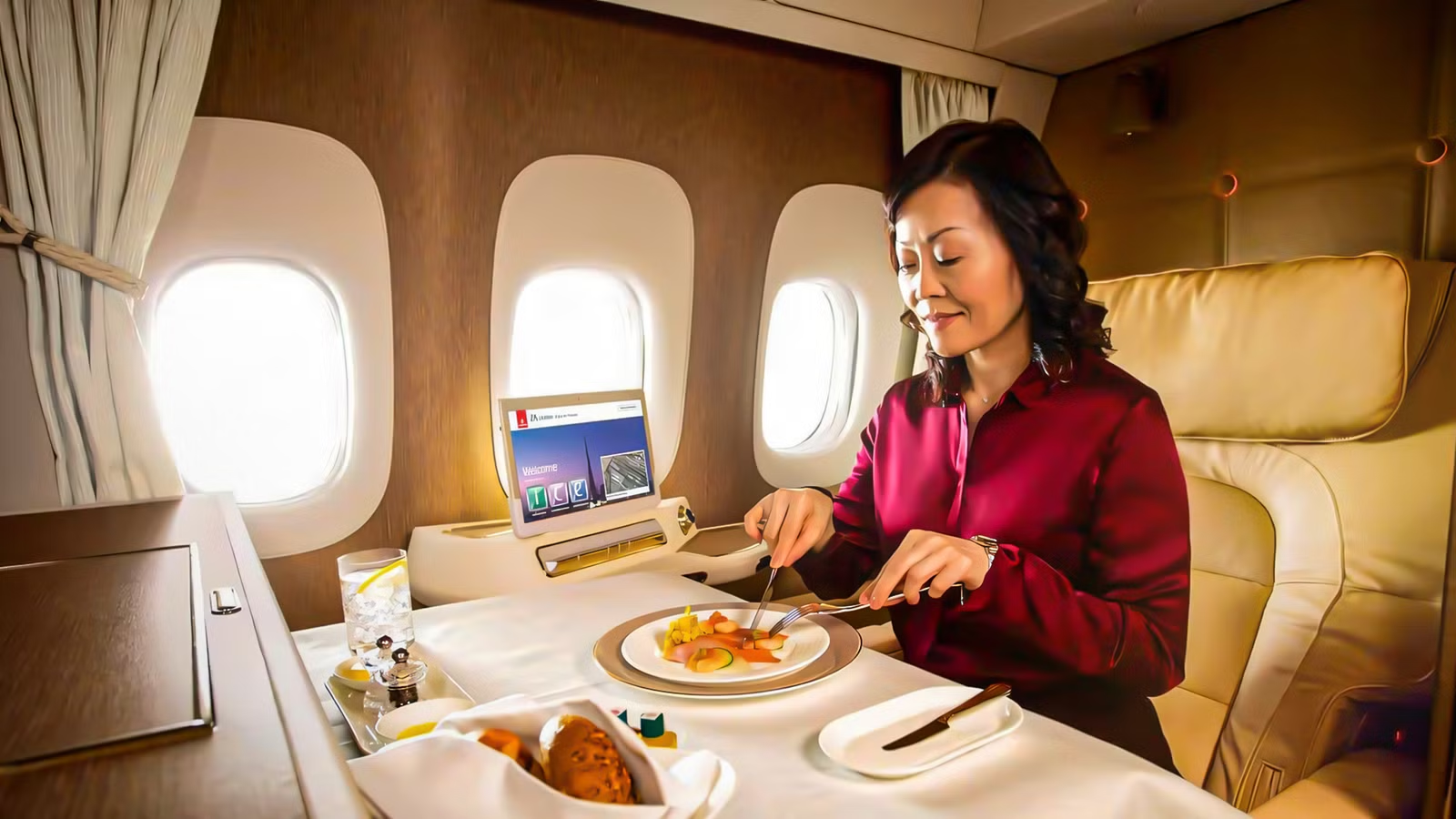
 Emirates operates the world’s largest international first class network, with approximately 26,800 first class seats per week across its fleet. Of those seats, six per departure are categorically different from every other first-class seat on the planet: fully enclosed from floor to ceiling, with doors that close without gaps, virtual windows in the center positions, and zero-gravity seat positioning drawn from Mercedes-Benz ergonomic research. They exist on nine of Emirates’ 250-plus aircraft. The other 241-plus aircraft fly either the Airbus A380, with 14 older-format suites and a shower spa, or a standard Boeing 777 first class that is competitive but not enclosed. Nine aircraft; six suites each. That is 54 of the best first class seats in commercial aviation, deployed on a schedule you will need to plan around rather than assume.
The question the number raises is not which Emirates first class is better, though that debate is genuinely interesting. It is why, given that the Game Changer suite is universally regarded as the superior privacy product, Emirates has installed it on fewer than four percent of its fleet and has no plans to retrofit the rest of its existing 777s. The answer lies in revenue density, route economics, and a specific trade-off that Emirates has decided to make in one direction only.
The Economics Behind Emirates’ Limited Game Changer Fleet

The Game Changer suite first flew in December 2017, introduced as a new configuration for Emirates’ Boeing 777-300ER fleet. The product’s defining feature, fully enclosed floor-to-ceiling walls reaching nearly 6.5 feet (2 meters), with no gaps above the sliding door, resolved the primary limitation of the A380 first class, whose doors close but leave a visible gap at the ceiling.
As Simple Flying’s comprehensive guide to Emirates first class details, the Game Changer’s center suites also include virtual windows — screens simulating an external view for passengers who would otherwise have no sight line to the aircraft’s exterior — along with individual temperature and lighting controls, a minibar, and a zero-gravity recline function. Each suite converts to a fully flat bed measuring approximately 82 inches (208 cm) in length.
The layout is 1-1-1 across, three suites per row, giving a total of six per aircraft. The standard Emirates Boeing 777-300ER first class, by contrast, features eight suites in an older configuration. A380 first class runs to 14. The six-suite Game Changer cabin is therefore a deliberate reduction in revenue capacity relative to both alternatives: it carries 25% fewer first class seats than a comparable 777, and less than half the first class inventory of an A380 on the same departure. That number is the consequence of the trade-off Emirates decided was worth making on a specific category of route. Understanding what that trade-off is requires understanding why reducing first-class capacity is sometimes commercially rational rather than simply an exercise in luxury signaling.
The Revenue Trade-Off Behind Every Game Changer Deployment

Reducing first class seats from eight to six on a given 777 departure means giving up two first class fares per flight. At Emirates first class cash prices, which, according to Simple Flying’s analysis of Emirates first class redemption values regularly exceed $10,000 per ticket and can surpass $25,000 on longer sectors, those two lost seats represent significant per-departure revenue.
Emirates accepts that cost on Game Changer routes because the suite commands a measurable per-seat premium over the standard 777 first class product, and because the shorter to medium-haul high-yield sectors where it operates, like  Dubai International Airport (DXB) to Geneva Airport (GVA) , Brussels Airport (BRU), and
  Chicago O’Hare International Airport (ORD), tend to attract precisely the privacy-prioritizing, high-profile traveler demographic that pays the premium without requiring the A380’s experiential features.
The current Game Changer route roster includes DXB to BRU, ORD, GVA, Kuwait International Airport (KWI), Melbourne Airport (MEL), and both Tokyo airports through the 2025-2026 winter schedule, with occasional appearances in Zurich Airport (ZRH) and  London Stansted Airport (STN). Those destinations reflect Emirates’ strategy of deploying the six-suite cabin where privacy is a stronger selling point than the A380’s onboard amenities, or where premium demand is high enough to make the lower seat count commercially worthwhile.
Why Emirates Won’t Retrofit Its Existing 777 Fleet

Emirates has been explicit on this point: it has no plans to retrofit its existing 777-300ER fleet with the Game Changer suite. The reason is economic and strategic. A retrofit of the scale, such as rebuilding the first-class cabin to accommodate fully enclosed, floor-to-ceiling structures in a 1-1-1 layout, would require significant aircraft downtime, substantial capital expenditure, and structural modifications on airframes that are already in the middle portion of their service lives. The commercial logic of that investment depends on how many remaining years of service those aircraft will provide, and on what aircraft is already coming to replace them.
The answer to the replacement question is the Boeing 777X, which Emirates has ordered in substantial quantities and which will be delivered with a new generation of first class product, likely building on the Game Changer design philosophy but engineered into the airframe from the outset rather than retrofitted. According to Simple Flying’s analysis of the trade-offs in Emirates’ A380 cabin design, the 777X’s narrower fuselage means it will not be able to accommodate the A380’s shower spa equipment, but it is expected to incorporate the enclosed-suite approach of the Game Changer in a form that works within the 777X’s specific dimensional constraints.
Retrofitting existing 777-300ERs with an interim version of that product, for aircraft that will eventually be replaced by 777Xs carrying the definitive version, is an investment with a compressed return window that Emirates has consistently decided is not worthwhile. This leaves the A380 as the carrier of Emirates’ other differentiated first class feature, the one that the Game Changer does not have, and that becomes the deciding factor on routes long enough to make it relevant.
Catch what other flight trackers miss
Emergency squawks, holds, NOTAMs — live signals, no signup.
Open tracker
How The A380 Shower Spa Shapes Route Economics And Passenger Choice

The Emirates A380 shower spa consists of two separate shower suites, each offering five minutes of running water per first class passenger, controlled by a timer that the passenger activates. According to Emirates’ official product page, the water allocation is a deliberate design decision: carrying sufficient water for extended showers across 14 first-class seats on a 14-hour sector would impose a weight penalty inconsistent with the aircraft’s range requirements on ultra-long-haul routes. Five minutes is sufficient for a functional shower at altitude, and the oversized bathroom suite that surrounds those five minutes functions as the broader amenity even when the water is not running. The A380 also operates an onboard lounge bar, accessible to both first and business class passengers, which provides a social and spatial experience that has no equivalent on the 777 configuration.
But neither shower nor bar translates to the 777. According to Simple Flying’s analysis of the A380 cabin trade-offs, the A380 is specifically “the only plane capable of housing the heavy shower spa equipment, a feature that won’t make the jump to the twin-engine 777X”, and by extension, has never been viable on the narrower 777-300ER. The fuselage dimensions of the 777-300ER, combined with the structural weight implications, make the shower spa installation impractical, and there is insufficient cabin real estate behind the first class section to accommodate a separate standing lounge. The A380’s experiential amenities are therefore exclusive to the A380, permanently, which creates a genuine product differentiation between the two Emirates first class offerings rather than a simple hierarchy.
On a 14-hour flight from Dubai to Sydney or Los Angeles, the A380’s shower and bar are genuinely significant. On a six-hour flight from Dubai to Geneva, they are largely irrelevant and the Game Changer’s enclosure is what matters when arriving at a European city refreshed and having slept in a sealed room. The decision about which cabin to prefer is therefore a route-length and personal-preference calculation that most award travelers get wrong, by treating the Game Changer as an automatic upgrade rather than a context-specific choice.
Booking A Game Changer Suite And Knowing When It’s Worth It

From May 12, 2025, Emirates restricted First Class Classic Reward bookings to Skywards Silver, Gold, and Platinum members. The policy change was applied across the board — both the Game Changer and the standard first class on A380 and older 777s require Silver for direct award redemptions. A functional workaround remains: booking a business class award and upgrading to first class at the time of booking or at check-in, if first class space is available, does not carry the status restriction in the same way. That path works but is not guaranteed, since first-class upgrade availability is controlled by Emirates separately from award seat release.
On routes where both the Game Changer 777 and a standard first class option operate, the award pricing in Skywards miles is frequently identical despite the meaningful product difference. That creates an arbitrage decision: the same miles spent at calendar open on the right aircraft assignment, secure the better product. The challenge is that aircraft assignments on Game Changer routes change with schedule updates and can substitute right up to departure. Tracking the specific aircraft tail number on the booking is available via tools that query aircraft assignment — is the practical skill that separates passengers who consistently fly the Game Changer from those who expect it and receive the standard product.
The miles vs. cash calculus is worth stating plainly: a Game Changer cash fare from Dubai to Geneva regularly exceeds $8,000 one way, while the same route on the correct Skywards award or partner program redemption costs considerably less in cash-equivalent terms. The difficulty is not the mileage math. It is the aircraft assignment uncertainty on a product that exists on 54 seats across the entire Emirates network.
The Scarcity Is About To Change — But Not In The Direction Most Passengers Expect

As reported by Simple Flying, Emirates President Sir Tim Clark stated at the IATA Annual General Meeting in New Delhi in May 2025 that the airline is actively designing a new first class product for the A380, comparing the airline to a hotel that must continually upgrade its rooms to retain guests. That statement positions the A380 cabin as the next recipient of the enclosed-suite philosophy — not through a retrofit of existing Game Changer aircraft, but through a new design generation that brings floor-to-ceiling enclosure to the A380’s 14-seat configuration. If that product materializes as described, it would significantly change the calculus for long-haul first-class passengers who currently choose the A380 specifically because the Game Changer is not available on their route.
The 777X deliveries will simultaneously bring a new generation of enclosed suites to Emirates’ twin-engine widebody fleet, at higher volumes than the current nine Game Changer aircraft and built into the airframe rather than retrofitted. The number of truly enclosed Emirates first class seats in operation will grow — but through new deliveries rather than through any modification of the existing fleet. The nine Game Changer aircraft are, in that sense, a bridge product between the standard suite era and a future in which enclosed first class is Emirates’ baseline rather than its premium exception.
Whether that transition happens before or after the 777X delivery delays resolve is the variable that will determine how long the current nine-aircraft scarcity persists. Until the 777X arrives in meaningful numbers, the 54 seats across nine aircraft will remain the entirety of the world’s most private commercial first class offering, on a route roster that could change with each IATA season.