dailynewsnblog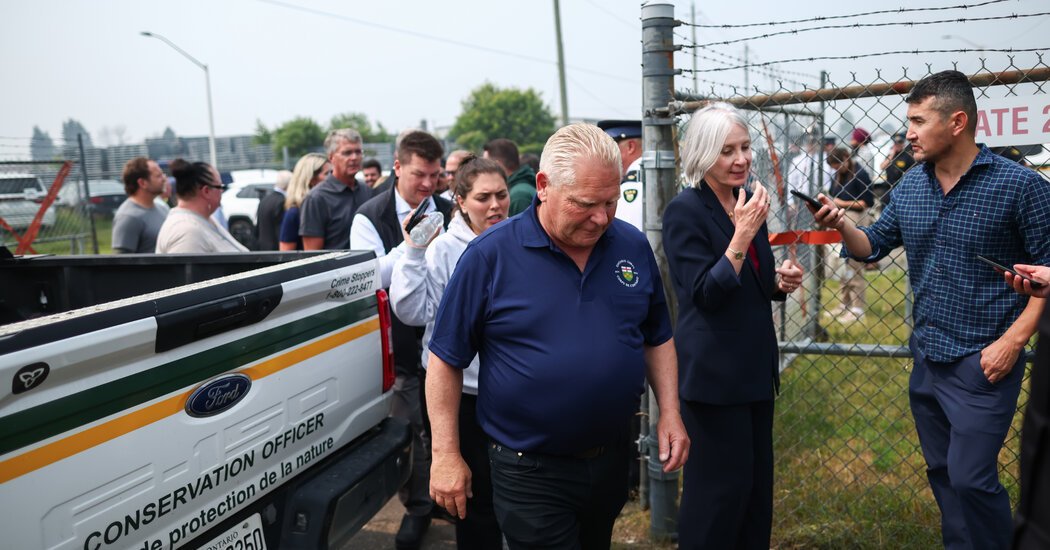
Out-of-control wildfires in Ontario continued to force evacuations and affect major cities in Canada and the United States on Saturday as the province’s leader made his first visit near the devastated area.
Speaking from a parking lot in Thunder Bay on Saturday, Premier Doug Ford said that 191 wildfires — seven more than Friday — were burning northwest of the city and that 73 were raging out of control.
Ten communities have been evacuated, and 300 people have been rescued from campsites in 40 operations, Mr. Ford added. Roughly 1.7 million acres have burned in Ontario, data from the Canadian Interagency Forest Fire Center shows.
In a short address, Mr. Ford said it was critical that people in the area did not return to their campsites or homes, especially because water bombers did not drop fire suppression loads when they saw people in the bush from overhead. He said there were 155 fire crews at work and 80 water bombers and helicopters flying, with 40 additional aircraft ready to deploy.
Mr. Ford has faced harsh criticism by his political opponents for budgeting 150 million Canadian dollars, or $107 million, for the current wildfire season after spending 271 million Canadian dollars, or $193 million, last year.
“It’s not time to politicize these emergencies,” Mr. Ford said. “It’s absolutely disgusting in my opinion that they want to politicize and play games when people’s lives are on the line,” he added, vowing there would be “no limit to spending.”
Under Canada’s division of powers, most forest lands are owned and managed by provinces, which collect royalties for commercial tree cutting and, with some exceptions like national parks, are also responsible for firefighting.
On a late flight to Thunder Bay from Toronto Friday night, the pilot was forced to make three approaches on landing because of unsafe conditions from the thick smoke, earning loud applause from the passengers when the twin turboprop touched down at Thunder Bay Airport. At least one plane could not land in the smoke and was forced to return to Toronto.
On the ground, smoke hung heavy over the road and diffused the light of street lamps, casting an eerie glow that was replaced at dawn on Saturday by the piercing orange light from the sun breaking through the hazy sky.
Mount McKay, a landmark in Thunder Bay visible from most places in the city, was mostly lost in the smoke, only a faint outline visible.
While Thunder Bay remains safe from flames — the closest fires are burning roughly 90 miles to the northwest — heavy smoke has seriously affected air quality.
There was rain in the region on Friday, and on Saturday temperatures remained fairly cool at 70 degrees Fahrenheit (21 degrees Celsius). Local air quality alerts warned of a high health risk caused by toxic particles in the smoke that drifted on light wind and smelled like a campfire.
Provincial officials said they had delivered 3,000 N 95 masks to an evacuation support center to be distributed to residents.
Thunder Bay is quickly becoming overcrowded with people fleeing their homes. Some evacuees have been sent to Toronto and other locations. Indigenous communities have been among the worst affected by the fires.
All week, smoke from the Ontario wildfires has darkened skies from Toronto to Detroit, New York and beyond. Air quality for millions of people across the United States and Canada has plummeted to unhealthy, even hazardous levels.
New York, Toronto and Washington had the worst air quality in the world on Saturday morning, and the plume of smoke floating far above Earth’s surface since Wednesday had not drifted clear.
On Friday, President Trump threatened to charge Canada tariffs to pay for harms caused by the wildfire smoke, joining a handful of Republican lawmakers who have criticized the Canadian government over what they called poor forest management.
Prime Minister Mark Carney of Canada did not immediately address the accusations on Friday, but he suggested this week that the United States should do more to combat climate change.
Mr. Ford on Saturday called the American lawmakers comments “unacceptable” and said they should focus more on helping a neighboring country — Canada has often contributed firefighting resources to the United States — than assigning blame.
“I find it a shame the administration in the U.S. and congresspeople writing these letters and blaming us and so on and so forth,” he said. “They have a very short, short memory.”