dailynewsnblog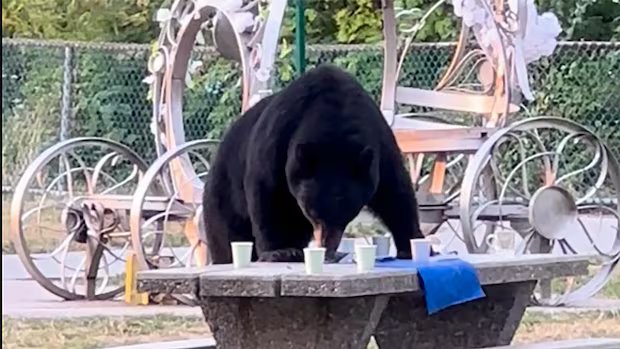
On a sunny morning earlier in July, Lucy Pecile was putting children’s lunch boxes out on a picnic table at North Burnaby’s Forest Grove Park.
A man she didn’t know came purposefully toward her and asked if she’d noticed the large black bear lying in a sunny patch of grass behind a bus stop bench, just metres from where the children she was looking after were playing.
Pecile immediately called out to warn the children there was a bear.
“As the bear heard us calling the kids, and the commotion of the kids running towards us and what not, the bear got up and started walking up towards us,” she recalled. “It was not in a hurry. It was casually … didn’t seem to be bothered by us being there.”

Pecile and another caregiver gathered up the eight children, who they’d taught to follow instructions and grab hold of the stroller in the event of a bear encounter, and walked out of the park away from the bear, which promptly helped itself to the lunches left behind on the picnic table.
Video of the incident soon made its way onto the community Facebook page, where the inevitable debate unfolded: some expressing concern at the bear’s behaviour and the safety of children, others noting the community is in bear territory and people should behave in ways that keep bears safe, says Nicole Gladish, whose four-year-old was present when the bear approached.

This video, uploaded to a community Facebook page earlier this month, shows a black bear lying in the grass near a picnic table at Forest Grove Park in Burnaby, B.C., while children played nearby. The encounter sparked debate over public safety and how people should behave in bear territory.
It’s a common debate in communities next to bear habitat — should you call the B.C. Conservation Officer Service to report a bear looking for sources of human food like garbage or kids’ lunch boxes?
Some encourage others not to report such incidents because of a belief that it amounts to a death sentence for the bear, Gladish says.
“It just always devolves into this blame game where nothing ever really gets solved.”
Gladish did call Conservation and questioned whether relocating “nuisance bears” — those who have lost their fear of humans and become accustomed to human food sources — was an option.
She says she was told research has proven relocation to be ineffective.

Gladish, a genetic epidemiology researcher at Stanford University, decided to dig deeper.
The articles she found said relocation of adult bears aged four and over is generally not successful — they tend to find their way back and resume the problem behaviour.
But it was a different story for juvenile bears between the ages of one and three who had yet to establish a home range. This was especially true of males, though one study found age to be a bigger factor than sex.
A 2009 Ontario study found male bears aged two or three were unlikely to return to the area where they were captured if relocated 30 to 64 kilometres away.
“Relocation may be a useful management tool for the removal of juvenile animals involved in human-bear conflicts. Juvenile males generally make up the majority of nuisance bears … and are least likely to return to the capture area or be involved in subsequent nuisance events,” the authors wrote.

Gladish discovered this was not an isolated finding.
“The consensus is so secure on relocating subadult bears and the success of that, that it is in textbooks, which is a sign that it is pretty established,” she said.
She proposed a pilot project focused on the highest-conflict areas that would see juvenile black bears moved rather than killed.
If successful, this would save bears’ lives and perhaps encourage more consistent reporting, if people knew there was a non-lethal alternative, Gladish adds.
The provincial government, however, said in a statement the experience in B.C. is that moving bears simply moves the problem.
Neither the Ministry of Environment and Climate Solutions, which oversees the B.C. Conservation Officer Service, nor the Ministry of Water, Land and Resource Stewardship, responsible for wildlife policy, would respond to questions on camera despite repeated interview requests.

“Moving all young male bears that are reported in conflict with humans would not be a sustainable strategy for a number of reasons,” said an emailed statement attributable to the Ministry of Water, Land and Resource Stewardship.
“When a relocated bear does not return to its point of capture, it is only a partial measure of success. Survival rates of bears after translocation are often much lower than resident bears, and the risk of the bear getting into conflict in another area is also higher.”
The province did not respond to a request for peer-reviewed research to support its policy.
What the policy says
What happens after someone reports a black bear in a residential neighbourhood depends on the bear’s behaviour, the Ministry of Environment and Climate Solutions said in an emailed statement.
In some situations, advice on how to better secure attractants such as garbage or bird feeders may be sufficient.
“Over time, the most successful way to avoid human-bear conflict and reduce resulting bear deaths is to manage attractants,” the Ministry of Water, Lands and Resource Sustainability said.

The province’s guidelines say relocation will be considered “only in a few, limited circumstances.”
“Bears that have lost their fear of people or are conditioned to non-natural food sources are not candidates for relocation or rehabilitation — the risk to public safety is simply far too great,” the Ministry of Environment and Climate Solutions said.
Neither ministry responded to a question about whether the policy applies equally to all bears of all ages.
Another document says “relocations for the management of wildlife that come into conflict with humans … should not require the Province to incur financial costs for the translocation or relocation.”
Neither ministry responded to a question about to what extent cost savings are a rationale for the minimal relocation policy, saying only that when black bears are moved, the province pays.
Meanwhile, Gladish’s children continue to go to the park most days. She worries about what would happen if a bear were to startle her kids, or vice versa.
“Unfortunately bears are large and children are small. And if a conflict really were to … happen, that’s not going to end well for my kids.”