dailynewsnblog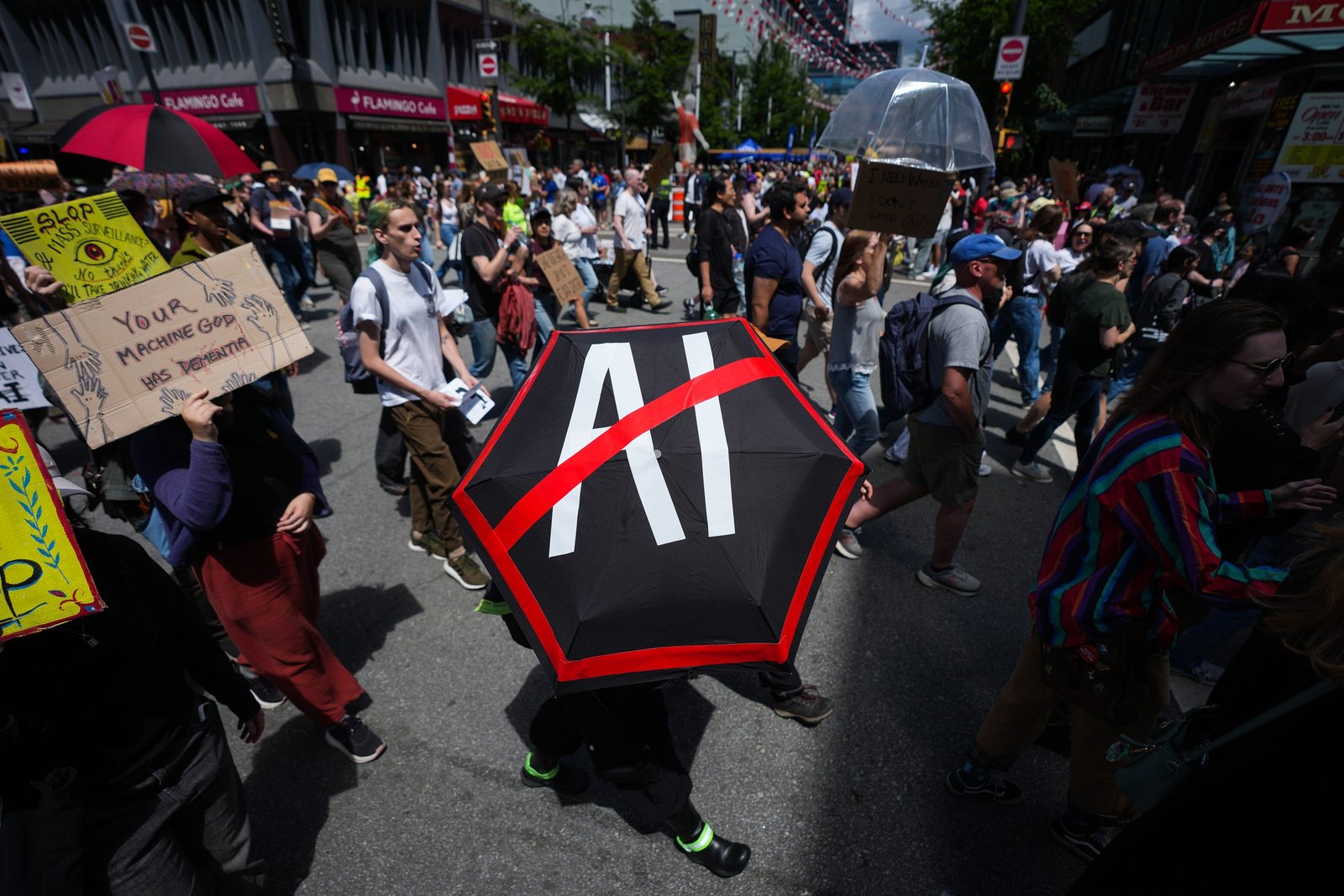
Here’s what the activist media is reporting on this week.
“The chant rumbled through Hamilton’s city hall: ‘Fuck AI.’ Packing the council chambers in early June, residents shouted their anger at a massive data centre suddenly planned in their city by a private equity firm.”
That’s how first-time Breach contributor Marcus Werner sets the stage for his real-time chronicle of what he describes as the “rising country-wide movement against AI data centres,” which was published just days before Hamilton City Council was due to vote on a motion to formally impose a temporary one-year pause on greenlighting any new data centres — a motion that, as Canadian Press reports, ultimately went down to defeat, although the city “will continue a study of potential issues around data centres.”
Hamilton“is by no means alone,” but is “part of a broader Canadian movement rising up against a spate of hyperscale data centres being fast-tracked across the country,” Werner notes.
“Planned with few guardrails to protect the environment and nearby residents, these data centres threaten to hoover up water and energy, expelling pollution while multiplying local electricity rates. And since AI centres are being planned with little warning and transparency, under a hasty federal AI strategy that will enrich tech companies, the movement is increasingly seeing the fight against data centres as a fight for democracy and against Canada’s burgeoning tech oligarchy. Remarkably, in places like Hamilton, their campaigns are already starting to win.”
Citing a recent York University report that offers the “first comprehensive mapping of Canada’s data centre landscape,” he reports that there are “194 currently-active data centres across Canada,” although only five would qualify as “hyperscaler,” which “draw over 50 megawatts of power, making them large enough to train and deploy artificial intelligence models,” as per the paper.
“The expansion that’s happening now would bring an additional 159 hyperscalers to Canada, in places like Olds, Alberta; Mississauga, Ontario; and Vancouver, B.C. These planned hyperscalers need, on average, over ten times more power than the currently-operational facilities.”
What’s more, the “boom is zeroing in on one province: Alberta,” which “accounts for 93 per cent of all planned data centre capacity in Canada, in large part because of its cheap natural gas-powered electricity,” he points out.
“Plus, Alberta’s UCP government has been courting the AI industry, offering corporate tax incentives to data centre builders and exempting them from otherwise routine environmental impact assessments.”
In the wake of the initial success of the ‘Stop the Datacentre’ hub in Hamilton, “a dozen cities are now running campaigns” using the same model, he notes.
“This month, councillors in Vancouver and Mississauga are expected to bring forward motions asking their cities to place a moratorium on new data centres,” while in Alberta, “Indigenous communities have been at the forefront of fighting back, arguing that data centres could violate their rights,” he explains.
“The general feeling is that AI data centres are being built too fast, and too big. According to an Angus Reid poll, 68 per cent of Canadians would oppose a large AI data centre near their home.”
Also keeping a watchful eye on the “frantic imposition of artificial intelligence in Canada” is Rabble contributor Jenn Jeffreys, who provides a point-by-point rebuttal to the “long-awaited and repeatedly delayed AI strategy” unveiled by Prime Minister Mark Carney and Evan Solomon, who was appointed as Canada’s first ever Minister of Artificial Intelligence last year, just before the House of Commons rose for the summer.
“The strategy, which includes $2B in federal spending on AI, comes at a time of unprecedented austerity in this country – with Carney divesting from human labour in favour of automation, ostensibly making our civil service more ‘innovative’ and ‘efficient,’ and “on the heels of Elon Musk’s failed DOGE crusade in the United States which decimated their civil service, mined private data for yet unknown purposes, and led to hundreds of thousands of preventable deaths across the Global south,” she notes.
“Like any workplace, there are roles in government that simply cannot be replaced by automation, but they’ve already started anyway. Public servants in departments and agencies across the country are deeply demoralized,” while “across the private sector, studies are already showing that 55 per cent of companies who fire large swaths of their staff in favour of AI eventually live to regret it.”
For his part, shortly after his government secured a second go-round in office, “Carney signed an agreement with Canadian multinational tech giant Cohere, Inc. now worth an estimated $7 billion,” she points out.
“Cohere was purportedly tapped by the feds to ‘transform the public sector’ with ‘secure, sovereign AI technology. It’s unclear what this has entailed, exactly, but it appears as though the main thing Cohere does is roll out chatbots – presumably across the federal departments where mass layoffs are happening.”
Elsewhere on the site, Alberta-based Rabble writer David Climenhaga wonders why his home province “is determined to welcome an industry that is distrusted and unwanted in many North American jurisdictions,” including — but not limited to — the “massive AI data centre” that California-based Meta Platforms aims to build just outside Edmonton.
“(Alberta Premier Danielle Smith’s government” has been promoting the province for months as an international hub for AI data centres and dismissing concerns about their enormous draw of energy and other potentially negative environmental and economic impacts,” he recalls.
“The announcement of Meta’s claimed $13-billion project, which if completed will be the biggest AI data centre in Canada and one of the largest in the world, was the other shoe dropping after the July 4 announcement that three corporations plan to build a huge natural-gas-powered electricity plant called the Greenlight Electricity Centre in the Sturgeon County ‘industrial heartland.’ Greenlight will provide the power for Meta.”
Climenhaga is also sounding the alarm over Elections Alberta’s decision to reject the Water Not Coal citizen initiative petition submitted by “musician and clean-water advocate” Corb Lund, ostensibly on the grounds that it fell short of the 177,732 signatures required to proceed to a referendum.
As he explains, that conclusion appears to conflict with the conclusions of an independent analysis conducted by University of Toronto statistics professor Jeffrey Rosenthal, who “used data from Elections Alberta to conclude the petition easily exceeded the number of validated signatures required to get Lund’s question on the ballot this fall,” as initially reported by CBC Edmonton earlier this month.
“That, of course, was an outcome Premier Danielle Smith’s government was determined to prevent so that a controversial coal mine on the Eastern Slopes of the Rocky Mountains can proceed – a fact that may or may not have something to do with Elections Alberta’s conclusion the petition did not have enough valid signatures,” he observes.
Over at The Maple, Alex Cosh does a quick background check on Susannah Pierce, the “former oil executive” picked by Carney to serve as Canada’s consul general in New York City, and digs up a distinctly less than glowing 2023 assessment from Environmental Defence, who called Pierce an “an expert level greenwasher … a tactic she uses to distract from her plans to continue expanding oil and gas and extract every ounce of revenue for Shell,” the group contended.
“The same year, Pierce reportedly told Reuters that oil and gas companies can’t be held solely responsible for the pace of the global energy transition,” and “expressed concerns about the Trudeau Liberal government’s mandatory cap on emissions from the Canadian oil and gas industry.”
Carney “scrapped the emissions cap last year,” and “also appointed Claire Kennedy, a committee director at mining firm Alamos Gold Inc., as Canada’s consul general in Chicago,” he notes.
Meanwhile, Maple contributor Emma Paling highlights growing concern over “anti-Indigenous hate speech,” which B.C. Assembly of First Nations regional chief Terry Teegee suggests is “rising ‘exponentially’ across Canada” during a panel discussion at the Assembly of First Nations annual national meeting in Ottawa.
“Teegee and the other leaders at the press conference called on the federal government to criminalize residential school denialism. But just last month, senators voted down an amendment to a bill that would have done just that.”
Rounding out the progressive-left roster, Rabble contributor Jeremy Appel recaps Postmedia’s “decade of pushing Canada’s politics to the right,” and specifically, its near-monopoly on the remaining dailies, giving the “MAGA-aligned newspaper chain enormous influence over the flow of information and how current events are perceived across the country.”
Trending on the right-of-centre side of the Canadian activist mediaverse:
- Rebel News commander Ezra Levant makes the case that blocking AI data centres isn’t just a “self-defeating move,” but “hands China the advantage,” which, he suggests, may be why so many “left-wing politicians” in both the U.S. and Canada are “jumping on the bandwagon.”
- Alberta Rebel bureau chief Sheila Gunn Reid stopped by the “sold-out Stampede breakfast” hosted by pro-independence group Let Alberta Decide, which “drew approximately 1,000 supporters, marking one of the largest public events yet of the referendum,” and, she contends, debunks the notion that the movement “exists only on social media,” and concludes: “This thing is not a hashtag.”
- Juno News contributor Alex Dhaliwal crunches the numbers in the latest Fraser Institute report on the equalization program, which “has repeatedly done the opposite of what it promises — cutting cheques to richer provinces while poorer ones were shut out.”
- Last but not least, fellow Juno affiliate Keean Bexte explains why Pierre Poilievre is “not the problem,” and changing the Conservative Party leader “will not change the political reality facing Canada’s right.”