dailynewsnblog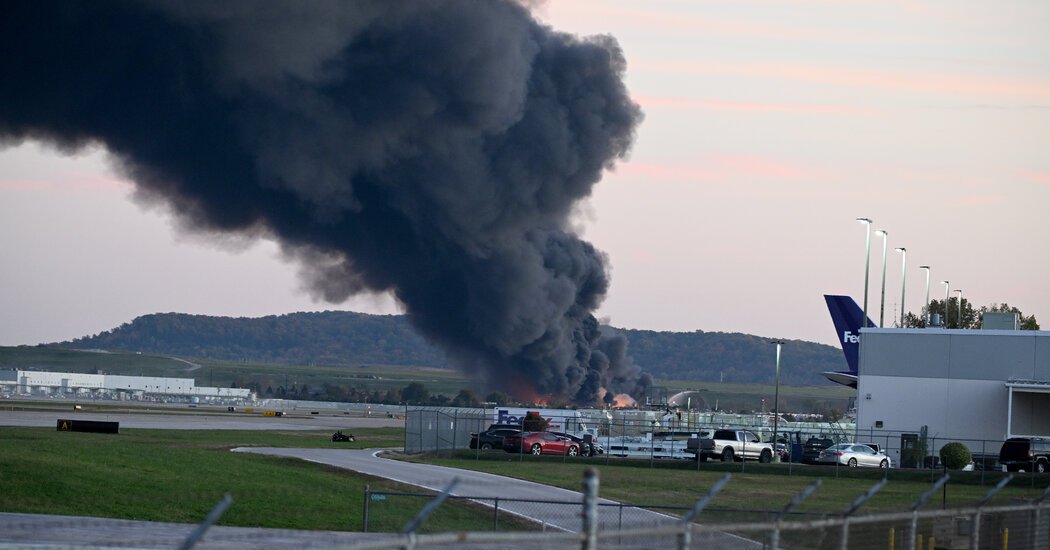
United Parcel Service never instructed inspectors to examine a part that failed in last year’s deadly crash of one of its cargo jets in Louisville, Ky., despite having been warned repeatedly that it was faulty, according to new documents released by the National Transportation Safety Board, which is investigating the accident.
But the shipping company blames Boeing, the airplane’s manufacturer, for the omission, contending that it did not insist on those inspections or make it clear that the part in question could jeopardize the entire aircraft if it failed.
The N.T.S.B. identified a spherical bearing assembly, housed in a bracket that held a wing engine in place, as the point of initial equipment failure that caused the crash of a UPS McDonnell Douglas MD-11 on Nov. 4 outside Louisville Muhammad Ali International Airport, killing 15. According to investigators, the bearing’s failure created pressure inside the bracket, causing its lugs to crack and the plane’s left engine to detach.
During an investigative hearing in May, it was revealed that Boeing knew the bearing assembly was faulty, but did not think its failure could trigger such a catastrophic series of events. Instead of treating it as a critical safety problem that needed to be fixed, the company merely recommended that airplane owners conduct periodic inspections of the part and replace the assembly if needed.
Those recommendations never made it onto the checklists that UPS gave to the inspectors at ST Engineering San Antonio Aerospace, a subcontractor that UPS hired to check its fleet.
Chris Hentz, the subcontractor’s vice president for maintenance operations, submitted copies of UPS’s inspection orders to the N.T.S.B., noting that they made “no reference” to the bearing in question and required only limited checks of the assembly.
Each relevant order “only requires the maintenance technicians to check for corrosion and structural defects,” the subcontractor’s filing added.
UPS did not dispute the omission. But in a new filing released by the N.T.S.B. this week, the company’s officers blamed Boeing for only recommending, but not requiring, additional inspections, and stating that the problem with the bearing “was not a safety of flight condition.”
Boeing representatives did not respond to a request for comment.
UPS’s filing questioned whether a technician tasked with inspecting the part more closely would have found any potential problems, noting that “there was no evidence” that the bearing was faulty, and that maintenance inspectors who lubricated the bearing assembly just 17 days before the accident had flagged “no noted discrepancies.”
The N.T.S.B. is not expected to release its findings from the investigation for several more months. But its conclusions and recommendations may ultimately determine who bears responsibility for neglecting to elevate an apparent pattern of problems with the part that failed to a level where it might have been addressed with more urgency.
Representatives of ST Engineering San Antonio Aerospace, UPS, Boeing and the Federal Aviation Administration were all grilled during the investigative hearing in May on why they had not taken more seriously evidence that the bearings could be catastrophically problematic.
The Louisville accident bore many similarities to the United States’ deadliest aviation accident, the 1979 crash of American Airlines Flight 191. In that accident, a McDonnell Douglas DC-10 — a predecessor to the MD-11 — crashed shortly after takeoff from Chicago O’Hare International Airport after its left engine separated from the aircraft, killing all 271 people on board.
N.T.S.B. officials have focused on at least four other episodes of bearing failures on MD-11 aircraft, questioning why Boeing sought — and obtained — the F.A.A.’s approval to reduce the frequency of inspections for that part even as documented problems racked up.
A filing from Boeing, released this week, indicated that the change was made to accommodate the concerns of operators, who had complained to the company that they were having to service several planes from their fleets simultaneously, and worried about being able to perform the maintenance checks “without pulling aircraft from service for extended downtimes.”