dailynewsnblog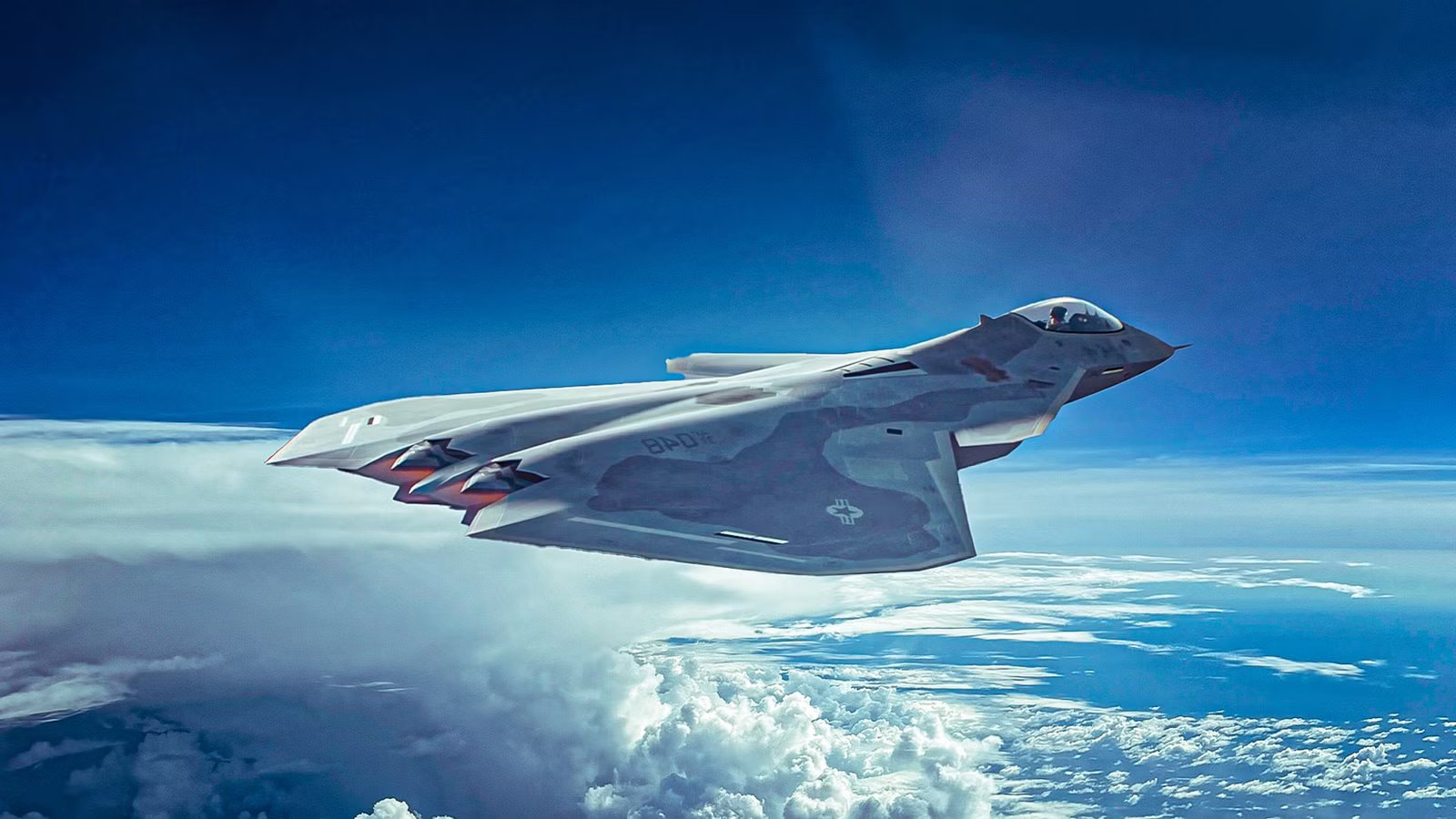
As the race to build the first sixth-generation fighter jet heats up among the great powers of the world, the first image of America’s Next Generation Air Dominance has surfaced online. The Boeing F-47 was spotted with a thermal camera in the vicinity of the US Air Force training range at Groom Lake, also known as Area 51. The silhouette of what appears to be a next-gen stealth fighter closely resembles previously circulated artistic renderings of the F-47.
The aircraft spotted at Area 51 appears to be configured in a ‘cranked kite’ aerodynamic profile and lacks any obvious vertical tail surfaces. These are among the most obvious visual identifiers that are expected of the forthcoming F-47, which is speculated to be named ‘Phoenix.’ Boeing was awarded $20 billion in early 2025 to begin the process of developing the fleet that is expected to be at least 185-strong. To replace the legacy Lockheed Martin F-22 Raptor before a capability gap develops, the first prototype is slated to fly by 2028.
Tempering Expectations: The Reality Of The F-47

The Next Generation Air Dominance program is a highly classified project with minimal details being released to the public. In the past, the Air Force has said that it could cost twice as much as the F-22 Raptor, yet more recently they claim that it will actually be less expensive. The double-talk surrounding the price point follows the same trend as the conversation about specifications and capabilities. The aircraft is intended to be vastly superior to the F-22 in terms of multi-spectral stealth, speed, range, and technology, and to be more rugged and cheaper to maintain.
The Air Force has a long wish list for the NGAD, and awarding the contract to Boeing was also questionable, given the current difficulties the company has had with both civilian and defense projects. Boeing has been hemorrhaging money on the Next Generation Air Force One program; it has experienced many strikes and supply chain disruptions affecting the F-15EX Eagle 2 production line, and its 737 MAX and 777X airliners have made headlines for their issues and delays. Simultaneously, the Next Generation propulsion systems with variable cycle technology may already be behind schedule.
If the technology demonstrator captured by Project Fear is configured using the same design principles that will be present in the production F-47, then we can glean several insights into the final design that the NGAD will feature. First and foremost, the absence of any vertical tailplane will dramatically reduce the radar cross-section. Combined with advanced materials and electronic warfare systems, this clearly indicates it will be a far more stealthy platform than the F-22 before it. It does, however, also mean that the plane will likely be less maneuverable.

From 76 F-22 Raptors To 200 Next-Gen Fighters: How Much Larger America’s Air Superiority Fleet Could Get
A closer look at the future of air power in the US Armed Forces.
Bound By Physics: The Design Trade-Offs Of NGAD

The F-22 was developed at a time when dogfighting was still a crucial tactical necessity to establish air superiority in a conventional conflict. Since the fall of the Soviet Union, the United States has not had a near-peer adversary likely to engage in such a battle. Just like the F-35 Lightning II, NGAD is expected to sacrifice some of the maneuverability of legacy fighter jets in order to improve its capability as a ‘quarterback’ in the ‘kill web’ on the battlefield tomorrow.
Instead of being the fastest and most agile jet in the sky, the F-47 will aim to be the most rapid in responding to threats as they emerge and to benefit from extreme persistence over the battlefield to maximize the value of its stealth and sensor suites. As the command node in the kill web, instead of putting the nose on the target and firing a missile or gun, the F-47 will instead paint targets using advanced electro-optical, radar, and electronic warfare sensors or other platforms to strike.
The plane is expected to have very large fuel reserves that will combine with variable-cycle engines that can switch between Mach 2 high-performance and high-bypass fuel-efficient profiles to master the sky over the front line. These engines will allow it to transit combat theaters extremely fast and remain overhead for extended periods of time without requiring aerial refueling or returning to base. It will also generate a massive amount of electrical power for the supercomputers on board and even directed energy weapons, or lasers.
The NGAD will ‘farm out’ targets after it finds them to drones or other friendly units in the air, on the sea, or on land. For that reason, the aircraft will need to maximize its efficiency and stealthiness above all other qualities while retaining just enough maneuverability to defend itself or perform a direct attack in an emergency. The profile of the aircraft seen matches this design philosophy, while the relatively large forward canard surfaces indicate it will remain a somewhat agile fighter jet.

5 Fighter Jets That Will Define Air Combat In The 2030s
The next era of air power is on the horizon.
The Question Of Authenticity

If the plane spotted at Groom Lake is indeed a flying prototype of the F-47 series, that would put the program roughly two years ahead of schedule. The Aviationist reportedly confirmed the authenticity of the grainy infrared images through Anders Otteson, who vouched for the authenticity of the post by the Project Fear YouTube channel on June 3, 2026. He told the Aviationist:
“This was an amazing capture! I met up with the team who recorded this to show them some potential spotting locations around the Area 51 perimeter after introducing them to the gear I often use for night sky monitoring – in this case thermal imaging cameras. … I get a call asking if I can take a look at something they’d captured on the thermal imager. As soon as they sent the footage over, I knew we were looking at something very interesting that has not been captured before.”
“I posted about this because I noticed some people calling it fake due to coming from a “paranormal” channel and wanted to clear that up. It is indeed real and shot on an InfiRay HCH50R thermal, the same model I own.”
While the online consensus has come to conclude that this imagery is likely not forged, the subject of exactly what aircraft was captured is still up for debate. Many analysts have speculated that it is likely an X-plane demonstrator and not a prototype of the actual F-47 airframe. The US Air Force revealed in 2020 that some full-size, airworthy test platforms had already taken flight, as reported by Aviation Week, meaning that the latest spotting is likely one of these NGAD tech demonstrators.
Boeing has been given the imperative to catch up with the rapid iterative design development process in China, but has yielded at least two flying prototypes which have been leaked through social media. The so-called J-36 and J-50 took flight in 2024, surprising the world and creating an immediate sense of urgency for the US and its allies to accelerate their next-gen fighter programs. The US defense industrial base has come under increasing scrutiny for the protracted 15 to 20 years of research and testing required to produce a new fighter.
This institutional inertia has been playing in favor of giving the People’s Liberation Army Air Force an opportunity to leapfrog ahead of Western military powers, especially America, in the race for a sixth-generation fighter. Since these planes came to light, the Air Force claimed it could slash design times by building and testing the F-47 entirely in a digital space. If the aircraft is already flying, it proves the new R&D pipeline works as well as claimed. Still, it is much more likely that the plane seen flying over Area 51 is one of the existing demonstrators being used for more testing.
Why The Country That 1st Flew A 6th-Gen Fighter May Now Be A Decade Behind
The global race to fly the ultimate stealth fighter.
The Competition: China’s Next-Gen Fighter Programs

Since 2024, at least four different Chengdu J-36 prototypes have been seen flying close to Chengdu, demonstrating the aircraft’s progress through an accelerated flight-testing phase. Similarly, from late December 2024 to early 2026, the Shenyang J-50 was observed performing flight tests near Shenyang facilities. While China initially leaped ahead by showing physical prototypes via social media leaks on Chinese sites like Weibo, reaching a production-grade weapon system involves a decade-long maturation process that has not been seen progressing.
The 14-month period between the first J-36 flight and the introduction of the fourth prototype was a shockingly aggressive iterative prototyping strategy that drew attention to the relatively slow pace of the US and European next-generation fighter programs. While China is flight-testing the WS-15 engine, it lacks the variable-cycle technology found in the P&W XA103, which is essential for sixth-generation powerplants.
The J-50 is speculated to be a prospective carrier-based sixth-generation fighter for the Type 003 Fujian aircraft carrier. The J-36 is believed to be a more mature design and to have twice as many airworthy prototypes as the J-50, of which it is speculated there are only two. The J-36 appears to be built in a double-diamond delta configuration, while the J-50 is what has been dubbed a lambda-wing shape.
In general, Chinese aircraft have far less powerful and more inefficient engines than their Western counterparts, even on the most advanced airframes like the Chengdu J-20 Mighty Dragon or Shenyang J-35A Gyrfalcon. At least one J-36 prototype was shown with three engines, but the design’s capabilities are purely speculative. If China follows its J-20 timeline, experts anticipate serial production starting by 2031, with full combat squadrons not ready until 2035.