dailynewsnblog
For most of commercial aviation’s history, crossing the Atlantic has been the exclusive domain of the widebody jet. If an airline couldn’t fill roughly 250 seats a day between two cities, the route simply didn’t exist — and passengers in smaller cities accepted this by routing themselves through mega-hubs in New York, London, or Paris, often adding hours of extra travel for the privilege. That decades-old calculus began to crack in 2026, driven by a single-aisle aircraft called the Airbus A321XLR — a narrowbody that can now cross oceans and make thin city-pairs profitable for the very first time.
In summer 2026, industry trackers counted roughly 37 new transatlantic routes launched by approximately 14 airlines — the largest single-year burst of US-Europe route additions in modern aviation history, according to MiGFlug. Understanding why this happened requires understanding the machine at the center of it: a narrowbody with widebody ambitions, a permanent fuel tank hidden beneath its cabin floor, and a range that was physically impossible for a single-aisle jet just years ago.
Engineering A Tank That Changed Everything

The A321XLR (Xtra Long Range) is the most capable narrowbody commercial aircraft ever certified for passenger service. Officially launched at the Paris Air Show on June 17, 2019, the aircraft promised a manufacturer range of up to 4,700 nautical miles — roughly 8,700 kilometers — with a maximum flight time of approximately 11 hours, according to Ready For Take-Off Book. That range, backed by a maximum takeoff weight of 101 tonnes, is enough to fly nonstop from Montreal to Toulouse, New York to Rome, or Edinburgh to the US East Coast — all in a single-aisle cabin.
The engineering breakthrough at the heart of this capability is a permanently integrated Rear Center Tank (RCT) built directly beneath the aircraft’s rear cabin floor. Unlike its predecessor, the A321LR, which used removable auxiliary tanks in the forward cargo hold, the XLR’s RCT is a structural feature of the airframe, adding approximately 12,900 liters of fuel capacity and bringing the total to around 40,000 liters.
Certifying the aircraft took years of rigorous regulatory work. To elaborate, the EASA conducted over 900 flight test hours, held more than 400 specialist meetings, and reviewed over 500 technical documents — with particular scrutiny on how the RCT would behave in a belly-landing or gear-collapse scenario. The agency required the tank to resist external pool fires for at least 2.5 minutes and to limit fuel leakage during extreme structural events.
Technical Specifications: How The A321XLR Stacks Up

The A321XLR’s performance gains over its narrowbody siblings are substantial, while its physical dimensions remain identical to the standard A321neo — making it nearly invisible externally but a fundamentally different commercial proposition underneath. The aircraft delivers approximately 30 percent lower fuel burn per seat than older-generation jets on equivalent long-haul routes, with both engine options — the CFM LEAP-1A and Pratt & Whitney PW1100G-JM — offering fuel efficiency improvements of 15 to 20 percent over their predecessors. Full cockpit commonality with the broader A320 family means pilots already rated on the A321neo or A321LR can transition to the XLR with minimal additional training, reducing costs for airlines building new long-haul programs from scratch.
Specification | Airbus A321XLR | Airbus A321LR | Airbus A321neo | Boeing 737 MAX 8 |
Range | 4,700 nautical miles | 4,000 nautical miles | 3,500 nautical miles | 3,500 nautical miles |
Maximum Takeoff Weight (MTOW) | 101 tons | 97 tons | 97 tons | 82 tons |
Typical Seating | 206-220 | 206-220 | 206-220 | 162-178 |
Max Flight Time | ~11 hrs | ~9 hrs | ~8 hrs | ~7 hrs |
The A321XLR’s range advantage over the Boeing 737 MAX 8 exceeds 1,200 nautical miles — a gap that places European cities entirely out of reach for the Boeing narrowbody, while the Airbus variant thrives on those very sectors. The 19-tonne difference in maximum takeoff weight between the two types reflects the structural and fuel investments Airbus made to unlock transatlantic range, investments Boeing’s current narrowbody family has no equivalent for. Until Boeing develops a competing product, the A321XLR holds a structural monopoly on single-aisle transatlantic flying — and airlines are moving quickly to exploit that window.
The Economics That Unlocked Routes No Widebody Could Justify

The commercial logic of the A321XLR is straightforward: it flies routes that a widebody would make unprofitable. A 777 or A330 requires filling 250 to 350 seats per departure to cover its costs on a transatlantic crossing; the A321XLR makes the same trip viable with 180 to 220 passengers — a threshold dozens of secondary markets can meet seasonally or three times weekly, but could never sustain a full-sized twin-aisle. This shift in break-even economics fundamentally changes which routes airlines are willing to attempt.
The impact is most visible in city pairs that carry genuine travel demand but have never seen nonstop service. Routes such as Dublin to Raleigh-Durham, Montreal to Nantes, and Halifax to Brussels all exist in 2026 precisely because the A321XLR allows airlines to serve them without having to bet on 300 seats. Airlines can launch at three weekly frequencies, test market response, and scale up or exit without the enormous capital exposure of widebody deployment.
Beyond pure route economics, the A321XLR can operate from runways as short as approximately 7,300 feet at takeoff, giving it access to airports that widebodies cannot efficiently use. Combined with lower training costs and narrowbody maintenance simplicity, this gives smaller or less capitalized carriers a credible path into transatlantic flying. For the first time, launching a new transatlantic route looks less like a high-stakes widebody gamble and more like a measured, scalable experiment.
Air Canada: Building A Narrowbody Transatlantic Network

 Air Canada has been one of the most strategically deliberate early adopters of the A321XLR, ordering 30 aircraft with options for up to 10 additional deliveries in 2026. Its chosen launch route — Montreal to Palma de Mallorca, inaugurated June 17 — made Air Canada the first Canadian airline to serve the Spanish island, and introduced lie-flat business class on a Canadian narrowbody for the first time, with 14 Signature Class seats alongside 168 economy seats. This configuration brought a genuine widebody cabin standard to a single-aisle frame, challenging the assumption that premium transatlantic travel requires a twin-aisle aircraft.
The A321XLR serves Air Canada’s Montreal–Toulouse route, replacing the 787-8 Dreamliner, resumes service between Montreal and Edinburgh with an upgraded onboard product, and launches the new Montreal–Berlin route on July 2. These routes, each operating three times weekly, would not be able to sustainably support the economics of a widebody aircraft. In June, Air Canada completed the first commercial narrowbody transatlantic crossing to Toulouse, home to Airbus’ own global manufacturing headquarters.
The rollout has not been without friction. According to Travel Tourister, Chief Operations Officer Mark Nasr publicly acknowledged in June that XLR deliveries were running approximately two years behind the original schedule, due to industry-wide supply chain disruptions and labor shortages affecting both Airbus and Boeing. Despite those delays, Air Canada adapted its network planning and pressed forward with its transatlantic ambitions.
The 2026 Route Boom: Airlines, Destinations, & The World Cup Effect

The 2026 transatlantic expansion stretched well beyond any single carrier or aircraft type. 14 airlines in total launched new transatlantic routes across the summer, ranging from full-service legacy carriers to ultra-low-cost operators, each finding a different commercial rationale in the new economics of narrowbody long-haul flying. The A321XLR was the primary enabler for many of these launches, but widebody routes also expanded significantly — particularly among US carriers targeting niche European destinations that lacked nonstop connections from American cities.
Airline | Route | Aircraft |
Air Canada | Montreal – Palma de Mallorca | Airbus A321XLR |
Air Canada | Montreal – Berlin | Airbus A321XLR |
Aer Lingus | Dublin – Raleigh-Durham | Airbus A321XLR |
American Airlines | New York – Edinburgh | Airbus A321XLR |
Royal Air Maroc | Los Angeles – Casablanca | Boeing 787-8 Dreamliner |
Alaska Airlines | Seattle – Rome | Boeing 787-9 Dreamliner |
The 2026 FIFA World Cup, hosted across North America from June 11 to July 19, provided a meaningful demand catalyst that accelerated several launches and justified higher-than-typical summer frequencies. Royal Air Maroc timed its historic Los Angeles-Casablanca debut — the first Africa-US West Coast nonstop in seven years — for June 7, four days before the World Cup kickoff, specifically to capture Moroccan fans, African supporters, and diaspora travelers flying to host cities. Alaska Airlines also made its long-awaited transatlantic debut with Seattle–Rome fares from $599 roundtrip and year-round daily service to London Heathrow, both on 787-9s, following its merger with Hawaiian Airlines.
The Passenger Trade-Off & Long-Term Outlook

United Airlines | Simple Flying
Flying seven to eleven hours across the Atlantic in a single-aisle cabin is a different proposition from the same journey in a twin-aisle widebody. The A321XLR’s interior is 3.70 meters wide — identical to any other A321 — which means six-abreast economy seating in a 3-3 layout, constrained galley space, and fewer lavatories than a widebody long-haul passenger would typically expect. Airlines have managed these constraints differently depending on their market positioning and the competitive dynamics of their chosen routes.
Premium-focused operators have responded by going small and luxurious. For example, American configured just 155 total seats on its XLR — 20 enclosed Flagship Suite business class seats, 12 premium economy, and 123 economy. At the opposite end, Wizz Air operates the XLR in all-economy configuration on routes from London Gatwick to Jeddah and Milan to Abu Dhabi, where price sensitivity far outweighs seat width.
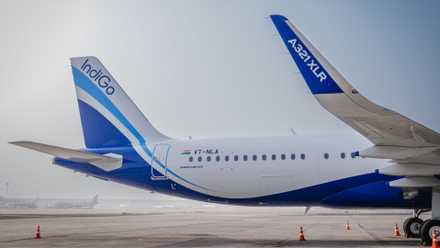
8-Hour Nonstop Flights: IndiGo Unveils 2 Brand-New Airbus A321XLR Routes [Map]
IndiGo’s 8-hour Bali flights showcase the A321XLR’s potential to transform aviation route planning as we know it.
With over 500 orders on the books, the XLR’s route-unlocking effect will compound steadily through the rest of the decade as fleets grow and operators gain confidence in the type. Airlines like  IndiGo has placed 40 orders for this aircraft. Consequently, secondary airports will gain direct intercontinental connectivity, the stranglehold of mega-hubs on transatlantic flows will gradually ease, and the assumption that only a widebody can cross the Atlantic will come to seem, in hindsight, like a limitation that was always waiting to be solved.