dailynewsnblog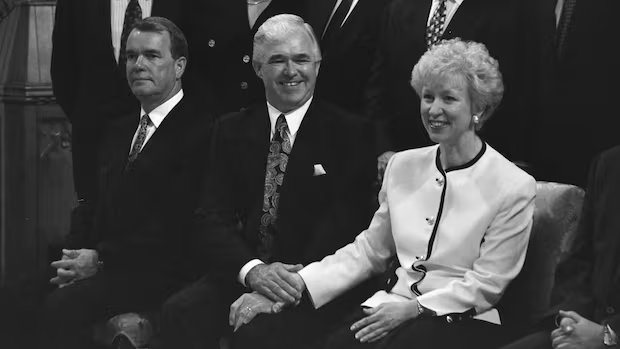

Listen to this article
Estimated 4 minutes
The audio version of this article is generated by AI-based technology. Mispronunciations can occur. We are working with our partners to continually review and improve the results.
Tom Siddon, who served as a cabinet minister under Prime Minister Brian Mulroney during the Oka Crisis and later helped to establish Nunavut, has died at 84.
His daughter, Katie Siddon Karn, confirmed his death Sunday in a post on social media. Siddon and his wife, Pat, had five children.
Siddon Karn said her father, originally from Alberta, “stumbled” into politics in the 1970s after speaking up at a public hearing.
“Not short of his own opinions, and incredibly intelligent, my dad was exceptionally skilled at building bridges and finding consensus,” she wrote.
Siddon began his political career as a councillor in Richmond, B.C., and went on to be elected as a member of Parliament five times between 1978 and 1993.
He held a number of cabinet portfolios during that time, including minister of defence and minister of fisheries and oceans.
Siddon Karn wrote that one of her dad’s proudest accomplishments was working to secure the Nunavut Land Settlement Agreement that — quite literally — put Nunavut on the map.
Helena Konanz, the Conservative MP for Similkameen-South Okanagan-West Kootenay, said in a social media post that Siddon was her friend and mentor. He “always found time to share his wisdom and advice” and was dedicated to making Canada a better place, she wrote.
Former staffer Bob Ransford wrote that Siddon was “extremely brilliant.”
“He had very little cynicism. He was an optimist and loved our country. He cared about people. He was always full of ideas about Canada pursuing big things and he really believed in education,” Ransford wrote.
1990 Oka Crisis
Siddon was Canada’s minister of Indian Affairs during the 1990 Oka Crisis, which arose from a protest to stop a golf course from expanding onto an ancestral Kanien’kehá:ka, or Mohawk, burial ground in Kanesatake, northwest of Montreal.
Mohawk Warriors built barricades over a road to block access to the area. In July 1990, Quebec provincial police tried to push back the protesters with tear gas and concussion grenades. A shootout ensued and a police corporal, Marcel Lemay, was killed. A coroner’s inquest could not determine who fired the fatal shot.
The Canadian Armed Forces was later sent into the area with armoured vehicles, helicopters and barbed wire. Negotiations eventually put an end to the standoff after 78 days, in late September.
The response to the crisis cost an estimated $200 million and involved 4,000 Canadian soldiers.

After 78 days, the Mohawks decide to put down their weapons. Aired Sept. 26, 1990 on CBC’s The National.
Quebec’s coroner wrote a report in 1995 that said Siddon let the situation degenerate by refusing to listen to members of the community who wanted to meet with him in Ottawa, and called the federal government’s slowness to act “inexcusable.”
Siddon defended the government’s actions over the years.
He told The Canadian Press in 2015 the standoff played a key role in addressing the thorny issue of land claims.
“I think we were able to make some major progress and I do believe that Oka was an important turning point in our natural history,” he said.
The crisis led to the Royal Commission on Aboriginal Peoples and helped usher in new agreements, including resource-sharing deals with Indigenous communities. A federal report on the crisis later described Oka as an avoidable tragedy.
After losing the 1993 election, Siddon remained politically engaged. In 2012 he and other former fisheries ministers wrote an open letter to the government of Stephen Harper warning proposed changes to the Fisheries Act would weaken habitat protection provisions.