dailynewsnblog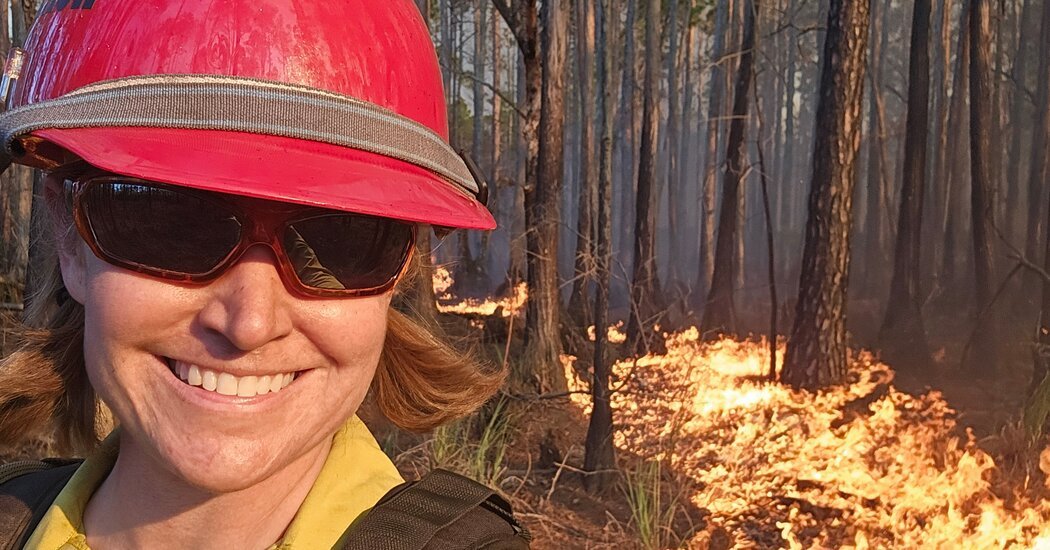
Ever since she became a volunteer firefighter in college, Emily Barker thrived in the male-dominated world of wildland firefighting. She traveled across the country with her federal fire crew, hiking into burning forests, buzzing over smoke plumes in a helicopter and sleeping in dirt foxholes.
Women like Ms. Barker make up only about 10 percent of wildland firefighters. But two of the three firefighters killed this weekend in a wind-driven wildfire in western Colorado happened to be women, federal officials said on Monday.
Their deaths highlight the equal perils that women in firefighting face in a profession where they are less visible than men.
The Department of the Interior identified the three firefighters as Ms. Barker, 38; Sydney Watson, 27; and Nick Hutcherson, 27. Ms. Barker and Ms. Watson had been assigned to a Helitack unit based in Rifle, Colo., about 180 miles west of Denver, that uses helicopters to fly crews into wildfires, sometimes rappelling them in.
Mr. Hutcherson had been assigned to the Kaibab National Forest in Northern Arizona.
As elected officials mourned on Monday and ordered flags to be lowered, dozens of firefighters near the Utah-Colorado border were struggling to get control over the fire that killed the three firefighters, battling another day of hot, windy weather that has swelled its size to about 28,000 acres.
That blaze, known as the Snyder fire, is one of several wildfires raging across Arizona, Colorado, Utah and other drought-stricken parts of the West that are primed to burn after a dry winter and record-hot spring. The fires have chased hikers off the Continental Divide Trail, closed parts of Canyonlands National Park, canceled Fourth of July fireworks shows and choked Western skies with smoke.
On Monday, Ms. Barker’s family was making sudden preparations to travel from their homes in Michigan to western Colorado so they could attend a memorial for her and the two other firefighters killed this weekend.
“She was the strongest, bravest person,” Ms. Barker’s sister, Lisa Karczewski, said in a telephone interview as the family got ready to head to the airport.
Ms. Barker discovered firefighting while she was studying ski-area management in northern Michigan. She spent her winters working for the Vail ski resort in Colorado, and her summers doing prescribed burns and fighting fires in Idaho and Colorado, but also Florida and the Carolinas.
“We were terrified when she first began, but as time went on, it became natural,” Ms. Karczewski said. “It was, ‘I’m going into a fire.’ ‘OK be safe.’ We knew this was always a risk.”
Federal officials have not offered a detailed account of how the firefighters perished, but said the five-person team became trapped on Saturday and had to deploy their emergency shelters, typically a last, desperate act when there is no way to escape a burnover.
Two other firefighters survived and were being treated for burn injuries, but federal officials have not released their identities or conditions. Relatives of Ms. Watson and Mr. Hutcherson did not respond to phone messages on Monday.
Ms. Karczewski said she had last spoken with her sister on Friday, and they had talked mostly about a mint-chocolate ice cream that Ms. Barker loved. She had not even realized that Ms. Barker was working the Colorado wildfires.
“Then, we got the call,” she said.
It is far less common for women to be killed while firefighting than men, according to a database of firefighter deaths kept by the U.S. Fire Administration. The agency said that 104 female firefighters had been killed on duty from 1990 to 2024, compared with 3,772 men.
So when news broke of the three deaths in Colorado, many online tributes mistakenly called the firefighters “fallen brothers” or posted A.I.-generated images of three men in fire gear.
“There’s an assumption that it’s only male,” said Riva Duncan, a retired wildland firefighter who spent 32 years with the U.S. Forest Service and is now president of Grassroots Wildland Firefighters. “There’s still some people who don’t think we belong.”
Ms. Duncan pointed out that male and female firefighters have to pass the same arduous physical-fitness tests, lug the same heavy backpacks through smoldering forests and swing the same axes to cut containment lines.
Some female wildland firefighters have faced harassment and discrimination in their careers, but Ms. Barker always felt welcome as one of the few women on a fire line, her sister said. A male colleague this year had asked Ms. Barker to help get him into shape for his fitness test.
Off the fire lines, Ms. Barker played on a women’s hockey team and snowmobiled and dirt-biked her way across the West. Her left arm had a sleeve of tattooed images of the mountains and desert landscapes she loved.
Ms. Karczewski, a teacher, said she often bragged about Ms. Barker.
“Look at her, she’s a female wildland fighter,” she would tell her students. “You can do anything.”