dailynewsnblog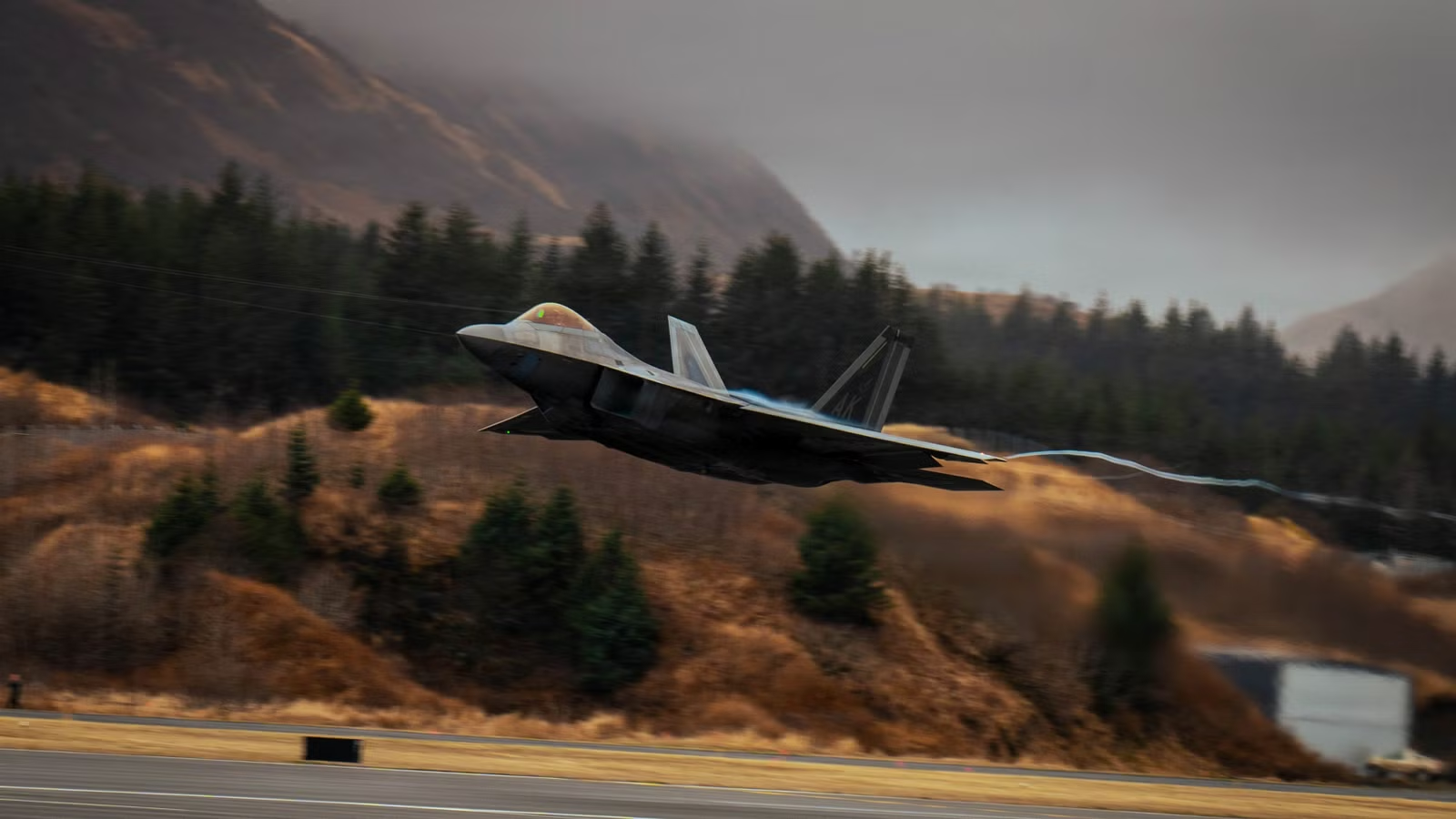
The United States is rushing the development of its next-generation Boeing F-47 air dominance fighter that is expected to take the role of the tip of the spear from the F-22 Raptor. The Air Force (optimistically) wants the F-47 into service by around 2030. Even if that date was achieved, it would take some time for Boeing to deliver F-47s in numbers and for the platform to mature and reach its potential.
Some time in the 2030s, the F-47 may be ready to complement the Raptor in the air superiority role. This means that the Air Force will need to continue to rely on its fleet of 143 combat-coded F-22s through the 2030s. The Air Force is currently rolling out a massive midlife upgrade that will keep the F-22 at the top of its game through the 2030s and into the 2040s. Part of this midlife refit is updating its Pratt & Whitney F119 engines.
Pratt & Whitney’s Ongoing Raptor Engine Upgrade

In February 2025, RTX (the parent of Pratt & Whitney) announced that it had secured a three-year contract worth up to $1.5 billion to sustain the F-22’s F119 engines. RTX said, “The contract will improve readiness and reduce costs for an F119 fleet of more than 400 engines that have flown over 900,000 engine flight hours.”
The announcement also said that Pratt & Whitney has lowered costs on its F119 engines through its ongoing Usage-Based Lifing program, which “leverages real-time data to enhance maintenance efficiency and extend engine life; while also improving the engine’s kinematic performance with an engine control schedule update.” The F119 engines produce over 35,000 lbf and allow the Raptor to fly at altitudes exceeding 65,000 feet, although the maximum altitude is classified.
The Raptor is powered by a pair of F119 engines, while the F-35 is powered by a single Pratt & Whitney F135 engine derived from the F119. The Raptor’s F119s enable the aircraft to achieve what is believed to be the best supercruising capability of any fighter jet in service. The engines power the aircraft to supercruise speeds (up to Mach 1.5) without engaging the afterburner, significantly increasing its supersonic range compared with the previous-generation F-15 family.
Adding Flexibility To Extend Raptor

These upgrades are significant and represent an “incremental modernization” of the Raptor’s engines. As a reminder that modern engines are much more sophisticated and computer-driven than their Cold War predecessors, Pratt will increase engine thrust via a software update. Writing in 2025, the Air and Space Forces Magazine said the update could be useful if the Air Force needs to extend the Raptor’s service life or there are delays with the F-47.
At the time, the Air Force announced it was temporarily freezing its 6th-generation fighter jet program until the new Second-Term Trump Administration decided whether to give the expensive program the green light. The following month (March 2026), the Trump Administration announced it endorsed the program, named Boeing the winner, and designated it the F-47. It has become a priority.
Nevertheless, uncertainties remain. The Air Force may now be confident it will receive the funding it needs to develop the F-47, but developing an all-new, cutting-edge fighter jet is difficult and prone to delays (like the F-35 was). It is common for fighter jets to be delayed by several years. In an effort to avoid further delays, the F-35 experienced concurrencymeaning that it was in production while some designs were still being finalized and some systems weren’t ready. It is only now receiving some of the capabilities that Lockheed promised.

5 Fighter Jets That Defined Air Combat In The Last Decade & Why They’re Already Obsolete
Obsolescence has various forms, all affecting some of the best fighter jets in the world.
The Usage-Based Lifing Data Tracking System

The Usage-Based Lifing data tracking system (UBL) is intended to leverage real-time data to enhance maintenance efficiency and extend engine life. It is also designed to improve the engine’s kinematic performance by updating the engine control schedule. The Air and Space Forces Magazine reported: “database is now the ‘single source of truth’ about the health and performance of the F119.”
UBL allows Pratt & Whitney to leverage real-time flight data and actual wear and tear on engine parts. The data will allow Pratt & Whitney to provide maintenance when it’s actually needed and not just when it’s forecast to be needed. UBL is expected to deliver approximately $800 million in savings over the program’s life cycle. The existing method of sustainment budgeting is based on historical data and average mission usage metrics.
Lockheed Martin F-22 Raptor | |
|---|---|
Entered service | 2005 |
Planned retirement | 2040s |
Number acquired | 187 |
Number combat coded | 143 |
Powerplant | 2x Pratt & Whitney F119-PW-100 |
Thrust | 2x 35,000 lbf |
The Full-Authority Digital Engine Control [FADEC] software update is expected to boost the kinematic performance of the engine and shift the automatic limits, although it’s unclear by how much. Pratt & Whitney plans to extend UBL to the F135 engine on the much more numerous F-35 fighter jet. The company is exploring other ways to help sustain the F119 engines, including additive manufacturing (aka 3D printing).
The F-22 Raptor’s Midlife Upgrade

The F-22 Raptor is getting a range of upgrades to keep it relevant into the 2040s. It will get a new Passive Detection (IRST) as underwing Infrared Search and Track pods. The IRST sensors will provide enhanced situational awareness, especially against stealthy threats. Being passive means the jet can detect threats without emitting radar signals.
It is to have radar improvements to its AN/APG-77 radar, including dynamic Synthetic Aperture Radar capabilities. A major limitation of the Raptor is its 1990s-designed airframe and radar-absorbent materials (RAM). Its RAM is being upgraded with improved stealth coatings, although there are limits to what is possible with the existing design. Other improvements include stealth drop tanks, an upgraded cockpit, an enhanced Electronic Warfare (EW) suite, and more.
Significantly, the Air Force is also purchasing tablets for its 143 combat-coded Raptors for Manned-Unmanned Teaming (MUM-T). The Raptor is expected to be the first US Air Force fighter jet to get loyal wingman drones (called Collaborative Combat Aircraft) in 2029. There is also debate over whether it is worth upgrading the 32 Block 20 training variant Raptors the Air Force has to a combat-coded capability.
Adaptive Cycle Engines For F-47

All these improvements have to work with what is at its heart, a 1990s-designed aircraft. These can make massive improvements, but there are limits. Looking ahead, the cleansheet F-47 is free to leverage three decades of technological development from the ground up. The Air Force is looking to adaptive cycle engines to provide a generational leap in range and thermal-management capacity beyond what can realistically be achieved with upgrades to the Raptor’s F119 engines.
Adaptive cycle engines add a third airflow channel surrounding the core, in addition to the traditional bypass flow. Traditional engines have two flows, the core stream and the bypass stream. Adaptive cycle engines are able to dynamically redirect air between the three paths depending on the engine and mission needs. This enables the fighter jet to become much more efficient, somewhat like shifting gears allows the car to be more efficient.
GE Aerospace is developing the GE XA102, and Pratt & Whitney is developing its PW XA103 engines as part of the NGAP (Next-Generation Adaptive Propulsion) program. These are potential engines for the upcoming F-47. These engines are expected to provide substantially more power for onboard generators to support the aircraft’s many systems, potentially including directed-energy weapons (aka lasers). The increased power demands of advanced sensors, processors, and other systems produce large amounts of waste heat, making thermal management one of the major engineering challenges facing sixth-generation fighters. As a loose analogy, it’s similar to a smartphone overheating.
US Air Force Awards Pratt & Whitney $1.5 Billion Sustainment Contract For F-22 Fleet F119 Engine
Pratt & Whitney not just wins a sustainment contract, but announces game changing improvements to engine maintenance.
Advanced Raptor & F-47 Thermal Management

One of the major engineering challenges in modernizing the F-22 Raptor is believed to be thermal management. 5th-generation fighter jets like the F-22 and F-35 made huge leaps in technology in thermal management, allowing them to carry heat-intensive systems (like powerful radars). However, the F-35’s ongoing Block 4 upgrade is stretching the limits of what is possible with the existing design.
Sixth-generation fighters are expected to adopt a more integrated approach to thermal management. This could include adaptive-cycle engines with a third airstream, extensive use of fuel as a heat sink, advanced endothermic fuel technologies, ceramic matrix composites, optimized airflow management, and other methods designed to dissipate increasing amounts of waste heat. There is also the use of additives to allow fuel to absorb more heat (up to around 201°C / 425°F).
There is no public evidence that the upgrades are pushing the F-22 to its hard limit, but it’s likely a major issue regardless. The Raptor remains heavily classified. The F-22’s thermal management system was exceptionally advanced for the 1990s and used liquid cooling loops and fuel as a heat sink. But the new electronic warfare hardware, the AN/ALR-94, new sensors, and computers must be adding an enormous amount more heat. There are hints of issues with some sensors added externally, and with new IRDS systems replacing existing ones rather than adding new ones.