dailynewsnblog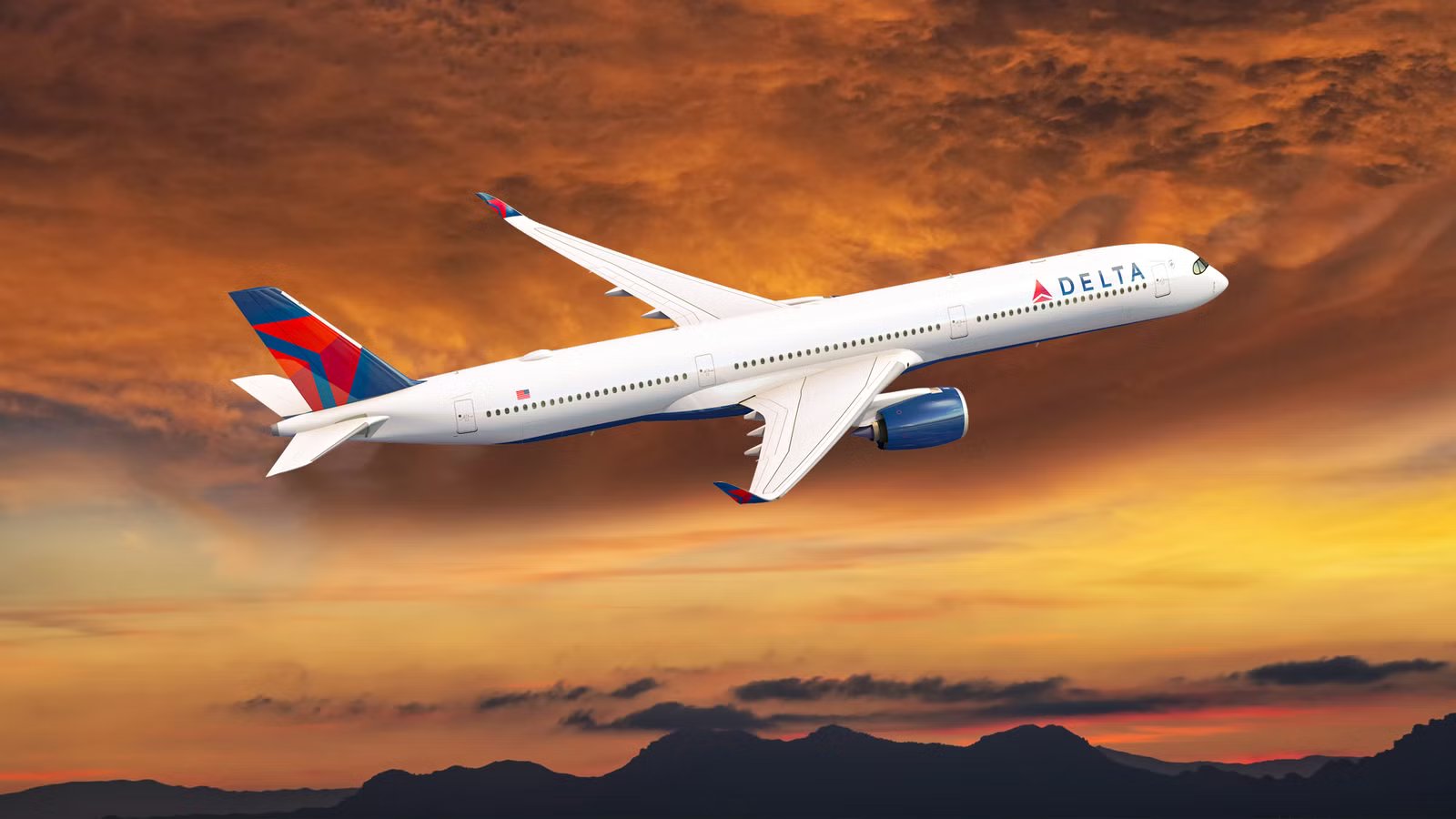
 Delta Air Lines will become the first US carrier to operate the Airbus A350-1000 when deliveries begin in late 2026. The aircraft will enter the fleet as Delta’s new flagship widebody, configured with approximately half its seats in premium cabins and deployed on the longest routes in the airline’s international network. The order, 20 firm with 20 options, represents a long-haul fleet strategy that looks meaningfully different from what United and American are pursuing.
United has built its near-term widebody strategy around a high volume of Boeing 787 deliveries. American operates an all-Boeing widebody fleet with no Airbus orders. Delta is going in a third direction, investing in a smaller number of larger, premium-dense aircraft designed to generate the highest possible revenue per departure on routes where the demand supports it. Here is what the A350-1000 brings to Delta’s fleet, what the cabin looks like, and what the order says about how the three largest US carriers see long-haul competition differently.
What Delta Is Actually Ordering And When It Arrives

Delta placed a firm order for 20 Airbus A350-1000 aircraft in January 2024 with options for 20 more, making it the first US airline to order the larger A350 variant. Deliveries are expected to begin in late 2026, with the aircraft entering the fleet alongside Delta’s existing 26 A350-900s. The A350-1000 is 239 feet 6 inches (73 meters) long, approximately 23 feet (7 meters) longer than the A350-900, with a corresponding increase in passenger and cargo capacity. Both variants share the same wing, Rolls-Royce Trent XWB engine family, and composite fuselage construction, but the -1000 carries more passengers on a similar range.
The A350-1000 delivers a 25% advantage in fuel burn and operating costs over previous-generation widebodies according to Airbus, a figure that reflects the composite airframe’s weight savings, the Trent engine’s efficiency, and the aerodynamic improvements built into the A350 platform. For Delta, the aircraft fills a specific gap in its long-haul fleet. The 767-300ER, which has served as a transatlantic workhorse for decades, is aging and increasingly expensive to operate. The A330-200 and A330-300 fleet, while younger, lacks the range and efficiency profile to compete with the newest widebodies on the longest routes in Delta’s network. Delta also operates the newer and more efficient A330-900neo.
The A350-1000 gives Delta a widebody that can serve the longest routes in its network with the capacity to carry a large number of premium passengers. Asia-Pacific, India, and the Middle East routes are the primary targets for the type, markets where stage lengths are long and premium demand has been growing. The aircraft’s range of approximately 8,700 nautical miles (16,100 km) covers every route Delta currently operates and opens city pairs that the 767 and A330 cannot reach nonstop.
The Cabin Delta Is Putting On It

Delta’s A350-1000 will carry approximately half its seats in premium cabins, a ratio that is unusual for a US carrier and aggressive by any standard. The configuration includes 53 next-generation Delta One Suites in a 1-2-1 layout, each with an 83-inch (211 cm) lie-flat bed, a 24-inch (61 cm) 4K QLED entertainment screen, and a sliding privacy door. That is 53 business class suites on a single aircraft, more than Delta currently offers on any widebody in its fleet. An expanded Premium Select cabin sits behind Delta One, followed by Comfort+ and Main Cabin. The overall seat count has not been publicly confirmed, but the 50% premium split means roughly as many seats are forward of the economy curtain as behind it.
The Delta One Suites on the A350-1000 represent a step beyond what the airline currently flies on its A350-900 and A330-900neo. The bed is longer at 83 inches (211 cm) compared to 76-80 inches (193-203 cm) on existing Delta One aircraft. The screen is larger. A dedicated refreshment station in the Delta One cabin allows passengers to serve themselves between meal services. The suite itself is designed by Thompson Aero Seating and built around a philosophy of maximizing usable space within each position rather than relying on cabin width alone.
The configuration is a revenue bet. A 50% premium seat mix only works financially if Delta can fill those seats at fares that generate more revenue per departure than a denser configuration with more economy seats would. Delta’s thesis is that the routes the A350-1000 will serve, primarily long-haul international sectors with deep corporate and premium leisure demand, generate enough high-fare traffic to justify the reduced economy seat count. If that thesis holds, the A350-1000 becomes the most profitable widebody in the fleet per departure. If premium demand softens on those routes, the airline is flying with a large number of expensive seats that are harder to fill at discount fares.
Why In The World Does United Airlines Fly The Boeing 787-10 And Not The Airbus A350-1000?
United flies the 787 but not the A350 because the A350 order has not yet been fulfilled. Meanwhile, it inherited a Continental Airlines order.
The Cascading Strategy: What Gets Replaced And What Gets Upgraded

Delta’s A350-1000 deliveries will not simply add capacity to the fleet. They will trigger a sequence of fleet moves that reshuffles which aircraft fly which routes. The process, which Delta has described as cascading upgauging, works by placing the A350-1000 on the highest-demand long-haul routes currently served by the A350-900, then moving the displaced A350-900s onto routes currently operated by A330s and 767s, which in turn either move to lower-demand routes or retire entirely.
The 767-300ER is the primary aircraft being retired through this process. Delta operates one of the largest remaining 767-300ER fleets of any carrier, and the aircraft has been flying transatlantic, transcontinental, and South American routes for decades. It remains a functional widebody, but fuel consumption and maintenance costs are increasingly difficult to justify on routes where newer aircraft are available. As A350-900s cascade down from routes that the A350-1000 takes over, the 767 exits on those same routes. The A330-200 and A330-300 face a similar timeline, though Delta has committed to retrofitting some A330s with sliding-door Delta One suites as part of a broader investment of over $1 billion in fleet upgrades.
The retrofit program serves a specific purpose. It takes years for 20 A350-1000s to be delivered and fully deployed, and during that transition period, Delta needs its existing widebody fleet to remain competitive against what United and American are offering on overlapping routes. Retrofitting A330s with the door-equipped suites that passengers now expect ensures that Delta’s older widebodies do not fall behind in product quality while they are still flying premium routes. The A350-1000 sets the new standard. The retrofits keep the existing fleet from becoming a liability during the years it takes for the transition to complete.
United’s Different Bet: 787s Over A350s

United has taken a different approach to the same long-haul competition. Rather than order the A350-1000, United deferred its existing A350 commitments to 2030 and built its near-term widebody strategy around the Boeing 787, specifically the Elevated 787-9. United’s 787-9 carries 72 lie-flat seats across 64 Polaris Suites and 8 Polaris Studio positions, which is actually more lie-flat capacity per departure than the 53 Delta One Suites on the A350-1000. United expects 20 Elevated 787-9 deliveries by the end of 2026 and 30 by the end of 2027.
The strategic difference is in total aircraft size and how each carrier distributes capacity across its network. The A350-1000 is a larger aircraft overall, carrying more total passengers, including a substantial economy cabin. Delta is using fewer, bigger aircraft on its highest-demand routes. United is deploying a larger number of 787-9s across more routes at higher frequency. Both carriers are investing heavily in premium lie-flat seats, but Delta is pairing that investment with a larger overall aircraft, while United is pairing it with greater network coverage.
The product itself is competitive. The Elevated 787-9 carries Polaris Suites and the larger Polaris Studio with 27-inch (69 cm) screens, companion seating, and an exclusive caviar service.
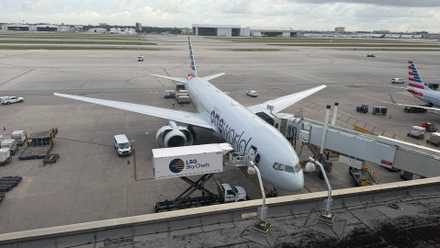
American Airlines In Talks With Airbus & Boeing Over Replacement For Aging 777-200ERs
The carrier has begun the search for its next big twinjet.
American’s All-Boeing Fleet And What The Big Three’s Widebody Choices Say About Each Carrier

American Airlines operates an all-Boeing widebody fleet of 787s, and 777s. That was not always the case. Before the pandemic, American also operated Airbus A330-300s, Boeing 767-300ERs, and Boeing 757-200s on international and long-haul domestic routes. COVID accelerated the retirement of all three types. The A330s were withdrawn in 2020 and never returned. The 767-300ERs were retired the same year. The 757s followed shortly after. American used the pandemic downturn to simplify its widebody fleet down to two types and has not reintroduced any of them, which many say was a fatal mistake. The Flagship Suite, American’s door-equipped business class product introduced in 2025, is being installed on the 787-9 fleet and will eventually appear on the 777-300ER.
American’s post-COVID fleet strategy reflects a different set of priorities from either Delta or United. By standardizing on two Boeing widebody types, American simplifies its maintenance infrastructure, pilot training, and spare parts inventory. The trade-off is that American lacks the aircraft diversity to match Delta’s premium-dense A350-1000 on ultra-long-haul routes or United’s volume of 787 deliveries in the near term. American’s widebody order book is thinner than either competitor’s, and the airline has been more conservative about fleet investment since the pandemic.
Catch what other trackers miss
Emergency squawks, holds, NOTAMs — live signals, no signup.
Open tracker
Catch what other trackers miss
Emergency squawks, holds, NOTAMs — live signals, no signup.
Open tracker