dailynewsnblog
Over the years, a wide range of aircraft designs have been proposed by both  Boeing and Airbus. The design principles of several of these proposed programs have helped shape aviation as we know it today despite never having taken to the skies themselves. Some were too expensive to develop, some arrived at the wrong moment, and others simply failed to attract enough airline interest. In many cases, these aircraft were not bad ideas on paper.
From stretched jumbojets designed to rival the Airbus A380 to specialized Dreamliner variants and long-range versions of existing aircraft, these canceled projects show how difficult aircraft development can be. Even for Boeing and Airbus, strong technical concepts are not enough if airlines are unwilling to commit. Here are five aircraft that were planned but never entered commercial service.
Boeing 767-400ERX
The long-range 767 that depended on another aircraft’s engine

Back in 2000, Boeing planned to launch the Boeing 767-400ERX, a long-range sub-variant of the Boeing 767-400ER. The aircraft was planned to feature higher-thrust engines, reinforced structural components, and additional fuel capacity to realize a range of over 6,150 nautical miles (11,390 km). This was around 525 nautical miles (950 km) farther than the -400ER, with a similar capacity of 245 passengers in a three-class configuration.
Since the -400ERX would require a heavier maximum take-off weight (MTOW) of 465,000 pounds (210,920 kg), the aircraft also needed engines with additional thrust. For this, a new engine needed to be developed, adding complexity to the project. To mitigate this and reduce development risks, the -400ERX was planned to use the same engines as the 747X, which was also being developed around the same time, but later discontinued due to a lack of interest among airlines. The potential use of the 747X engine would have allowed the twinjet to gain massive additional thrust without the risks and costs of standalone engine development.
After the program’s launch in 2000, the first aircraft was planned for delivery to Kenya Airways in 2004, the only airline that had placed a firm order for the aircraft. However, due to a lack of additional interest from other airlines and the cancellation of the 747X and subsequent engine, the manufacturer ultimately canceled the project in 2001. After the official cancellation of the program, Boeing quickly shifted its focus toward further developing the 777 family and the new Boeing 7E7, which later became the Boeing 787.
Catch what other flight trackers miss
Emergency squawks, holds, NOTAMs — live signals, no signup.
Open tracker
Catch what other flight trackers miss
Emergency squawks, holds, NOTAMs — live signals, no signup.
Open tracker
Boeing 747X
Boeing’s last big push to reinvent the classic jumbo jet

As mentioned before, Boeing was also working on a new Boeing 747 variant. Between the late 1990s and early 2000s, the manufacturer proposed several advanced jumbojet variants as an alternative to Airbus’ A380 program. During the Farnborough Airshow in 1996, Boeing announced the 747-500X and -600X. These aircraft would have combined the 747’s fuselage with a new wing spanning 251 feet (77 m) derived from the 777. Boeing also introduced a third concept, the 747-700X. This aircraft would have a wider fuselage than the -600X, allowing it to carry 650 passengers.
After these three original proposals were scrapped due to high development costs and a lack of commercial interest, Boeing attempted to develop a new 747 variant again in 2000. This proposal, named the 747X, was more modest compared to the proposals a few years earlier. The new variant would feature a new wingspan and new engines, which were, as mentioned before, the same engines planned for the 767-400ERX. Much of the aircraft’s cockpit and cabin would have been inspired by the Boeing 777 family. Alongside the 747X, a longer 747X Stretch variant with additional capacity was also planned.
Aircraft | Range | Capacity |
|---|---|---|
Boeing 747-500X | 10,000 miles (16,100 km) | 462 |
Boeing 747-600X | 8,900 miles (14,300 km) | 648 |
Boeing 747-700X | 8,383 miles (13,492 km) | 650 |
Boeing 747X | 10,000 miles (16,100 km) | 430 |
Boeing 747X Stretch | 9,000 miles (14,400 km) | 500 |
Similar to the manufacturers’ earlier proposal for a new 747 variant, the 747X and 747X Stretch also failed to attract enough commercial interest. This made Boeing realize that market demand was shifting and that airlines increasingly preferred highly efficient, long-range twin-engine aircraft, a development that would later also result in the downfall of Airbus’ A380 program. Despite this, some of the new technology designed for the new 747 variants was later still used for the Boeing 747-400ER (previously called the -400X) and the Boeing 747-8.
The Real Reason Why The Airbus A380 Production Ended
What do you think is the real reason Airbus discontinued the A380?
Boeing 787-3
The short-haul Dreamliner built for Japan’s busiest routes

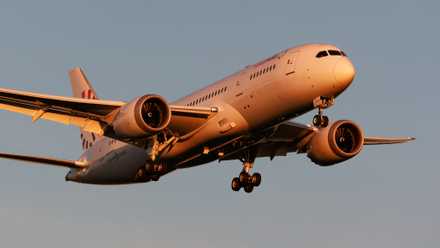
Boeing’s 787 is one of the most popular aircraft types in the modern aviation industry and is well known for its favorable economics and efficiency, even on the longest routes. Unsurprisingly, the aircraft is not quickly associated with short-haul operations. However, back when Boeing was still developing the 787, there were concrete plans for a high-density short-haul variant of the Dreamliner family. This Boeing 787-3 was designed specifically for high-density routes in the Japanese domestic market.
The twin-jet would have seated between 290 and 330 passengers in a two-class configuration, across a range of 2,500 to 3,050 nautical miles (4,630 to 5,650 km). This 787-3 was planned to have the same fuselage length as the Boeing 787-8, but with a reduced wingspan to increase access to smaller gates common for Asian domestic markets. To optimize fuel efficiency on short flights, the aircraft would have featured a lower MTOW.
By 2010, the airplane’s most important customers, Japan Airlines and All Nippon Airways, converted all orders to the Boeing 787-8. The primary reason for the two Japanese carriers’ decision was the development delays the 787-3 was facing, as Boeing prioritized the timely delivery of the first 787-8, and both airlines preferred to keep their fleet renewal plans on track. This order cancellation, however, removed the rationale for the specialized 787-3, resulting in the program’s formal cancellation.
What Happened To The Boeing 787-3?
The project had interest in Japan, but nowhere else.
Airbus A350-800
The baby A350 that became too heavy for its own market

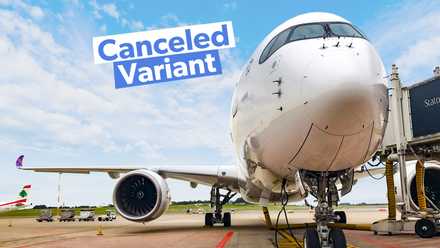
In 2010, Airbus decided to develop a shortened sub-variant of its new Airbus A350 XWB family. This new twinjet was designed as a 276-seat widebody airline meant to replace the older A330-200 and compete with the Boeing 787-8. However, the aircraft faced some structural inefficiencies that Airbus was unable to resolve, and despite having 180 outstanding orders at its peak, it quickly fell out of favor compared to other aircraft. Most customers of the aircraft had already switched their order for the larger Airbus A350-900, and when Airbus launched the A330neo in 2014, it canceled the -800 altogether.
Specification | Airbus A350-800 | Airbus A350-900 | Airbus A330-900neo |
|---|---|---|---|
Length | 198 feet, 7 inches (60.54 meters) | 219 feet, 2 inches (66.80 meters) | 208 feet, 10 inches (63.66 meters) |
Wingspan | 212 feet, 5 inches (64.75 meters) | 212 feet, 5 inches (64.75 meters) | 210 feet (64.00 meters) |
Height | 55 feet, 11 inches (17.05 meters) | 55 feet, 11 inches (17.05 meters) | 55 feet, 1 inch (16.79 meters) |
Thrust per engine | 75,760 lbf (337 kN) | 84,200 lbf (375 kN) | 72,000 lbf (320 kN) |
MTOW | 547,000 lb (248,000 kg) | 617,000 lb (280,000 kg) | 534,000 lb (242,000 kg) |
Range | 8,246 nautical miles (15,270 km) | 7,749 nautical miles (14,350 km) | 6,550 nautical miles (12,130 km) |
Cruise speed | Mach 0.85 | Mach 0.85 | Mach 0.86 |
Passenger capacity (three-class) | 280 passengers | 315 passengers | 287 passengers |
Source: aviatorjoe.net | |||
The main reason for the A350-800’s efficiency was the same heavy landing gear and massive wing structure optimized for the much larger A350-900. Carrying this structural “dead weight” meant it suffered from higher fuel burn per seat than its direct competitors. When the A330-900neo was introduced in 2014, this effectively matched the capacity needs of the -800 market segment but at significantly lower operational and acquisition costs.
The Airbus A350-800: A Widebody That Never Was
Airbus prioritized the A350-900 and decided to launch the A330neo instead.
Airbus A380neo
The superjumbo comeback that Airbus never dared to launch

Back in 2015, it was reported that Airbus was in talks with several airlines about the potential development of an Airbus A380neo aircraft. This aircraft was reported to feature new engines and wings, while also providing capacity for up to 50 additional seats. At the time, it was believed the new version of the Airbus A380 would be operational by 2020, but as many are aware, things took a different turn, and by 2021, the A380 program was discontinued.
In 2017, Airbus’ CEO Fabrice Brégier announced the company would not be pursuing the development of a new A380neo, stating that: “there is no business case to do that, this is absolutely clear.” However, Airbus did not fully write off the program and was still creating proposals to enhance the aircraft performance, such as the A380plus, which was unveiled in 2017 as well. At the same time, the type’s largest customer,  Emirates, has continued to push for the development of the A380neo, suggesting the airline was not interested in the minimal enhancements of the A380plus. Back in June 2016, Emirates CEO Tim Clark already stated, “the A380neo would be nice to have, but I cannot force Toulouse to do anything.”
Catch what other flight trackers miss
Emergency squawks, holds, NOTAMs — live signals, no signup.
Open tracker
Catch what other flight trackers miss
Emergency squawks, holds, NOTAMs — live signals, no signup.
Open tracker
Emirates is still in favor of a re-engined A380, and in 2023, Tim Clark once again pleaded for an Airbus A380neo variant. This new A380 variant is suggested to feature ultra-efficient engines that would reduce fuel burn by an estimated 20 to 25%. Furthermore, it would use lighter composite materials similar to the A350 and potentially have folding wingtips such as the Boeing 777X for improved airport access. Despite all of this, it remains unlikely Airbus will ever decide to develop the A380neo, as the financial gamble of restarting production and designing an entirely new engine option is unattractive when the market for ultra-large aircraft is limited almost entirely to Emirates’ specific hub-and-spoke model.