dailynewsnblog
Aircraft today routinely cruise above 40,000 feet (12,192 meters), operating in an environment where aerodynamic performance, aircraft systems, and human physiology all approach critical limits simultaneously. At those altitudes, the margin for error narrows dramatically. A small change in airspeed, turbulence intensity, aircraft weight, or pilot input can push an aircraft toward conditions from which recovery becomes increasingly difficult. Among pilots and aerospace engineers, few concepts illustrate this better than “coffin corner,” the high-altitude region where the safe operating speed range becomes exceptionally narrow.
Although the phrase sounds dramatic, coffin corner is a real aerodynamic limitation rooted in the relationship between stall speed and critical Mach number. As altitude increases, the aircraft must fly at a higher true airspeed to generate sufficient lift, while remaining below speeds where compressibility effects and shock waves begin to disrupt airflow over the wings. Eventually, those boundaries converge. At extreme altitude, the aircraft can be only a few knots away from either a low-speed stall or a high-speed Mach buffet. That reality explains why pilots operating at high cruise levels pay close attention not just to speed, but also to turbulence, aircraft weight, maneuvering loads, and cabin pressurization systems.
The Aerodynamics That Define Coffin Corner

Coffin corner, sometimes called “Q corner,” describes the point where an aircraft’s low-speed stall boundary nearly intersects with its high-speed critical Mach boundary. At lower altitudes, aircraft operate with a substantial margin between those two limits. Higher altitude changes that relationship significantly. Air density decreases with altitude, forcing aircraft to maintain higher true airspeeds to produce enough lift. At the same time, the speed of sound decreases as temperature drops, bringing the aircraft closer to Mach-related aerodynamic disturbances.
Catch what other flight trackers miss
Emergency squawks, holds, NOTAMs — live signals, no signup.
Open tracker
Catch what other flight trackers miss
Emergency squawks, holds, NOTAMs — live signals, no signup.
Open tracker
The result is a shrinking operating envelope. Fly too slowly and airflow separates from the wing, causing an aerodynamic stall. Fly too quickly and shock waves begin forming over portions of the wing as local airflow approaches the speed of sound, triggering Mach buffet and potentially destabilizing the aircraft. Near the service ceiling, the gap between those two conditions can become extremely narrow. The U-2 reconnaissance aircraft remains one of the most cited examples. At around 60,000 feet, pilots reportedly operate with as little as a six-knot margin between low-speed stall and high-speed Mach buffet. While commercial airliners do not typically fly with margins that narrow, the principle remains the same. The higher the altitude, the less tolerance exists for deviation.
Aircraft weight also plays a major role. A heavier aircraft requires greater lift, which increases the angle of attack necessary to maintain level flight. That raises stall speed and effectively lowers the altitude at which coffin corner conditions begin appearing. This is one reason long-haul flights often use step climbs, gradually ascending as fuel burns off and the aircraft becomes lighter. Certification standards account for these limitations. Commercial aircraft manufacturers must demonstrate that aircraft retain at least a minimal maneuvering margin at maximum operating altitude. Flight manuals include buffet onset charts showing where low-speed buffet and Mach buffet may occur based on aircraft weight, altitude, and atmospheric conditions. These calculations directly influence flight planning and cruise altitude selection on every long-range flight.
Why Routine Maneuvers Become Dangerous at Extreme Altitude

One of the least appreciated aspects of high altitude flight is how ordinary maneuvers can become hazardous near the aircraft’s ceiling. At lower altitudes, a modest turn or encounter with turbulence typically produces little concern. Above 40,000 feet, the aerodynamic environment becomes far less forgiving. Any maneuver that increases load factor also increases stall speed. Even a shallow bank angle during a turn requires the wings to generate additional lift. That higher lift demand increases the angle of attack and narrows the remaining margin to stall buffet, but accelerating can introduce risks of approaching the Mach buffet limits.
This creates a difficult balancing act for pilots. A maneuver that would be routine at 30,000 feet may require substantially more caution at 43,000 feet. Stability and control effectiveness also degrade at extreme altitude because thinner air reduces aerodynamic authority over the control surfaces. Aircraft respond differently, and abrupt inputs can create larger-than-expected deviations in speed or attitude. The issue becomes even more pronounced during upset recovery scenarios. If an aircraft experiences a sudden altitude deviation or unusual attitude near coffin corner, pilots must avoid over-control. Excessive pitch input can rapidly induce a stall, while aggressive acceleration may push the aircraft into Mach buffet territory. Training for high altitude upset recovery therefore emphasizes smooth control inputs and careful energy management.
Modern flight management systems and autopilots help reduce workload, but automation does not eliminate the underlying aerodynamic constraints. In some situations, autopilot systems may disconnect if aircraft parameters move outside allowable ranges, forcing pilots to manually stabilize an aircraft already operating near its limits.
Curved Earth: What Private Jet Pilots Notice At 51,000 Feet Where Commercial Jets Can’t Reach
Climbing to 51,000 feet, private jet pilots witness a visual shift that challenges flat-earth myths, with a rare glimpse of the planet from above.
Clear Air Turbulence And The Invisible Threat

Among the most serious external threats at high altitude is clear air turbulence, commonly abbreviated as CAT. Unlike turbulence associated with thunderstorms, CAT occurs in cloud-free regions and cannot be detected by conventional onboard weather radar because there is no moisture or precipitation to reflect radar energy. Clear air turbulence is most common between FL200 and FL450, precisely the altitude band where many commercial jets cruise. It frequently develops near jet streams, mountain waves, and boundaries between contrasting air masses. Because it often appears without visual warning, pilots rely heavily on forecasts, atmospheric modeling, and pilot reports from nearby aircraft.
At normal cruise altitudes, turbulence may primarily create passenger discomfort. Near coffin corner, it can become a far more serious aerodynamic hazard. A sudden vertical gust changes angle of attack almost instantly. In an aircraft already operating with a limited speed margin, that abrupt shift may push the aircraft into a low-speed buffet or momentarily exceed critical Mach conditions. The danger is amplified because turbulence-induced changes happen faster than pilots can manually react. Modern aircraft systems can mitigate some effects, but physics still governs the envelope. Violent CAT encounters have occasionally produced altitude excursions, injuries, and temporary loss of control events even in advanced airliners.
Pilots therefore treat turbulence avoidance seriously during high altitude cruise operations. Dispatchers and flight crews continuously exchange weather information, adjusting altitudes or rerouting around forecast turbulence zones when necessary. Even small altitude changes can restore a larger operating margin between stall buffet and Mach buffet.
Physiology Of High Altitude Flight

The aerodynamic risks of coffin corner receive considerable attention, but physiological threats above 40,000 feet are equally serious. Human beings cannot survive for long in an unpressurized environment at those altitudes without supplemental oxygen. Aircraft pressurization systems therefore become critical life-support infrastructure during high altitude flight. A rapid decompression event can quickly expose pilots and passengers to hypoxia, the condition caused by insufficient oxygen reaching body tissues. The danger increases dramatically with altitude because atmospheric pressure falls sharply as altitude rises. At 35,000 feet, useful consciousness after sudden decompression may last less than one minute. Above 40,000 feet, the available response time can become dangerously short.
Hypoxia is particularly dangerous because its early symptoms can be subtle. Pilots may experience fatigue, lightheadedness, mild headache, impaired concentration, or euphoria before recognizing that cognitive performance is deteriorating. Judgment and reaction time decline progressively, potentially preventing an effective emergency response. For this reason, pilots operating high altitude aircraft receive extensive hypoxia awareness training. Many experience altitude chamber exercises designed to help them recognize their personal symptoms before impairment becomes severe. Quick-donning oxygen masks in airline cockpits are specifically engineered to allow pilots to secure oxygen supply within seconds after decompression.
Percentage of Oxygen in the Air at Different Altitudes | |
|---|---|
Altitude (feet) | % Oxygen |
0 – Sea level | 20.9 |
5,000 | 17.3 |
10,000 | 14.3 |
20,000 | 9.7 |
30,000 | 6.3 |
Source: Hypoxico | |
Following a pressurization failure, emergency procedures typically require an immediate descent to breathable altitude. Commercial jets are designed to execute rapid emergency descents while maintaining structural integrity and controllability. However, initiating and managing such a descent at extreme altitude while dealing with alarms, oxygen masks, and potential passenger injuries remains a highly demanding task. Above 40,000 feet, aviation effectively becomes a controlled life-support operation as much as a transportation system. The aircraft’s environmental controls are not merely comfort features. They are essential survival systems.
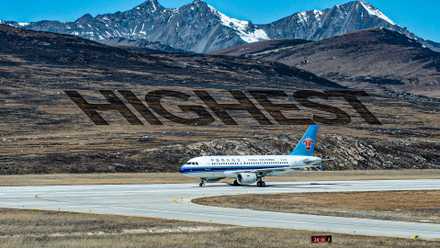
The World’s Highest Altitude Airports Still In Operation
China and Bolivia claim the world’s highest commercial airports with others found in neighboring regions.
How Pilots And Manufacturers Reduce Risks

Despite the challenges associated with coffin corner, modern commercial aviation maintains an exceptional safety record at high altitude. That reliability stems from layered engineering safeguards, rigorous pilot training, detailed operational procedures, and conservative certification requirements. Aircraft manufacturers carefully define maximum operating altitude based on aerodynamic testing, engine performance, and maneuvering margins. Airlines do not simply fly as high as possible. Cruise altitude selection depends on aircraft weight, atmospheric temperature, turbulence forecasts, and fuel efficiency considerations.
Step climbs remain one of the most important operational techniques. Aircraft departing on long-haul routes are often too heavy to operate efficiently at their eventual optimum altitude. As fuel burn reduces weight, pilots gradually climb higher, maintaining safer aerodynamic margins throughout the flight. Flight crews also continuously monitor Mach number, indicated airspeed, turbulence intensity, and atmospheric conditions. Modern flight management systems calculate optimal cruise profiles and alert crews to potential deviances. Autothrottle systems also help maintain precise speed control, which becomes increasingly important as the operating envelope narrows.
Training standards reinforce these safeguards. Airline pilots practice high altitude stall recovery, upset prevention, decompression response, and turbulence management in simulators that replicate extreme operating conditions. Regulators additionally require aircraft to demonstrate adequate buffet margins and maneuverability at certified operating ceilings. The industry’s approach reflects a fundamental principle of aviation safety: understanding limitations is as important as achieving performance. High altitude cruise delivers major fuel efficiency benefits, but only when operated within carefully managed aerodynamic and physiological boundaries.
Final Thoughts

Yet the existence of coffin corner does not make high altitude flight inherently unsafe. Instead, it highlights the precision with which modern aviation operates. Aircraft manufacturers, regulators, dispatchers, and flight crews collectively manage these risks through engineering, training, operational discipline, and constant monitoring. The result is a system capable of safely transporting millions of passengers through one of the most demanding environments humans routinely navigate.