dailynewsnblog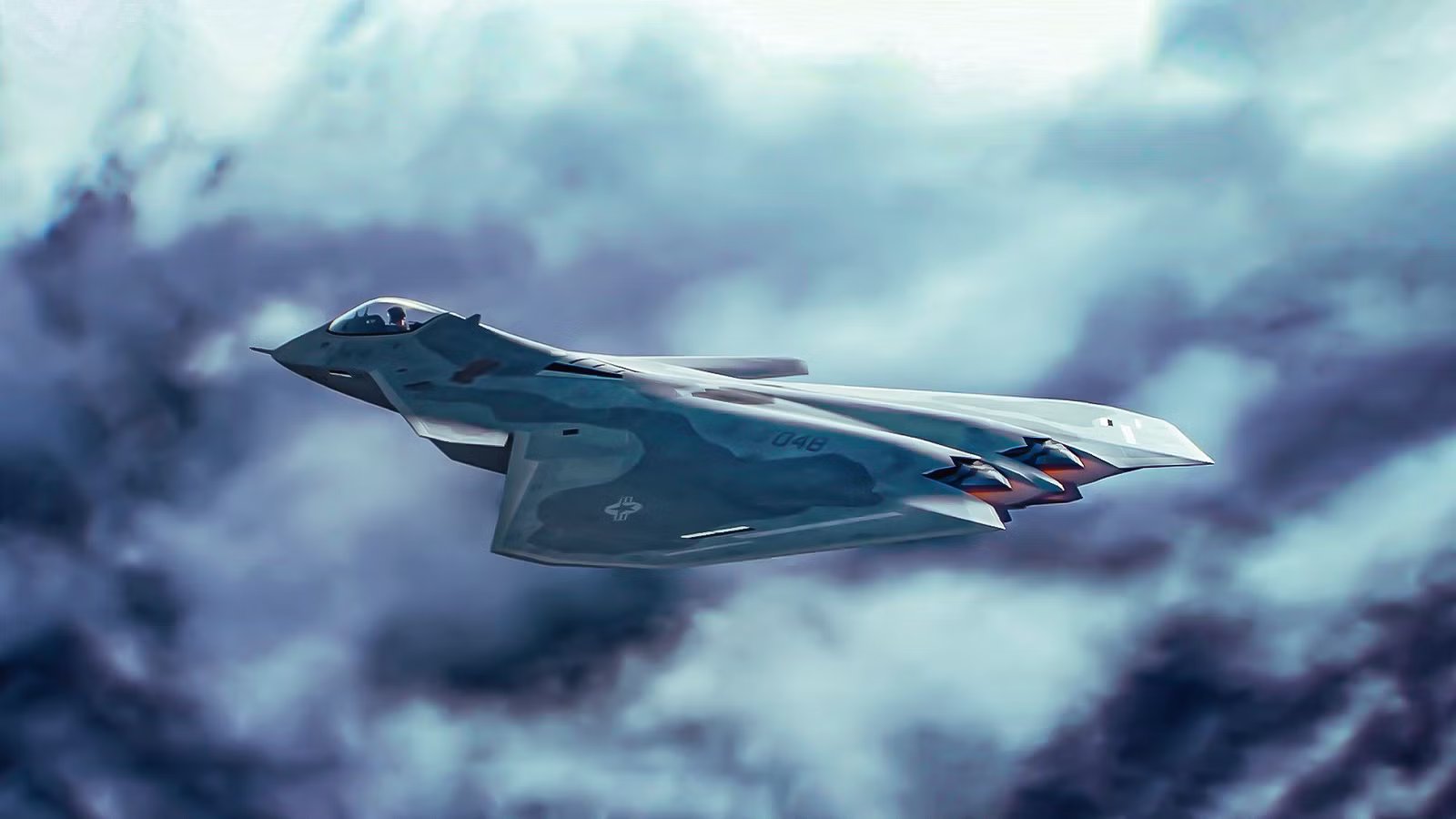
The United States Air Force’s F-47 program is reshaping how air combat is understood by turning a single pilot into the commander of multiple autonomous aircraft working as a coordinated network. Known as the “quarterback” concept, this Next Generation Air Dominance (NGAD) architecture pairs the crewed F-47 Boeing fighter with Collaborative Combat Aircraft (CCAs) such as the YFQ-42A and YFQ-44A, each one with an assigned role, ranging from strike missions to electronic warfare and reconnaissance.
Using technical documentation, Simple Flying articles, and external sources, this article explores how that structure works in practice, what the pilot actually controls inside the cockpit, and how a planned fleet of 185 F-47s supported by over 1,000 CCAs could redefine modern air power in the 2030s.
The “Quarterback” Concept: One Pilot, Many Machines

Since the NGAD program was first publicly described, the Air Force has used the term “family of systems” with deliberate consistency. The F-47 is the crewed node around which a broader combat network orbits, not simply a successor to the Lockheed Martin F-22 Raptor in the air-to-air role. Each F-47 is designed to fly alongside multiple CCAs, with each drone assigned a specific mission set: strike, intelligence-surveillance-reconnaissance (ISR), electronic warfare, or serving as a decoy to draw enemy fire away from the crewed aircraft.
According to Defense News, the Air Force has already successfully integrated third-party autonomous software into CCA prototypes, demonstrating that the drones can reliably follow commands transmitted by a human operator in flight.
The analogy that keeps appearing in US Air Force briefings and congressional testimony is that of a quarterback. The F-47 pilot calls the play; the drones execute it. The CCAs are semi-autonomous; they can fly, navigate, and execute a defined task without continuous human input, but the human pilot retains decision authority over the most sensitive actions, consistent with Air Force doctrine on AI-enabled combat systems. The drones do the dangerous legwork; the pilot decides if and when a weapon is actually released.
This architecture is a deliberate response to the threatening environment the F-47 is being built to operate in. Adversary integrated air defense systems (IADS) have become dense enough that sending a crewed aircraft to conduct ISR or electronic attack over the most contested corridors carries unacceptable risk to a $300-million airframe and, more importantly, to a highly trained pilot. By routing those missions through CCAs, the F-47 can stay outside the most lethal engagement zones while its drones press forward, multiplying the aircraft’s effective reach without multiplying the risk to the human crew.
Meet The Loyal Wingmen: YFQ-42A And YFQ-44A

The CCA program has already moved well past the concept phase. The Air Force selected two platforms for Increment 1 of its CCA effort: the General Atomics YFQ-42A, which completed its first representative flight in August 2025, and the Anduril YFQ-44A “Fury,” which followed on October 31, 2025. Both aircraft are now in active flight testing, and both are designed to operate as loyal wingmen to crewed fighters — including, eventually, the F-47 itself.
Notably, according to Defense News, the Air Force has already integrated third-party autonomous software into these prototypes, a milestone that confirms the human-drone command chain is not theoretical: it works.
While neither platform’s full capabilities are publicly confirmed, the Air Force has outlined the mission profiles CCAs will be expected to cover. A single CCA type is not built to do everything — they are mission-specialized, which is part of what makes the architecture so flexible. The F-47 pilot will be able to task different CCAs with different objectives simultaneously, mixing the roles within a single sortie. Those mission types, as the Air Force has described them, include:
- Strike operations: CCAs carry and deliver weapons against surface or airborne targets, reducing the exposure of the crewed F-47.
- Intelligence, surveillance, and reconnaissance (ISR): Drones push ahead of the crewed aircraft to gather sensor data in contested airspace.
- Electronic warfare (EW): CCAs carry jamming and spoofing payloads to degrade adversary radar and communications nets.
- Decoy operations: Purpose-built to draw enemy fire, CCAs can absorb engagements that would otherwise target the crewed aircraft.
The combination of those four roles, spread across multiple drones directed by one pilot, produces a combat effect that far exceeds what a single crewed aircraft could achieve alone. According to 19FortyFive, each F-47 may control up to eight CCAs simultaneously, meaning 185 aircraft could represent a combat force of well over 1,000 platforms in practice. That resembles an air army, rather than a fighter jets fleet.
Is It True That The F-35’s Maintenance Cost Is 45% Higher Than The F-16’s?
The F-35’s ‘45% higher cost’ claim is partly true, but it depends on how you compare data, and may stem from misinterpreted program figures.
What The Pilots Actually Control — And What They Don’t

One of the most important distinctions in the entire F-47 concept is the line between what the onboard AI manages autonomously and what the pilot must actively authorize. The CCAs are semi-autonomous, not fully autonomous: they fly, navigate, and execute assigned mission parameters without requiring continuous pilot input.
What they will not do, at least under current Air Force doctrine, is independently decide when to use lethal force. That decision remains with the human in the cockpit, consistent with Department of Defense policy on autonomous weapons systems.
What the pilot would physically control is closer to what a fleet admiral does than what a traditional fighter pilot does. Rather than flying their own aircraft through a merge and pulling the trigger in a dogfight, the F-47 pilot will manage a live tactical picture: assigning CCAs to waypoints, selecting target packages, adjusting mission parameters in real time based on the sensor data the drones stream back, and authorizing weapons release when the AI’s threat prioritization recommends it.
As 19FortyFive notes, the aircraft will use edge computing to process sensor data and recommend tactical decisions faster than a human could manage alone, but the human remains in the loop for actions that are irreversible. In that sense, flying the F-47 in a CCA-enabled mission will demand a new kind of cognitive skill: not the hand-eye coordination of a gun fight, but the situational awareness of a mission commander managing multiple simultaneous engagements across a battlespace that may span hundreds of miles.
President Donald Trump, unveiling the F-47 designation at the White House in March 2025, put it in blunt terms:
“It flies with many, many drones, as many as you want. And it’s a technology that’s new, but it doesn’t fly by itself. It flies [with a pilot] but with many drones, as many as we want. And that’s something that no other plane can do.”
That framing captures the doctrine more accurately than most official briefings.
The Numbers: 185 F-47s, 1,000 CCAS, And Billions In R&D

The scale of the program is difficult to overstate. According to Air Force Chief of Staff General David Allvin’s May 2025 infographic, the service plans to procure at least 185 F-47s — a number that matches the current F-22 Raptor fleet nearly one-to-one, suggesting a direct replacement of the air superiority mission. Alongside those crewed fighters, the Air Force envisions a fleet of at least 1,000 CCAs, providing each F-47 with multiple drone wingmen from the day it reaches operational status. The first F-47 is targeted to fly in 2028, with initial operational capability aimed at 2029 and broad fielding in the 2030s, as confirmed by Air & Space Forces Magazine.
The financial commitment behind those numbers is equally serious. According to Congress.gov, Congress appropriated around $8.2 billion for NGAD technology development between fiscal years 2022 and 2025. The Trump administration requested $2.58 billion for F-47 system development and demonstration in fiscal year 2026. That figure is expected to climb steeply as the program enters its most hardware-intensive phase: according to Air & Space Forces Magazine, the Air Force requested more than $5 billion in R&D funding for fiscal year 2027, with spending projected to peak at $5.25 billion in fiscal year 2028. The total engineering and manufacturing development contract with Boeing is valued at more than $20 billion.
The unit cost question remains politically sensitive. Congressional Budget Office estimates have previously placed the flyaway cost of each F-47 at up to $300 million — roughly three times the cost of an F-35A. Air Force leadership has consistently emphasized that the F-47 will cost less than the F-22, but given that the Raptor’s program cost ballooned well past original projections, that particular promise will be scrutinized closely as the program matures. For context on how Boeing’s production timeline compares to program expectations, Simple Flying has already explored why the F-47’s production is considered behind schedule before a single representative prototype has flown.

The World’s Largest Air Forces By Number Of Fighter Jets
This guide ranks the world’s largest fighter forces in 2026
The Platform: Stealth, Range, And Propulsion

Much of the F-47’s physical design remains classified, and the Air Force has acknowledged that official renders may include deliberate misdirections. What is publicly confirmed is a performance envelope that represents a generational leap over the F-22. According to the Air Force’s own infographic released by Gen. Allvin, the F-47 will have a combat radius exceeding 1,000 nautical miles (1,852 km) and a top speed above Mach 2. To put that range figure in perspective: the F-22 Raptor’s combat radius is approximately 590 miles (1,093 km), and the F-35A’s is around 600 miles (1,111 km). The F-47’s 1,000+ mile (1,852+ km) reach is a 69% improvement over the Raptor — enough to strike contested areas around Taiwan from bases in Guam or Japan without requiring tanker support, which has been a critical vulnerability in Pacific war-gaming scenarios.
The propulsion system driving that range and speed is itself a breakthrough program. The F-47 will be powered by an engine developed under the Next Generation Adaptive Propulsion (NGAP) program, a competition currently ongoing between Pratt & Whitney’s XA103 and GE Aerospace’s XA102. These are not conventional turbofans: they use a three-stream adaptive cycle architecture that can shift between high-efficiency cruise mode and high-thrust combat mode in flight, delivering up to 25% greater fuel efficiency and up to 20% more thrust compared with conventional fixed-cycle engines, according to Pratt & Whitney.
That dual-mode capability is precisely what allows the F-47’s 1,000-nautical-mile (1,852-km) combat radius — the engine runs efficiently while cruising to the fight, then unleashes full thrust when it gets there. The stealth designation the Air Force assigned to the platform, “Stealth++”, puts it a full category above the F-22’s “Stealth+” rating, suggesting all-aspect, broadband low-observability against both radar and infrared detection systems.
The combination of that range, speed, and stealth is crucial to the CCA mission. For the “quarterback” role to work, the F-47 must be able to survive long enough in contested airspace to actually command its drones, and survive deep enough into the adversary’s defended zone to make that command network tactically meaningful. An aircraft that could be engaged by an S-400 or a Chinese HQ-9 before its drones could even reach their targets would defeat the entire concept. The F-47’s performance specs exist specifically to keep the crewed command node alive while its CCAs press forward.
What This Changes About Air Combat — And Who Decides

The F-47/CCA architecture represents a redefinition of what a fighter pilot is. For the past 70 years, air combat at its most intense has been a bilateral contest: one aircraft against another, won by the pilot with sharper instincts, faster reflexes, and a better energy state. The F-47’s pilot will still need all of those skills, but their primary job in a multi-CCA sortie will be orchestrating a network of platforms that each outperform them physically. That is a profound cognitive shift, and the Air Force does not yet have a training syllabus, a simulator, or a combat-tested doctrine to match it.
What the Air Force has done, deliberately and with considerable care, is build the human authority question into the architecture from the start. The CCAs handle tasks that are either too dangerous or too routine for a crewed aircraft; the pilot retains final authority over actions that cannot be undone. That is a design choice that reflects both legal obligation and strategic prudence. An autonomous weapons system that can engage targets without human authorization raises escalation risks that even the most aggressive advocate of drone warfare recognizes as dangerous. Keeping the F-47 pilot in that loop is both a safeguard and, paradoxically, a combat advantage: a human who understands context, rules of engagement, and political constraints will make better targeting decisions than an AI optimizing purely for lethality.
What comes next is a race against both time and the technology curve. China is developing its own sixth-generation aircraft: the J-36 has been publicly photographed and appears to be a large, three-engine, tailless design, and the Air Force has been explicit that the F-47 and its CCAs must be operational before that gap closes.
Whether Boeing, the Air Force, and the broader US defense-industrial base can deliver 185 airframes plus 1,000 drones before the strategic window narrows is the definitive production question of the decade. The cockpit concept is sound, and the drones are flying. The clock, as always, is running.
Catch what other trackers miss
Emergency squawks, holds, NOTAMs — live signals, no signup.
Open tracker
Catch what other trackers miss
Emergency squawks, holds, NOTAMs — live signals, no signup.
Open tracker