dailynewsnblog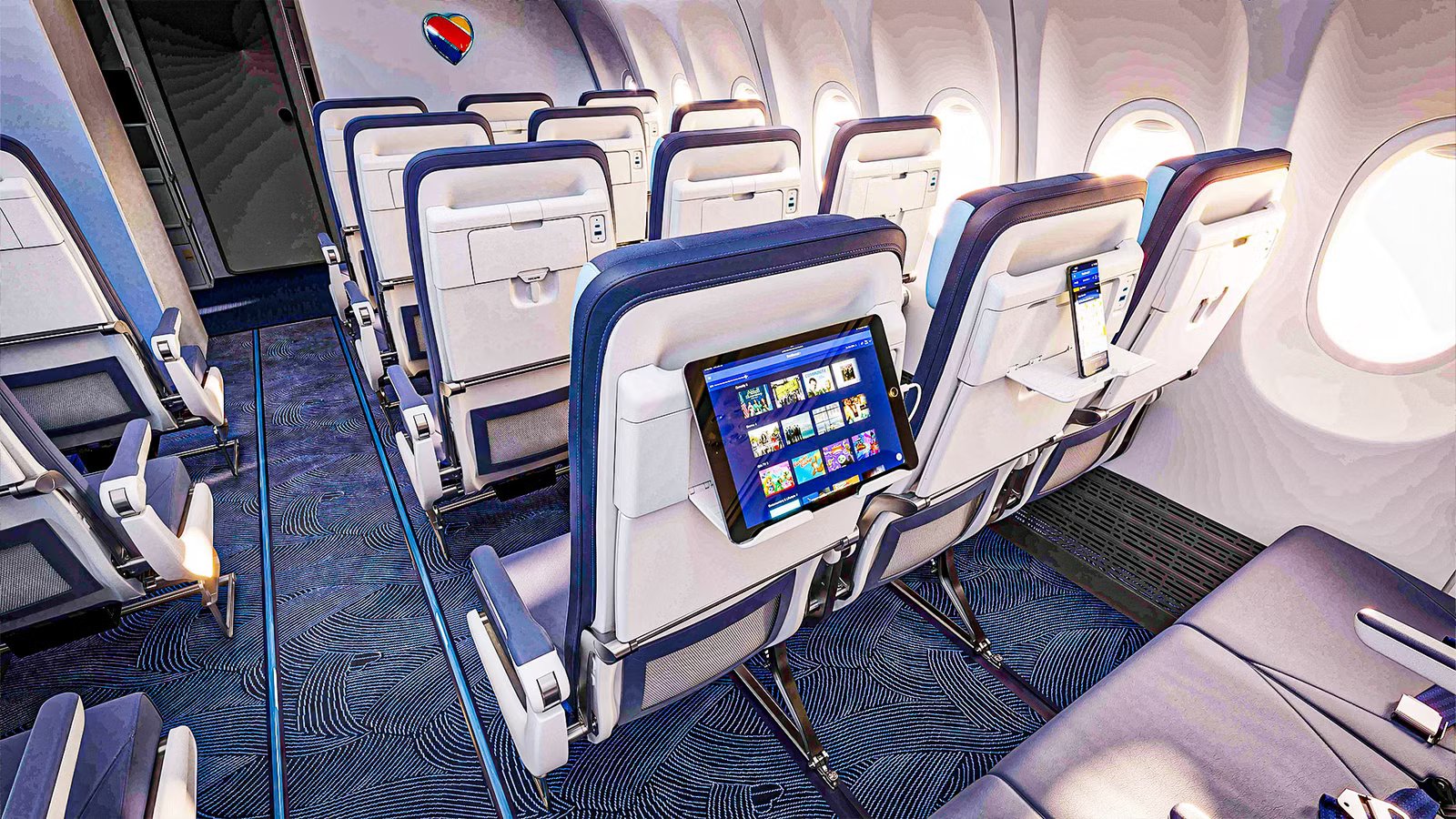
 Southwest Airlines has been transforming itself to become more aligned with the legacy carriers regarding product and business model. It now offers increased product options to appeal to premium customers, while also developing new fare types as part of a broader price segmentation strategy, and it’s added surcharges to lower-priced tickets for checked bags. Today, however, the real money is with premium cabins, and Southwest Airlines is still absent from this space.
The carrier rolled out extra legroom seats across its entire fleet, but this is mainly a method to better monetize existing economy seats, rather than offering a true domestic first class. The Dallas-based carrier is reported to be planning a premium cabin, but few details have been given, and it hardly appears to be the number one on Southwest’s priority list. Instead, it’s focusing on adding power ports and larger overhead bins, while also working on adding new lounge spaces at its operating bases.
A First Class For Southwest Airlines

Southwest Airlines has long only offered economy on its Boeing 737s, but economy tickets ultimately sell for low margins. Extra legroom seats are more profitable, but first class is the most lucrative cabin for domestic operations. With first class demand as high as ever, an airline that doesn’t offer it is simply leaving money on the table. This is why, in addition to the US legacy carriers, a comparable product is being planned by Frontier and is already offered by Breeze Airways, while JetBlue is planning its own domestic first class.
In addition to profit margins, domestic first class also serves to keep frequent flyer engagement high. Passengers generally do not aspire to fly in economy seats on domestic routes, but the opportunity to earn enough miles for award flights in first class is an aspirational goal, increasing credit card sign-ups. Airlines sell huge amounts of miles in bulk to credit card companies for much higher values than what passengers typically redeem them for, and US airlines in particular now generate nearly all of their profits from their loyalty programs.
Southwest CEO Bob Jordan has commented that the carrier is looking at a true domestic first class and possibly even lie-flat seating, although Jordan stopped short of confirming any plans. However, with the carrier already looking to expand its premium offerings, it’s all but assured to come eventually as the carrier is aligning itself with the legacy carriers rather than attempting to operate as a budget airline. Of course, even some low-cost carriers in the US are now offering premium cabins as well.
The Issues With Introducing A New First Class Cabin

American, Delta, and United all sell domestic first class seats on Boeing 737s, but what Southwest’s 737s lack is onboard ovens. The carrier only serves beverages and small snacks, but this won’t be sufficient for first class passengers who expect more robust service than economy. Passengers generally prefer hot meals, especially in premium cabins, but this can be resolved by retrofitting aircraft with ovens. It’s the galleys themselves that pose the bigger issue, or more specifically, their size.
Southwest does not install full-size forward galleys on its 737s, while its 737-700s feature small rear galleys (its 737-800s and 737 MAX 8s are equipped with full-size rear galleys). As such, it would need to retrofit its 737s with full-size forward galleys to accommodate additional trolleys that will be needed for enhanced first class service. The 737-700s may also require full-size rear galleys, depending on whether Southwest elects to further evolve service for economy passengers.
|
Aircraft |
Southwest Airlines Capacity |
United Airlines Capacity |
American Airlines Capacity |
Delta Air Lines Capacity |
|---|---|---|---|---|
|
Boeing 737-700 |
137 (all economy) |
126 (12 first/114 economy) |
N/A |
N/A |
|
Boeing 737-800 |
175 (all economy) |
166 (16 first/150 economy) |
172 (16 first/156 economy) |
160 (16 first/144 economy) |
|
Boeing 737 MAX 8 |
175 (all economy) |
166 (16 first/150 economy) |
172 (16 first/156 economy) |
N/A |
|
Boeing 737-900ER |
N/A |
179 (20 first/159 economy) |
N/A |
180 (20 first/160 economy) |
|
Boeing 737 MAX 9 |
N/A |
179 (20 first/159 economy) |
N/A |
N/A |
Southwest opted for these smaller galleys in order to provide added floor space for more seats, and installing full-size galleys will result in Southwest needing to install far fewer seats on its planes, likely closer to what the legacy carriers install on their 737s. Currently, the carrier’s layouts for its 737 fleet are relatively dense, resulting in lower per-seat costs, but the carrier still offers class-leading pitch for its extra legroom seats. If it installs first class, then it may need to reduce pitch for extra legroom seats, while overall capacity will drop.
Why US Carriers Are Doubling Down On Premium Cabins
Airline luxury is going mainstream.
A Lie-Flat Seat Onboard Southwest Airlines?

When asked about whether his airline would introduce lie-flat seating, CEO Bob Jordan did not rule out the possibility, but this comes with its own set of issues. Naturally, customers seated in a lie-flat first or business class seat will demand comprehensive meals, requiring the carrier to install larger galleys with ovens, but lie-flat seats themselves are also large and heavy. The 737 itself can accommodate any narrowbody-optimized lie-flat seat model, but it would require Southwest to significantly cut economy capacity.
Generally, the only routes within the US that generate a strong enough revenue premium to justify lie-flat seats are from New York and Boston to Los Angeles and San Francisco. However, while Southwest is making efforts to move upmarket, it has avoided serving these routes, and there’s little indication that the airline has an immediate desire to enter this market. It simply doesn’t align with Southwest’s business model, and these routes also rely heavily on corporate contracts that Southwest lacks.
|
Mahor US East/West Coast Airports |
Largest Airlines |
|---|---|
|
Boston Logan International Airport |
Delta Air Lines, JetBlue |
|
New York John F Kennedy International Airport |
Delta Air Lines, JetBlue, American Airlines |
|
Los Angeles International Airport |
Delta Air Lines, United Airlines, American Airlines, Southwest Airlines, Alaska Airlines |
|
San Francisco International Airport |
United Airlines, Alaska Airlines |
Southwest Airlines has set up partnerships with multiple European airlines and is reportedly planning nonstop routes to Reykjavik with its own metal. Iceland would be within the range of its 737 MAX 8s from most destinations in the Eastern part of the US, but it also does not always support lie-flat seats due to the short stage lengths involved. As such, while lie-flats could come to Southwest’s 737s in the distant future, this would be unorthodox in comparison to recliner seats.
What Southwest Could Opt For Instead

In Europe, the standard short-haul business class seat essentially consists of an economy seat with added legroom and a blocked middle seat, along with enhanced service. The benefit of this type of product is that it allows European carriers to dynamically size their cabins, allowing them to optimize supply for every flight. A similar product is also offered by LATAM and Avianca for short-to-medium length flights, and it’s been speculated that Southwest could opt for this rather than a dedicated recliner seat.
This type of product is already sold in the US by Frontier as ‘Upfront Plus’, which includes a seat in the first two rows of the aircraft with added legroom and an empty middle seat. While some airlines install a table in the center seat, Frontier does not. The benefit is that, although only four seats per row are being sold, the seats themselves have the same pitch as an extra legroom economy seat, which only results in a slight decrease in capacity. For Southwest, which may already need to remove seats to make way for larger galleys, this can be an appealing option.
The drawback, of course, is that these seats are less spacious than a standard recliner seat. For Frontier, the Upfront Plus seat is more of a stopgap measure, as the carrier is also planning a dedicated first class seat to slot above Upfront Plus. For Southwest, the carrier already does not offer seatback entertainment while often charging similar prices as the legacy carriers, which has led some to question the value proposition of its tickets. While this type of product would be space-efficient, it would represent a poor value unless it’s priced at a discount.
These Airlines Have The Most Spacious Seats For Economy Passengers In The US
Economy seat space varies widely among US airlines, with noticeable differences in legroom, width, and comfort.
Southwest’s Premium Push

In addition to adding extra legroom seats and exploring a full premium cabin, Southwest is also investing in its ground experience. The carrier has already secured a lease for a 12,241 square foot (1,137 square meter) lounge space in Honolulu, while also looking to build lounges in Nashville, Denver, and Dallas Love Field. Meanwhile, it’s secured space to build a 40,000 square foot (3,716 square meter) lounge in Austin, and while this space is officially labeled as a crew lounge, it’s more likely that this is actually intended for passengers.
Southwest Airlines is also believed to be working on a new co-branded premium credit card issued by Chase. Its current top credit card, the Rapid Rewards Priority Card, has an annual fee of $229, and it’s believed that the new credit card will have an annual fee ranging from $395 to $650, while including lounge access. While the legacy carriers do not include lounge access on domestic first class tickets, Southwest may introduce this perk on select routes to help monetize these spaces or include this benefit for its most loyal frequent flyers.
Southwest is looking to elevate its brand and add more premium products. A true premium product is necessary for the carrier to fully complete its transformation and become competitive with the legacy airlines. So far, Southwest hasn’t radically changed its network design, which points towards it offering a recliner-style first class seat rather than a lie-flat seat. However, it will require a significantly different layout with fewer economy seats and larger galleys, although this shouldn’t stop Southwest from pursuing first class.