dailynewsnblog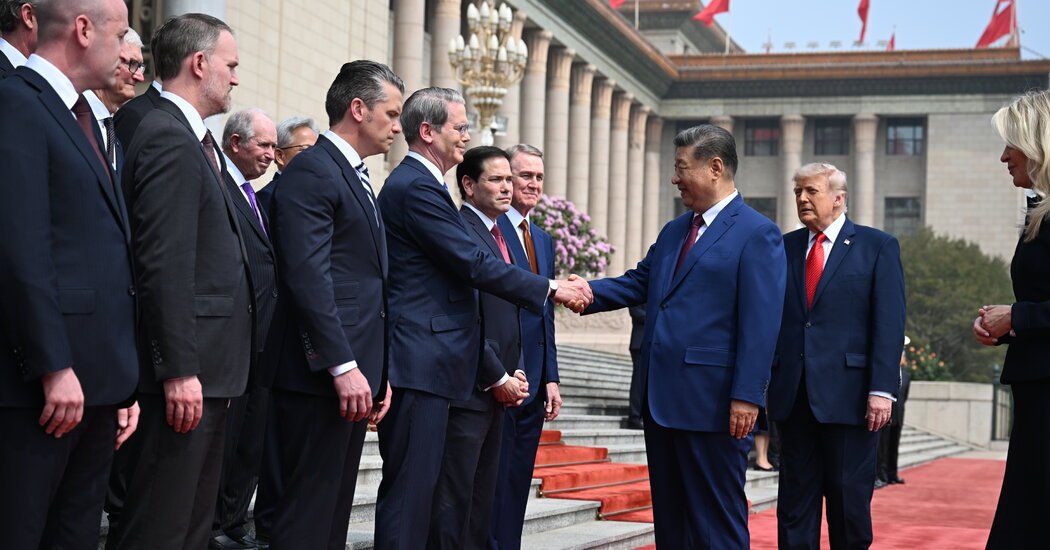
Top finance officials from the world’s wealthiest economies convened in Paris on Monday in hopes of devising a plan to contain the economic fallout from the war in Iran, which has sent global energy prices soaring and dragged down growth.
The meetings come at a fraught moment for the world economy and for the United States. After more than a year of imposing tariffs on its Western allies and threatening more, the Trump administration now needs the assistance of its fellow members of the Group of 7 nations to stabilize an economic crisis of its own making.
During the two-day gathering, the finance ministers also are expected to discuss sanctions policy, illicit finance and the future of support for Ukraine.
The summit comes days after President Trump met in Beijing with China’s top leader, Xi Jinping, to discuss ways to deepen ties between the world’s largest economies. Although Mr. Trump prefers to engage in bilateral negotiations, the challenge of dealing with Iran and confronting China’s control of the world’s critical minerals has forced the United States to lean on its traditional allies. That will be a tricky task given that Mr. Trump has spent much of his second term in office criticizing and threatening America’s closest allies, including Europe and Canada.
“I think there’s one lesson to be taken from the last six months, is that the law of the fittest doesn’t work,” Roland Lescure, France’s finance minister, said in an interview with The New York Times ahead of the meetings.
Mr. Lescure added that negotiations to reopen the Strait of Hormuz, which Iran has obstructed since the start of the war, have required international cooperation and that China’s export restrictions on minerals have called for a global response.
“When we saw that, you know, we felt that more than ever the G7 had a role to play, and that engaging in conversations, multilateral if possible, was the right way of addressing this,” Mr. Lescure said.
The U.S. delegation is being led by Treasury Secretary Scott Bessent, who traveled with Mr. Trump to Beijing. In addition to the usual G7 participants, representatives from India, South Korea, Brazil and Kenya are also attending.
Before the meetings in China last week, Mr. Bessent visited Japan and South Korea. He expressed concern about the weakness of the yen in Japan and in both countries held discussions about critical minerals and investment in the United States.
As the meetings started on Monday, Mr. Bessent urged his counterparts to work together to strangle Iran’s economy.
“We call upon all our G7 and indeed all of our allies and the rest of the world to follow the sanctions regime, so that we can crack down on the illicit finance that is fueling the Iranian war machine, and get this money back to the Iranian people,” Mr. Bessent said.
The global economy has been resilient in the face of a pandemic and Russia’s war in Ukraine. But the International Monetary Fund warned last month that disruptions to oil markets stemming from the Middle East conflict could slow growth, fuel inflation and raise the possibility of a global recession.
While the finance ministers gathered, concern was increasing over a global bond market sell-off that has been fueled by fears that higher energy prices will lead to a fresh bout of inflation.
“When oil prices hover above $100 and there is already impact of this war baked in, inevitably there would be a response,” Kristalina Georgieva, the managing director of the International Monetary Fund, said of the bond market volatility on Monday.
Ms. Georgieva said that policymakers needed to monitor the inflation situation carefully to ensure that they “don’t put in place measures that would make the situation worse.”
At recent G7 gatherings, U.S. tariffs have driven a wedge between Washington and its allies. Mr. Trump’s import duties continue to be a contentious issue this year.
“That’s not gone away,” said Josh Lipsky, head of international economics at the Atlantic Council. “So it’s hard to talk about cooperation with Iran economically when you have this hanging over their heads.”
European Union officials paused their work toward carrying out a trade deal with the United States in February after the Supreme Court struck down Mr. Trump’s sweeping tariffs.
Earlier this month, Mr. Trump vented his frustration about the lack of progress and he threatened to increase tariffs on European cars and trucks to 25 percent from the previously agreed 15 percent.
The United States gave the European Union until July to finalize the agreement, which Ursula von der Leyen, the president of the European Commission, said on May 7 was making “good progress.”
Russia could also be a point of contention between the Washington and the rest of the G7.
European nations were frustrated when the United States granted sanctions exemptions allowing the sale of some Russian oil as a way to contain oil prices that were rising because of the Iran war.
The general license authorizing the Russian oil sales was enacted in March and extended in April through last Saturday. The Treasury Department briefly allowed the exemption to lapse, but late on Monday, Mr. Bessent announced another 30-day reprieve that he said would help the most vulnerable nations access Russian oil that is currently at sea.
“This extension will provide additional flexibility, and we will work with these nations to provide specific licenses as needed,” Mr. Bessent said in a post on social media. “This general license will help stabilize the physical crude market and ensure oil reaches the most energy-vulnerable countries.”
Before that announcement, Mr. Lescure said that the meetings will include discussions about how to increase support for Ukraine, whose finance minister will be in attendance, and about the future of Western sanctions on Russia.
“We need to have a conversation to make sure that we all agree on one, Ukraine needs to be supported, and two, Russia shouldn’t be a winner of that conflict,” Mr. Lescure said.
The United States has been facing pressure from its allies to be tougher on Russia going forward.
“Now is not the time to release sanctions pressure against Russia,” said Valdis Dombrovskis, the European commissioner responsible for the trade bloc’s economy. “Instead, we actually need to enforce and strengthen that pressure.”