dailynewsnblog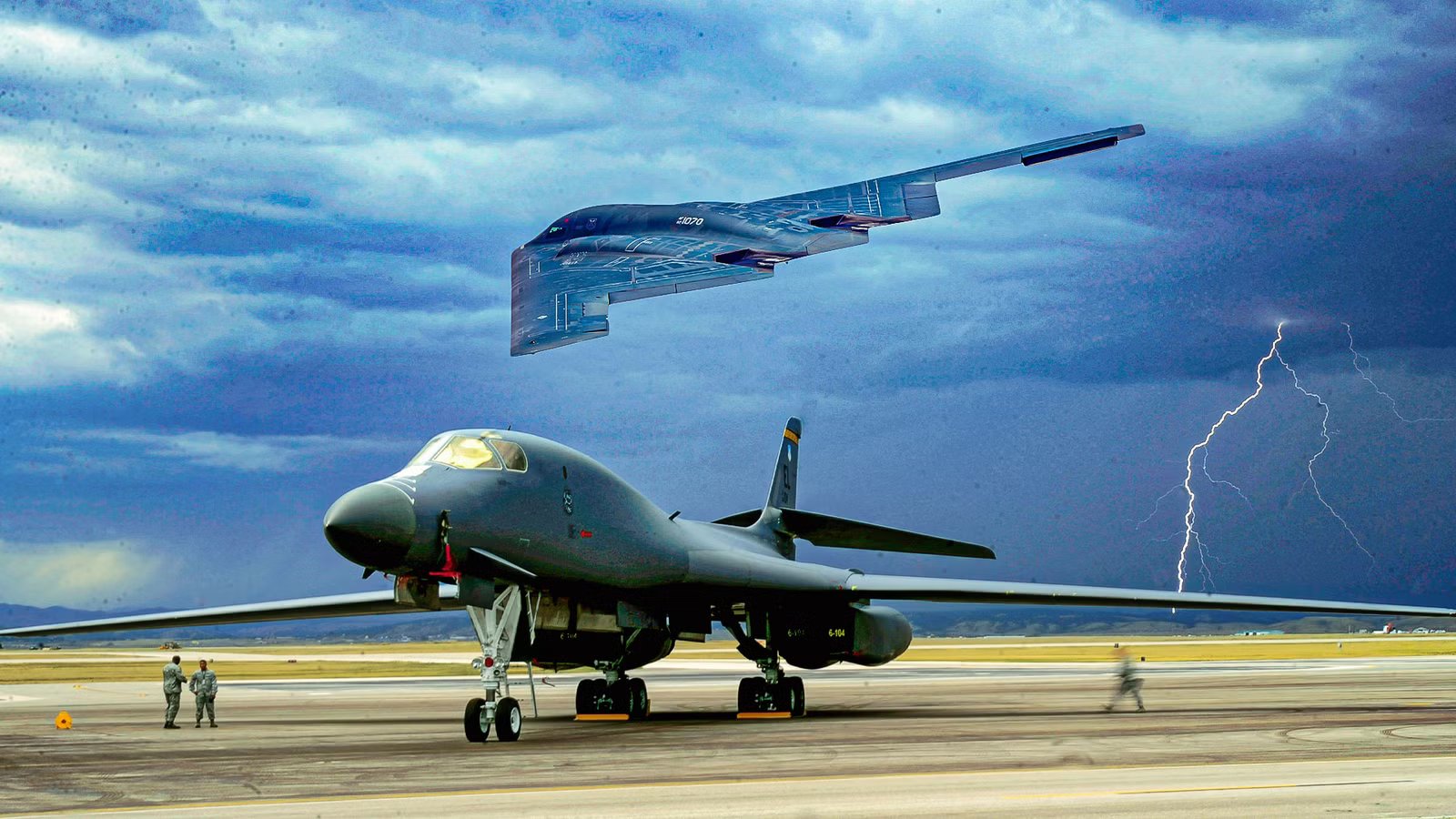
Following the debut of the Northrop Grumman B-21 Raider, the US Air Force is known to be working towards a two-bomber fleet with B-21 and  Boeing B-52J Stratofortress. At the same time, the legacy NG B-2 Spirit and Rockwell B-1 Lancer are also being extended to avoid a capability gap. Crucially, until the B-21 is fielded in full numbers, the B-2 remains the only fully combat-ready stealth bomber in the world. For that reason, the USAF recently committed nearly $1.7 billion to modernize the legacy fleet through the late 2030s.
While the B-52 Stratofortress may have been first introduced in the 1950s, it remains just as valuable today thanks to its evolution into a missile truck platform. Despite being nearly 70 years old, it is slated to remain in service through the 2050s, potentially reaching a full century of operation. The B-52 no longer needs to penetrate enemy airspace and is now being used to test and deploy new hypersonic weapons like the Mako and HACM, which stealth bombers cannot carry externally.
The B-21 Raider is expected to enter operational service around 2027, but reaching full-rate production will take time. The Pentagon plans to buy at least 100 B-21s, but experts suggest the US needs closer to 145 to 200 to meet global demands. In the ‘high-low’ mixed fleet, the B-21 and B-2 will penetrate contested airspace while the B-52J and B-1 stay in permissive airspace, launching massive volumes of standoff missiles once the stealth bombers have opened the door.
Two-Pronged Strategic Strike

In a strategic two-pronged strike, the B-1B and B-2 act as a ‘Hammer and Scalpel’ combination. While the B-2 stealthily dismantles the enemy’s ‘eyes and ears,’ the B-1B provides the overwhelming mass required to shatter their remaining infrastructure. Once the B-2 has neutralized the deadliest threats, the B-1B Lancer arrives to exploit the opening with massive volume.
The B-2 Spirit is the USAF’s primary ‘door kicker.’ It uses its stealth profile to penetrate A2/AD bubbles or areas protected by advanced systems like the S-400. By blinding the enemy and suppressing their surface-to-air missiles, the B-2 creates a ‘sanitized’ corridor for non-stealthy aircraft to enter.
While a B-2 can carry 16 heavy bombs, a B-1B can carry 24 to 48, depending on the configuration. The Bone provides high-capacity saturation. It focuses on ‘wide-area’ targets that require sheer tonnage: airfields, motor pools, industrial complexes, and troop concentrations. Even if the air defenses aren’t fully suppressed, the B-1B can launch JASSM-ER missiles from 600 miles away, allowing it to contribute to the ‘Scalpel’ phase without entering the danger zone.
Centurion: The Enduring Mission Of The BUFF

The B-52 Stratofortress is slated to remain in service until at least the 2050s, potentially reaching a century of flight, while the much younger B-1B Lancer is scheduled for retirement in the early 2030s. Designed in the 1950s using conservative engineering and ‘over-built’ airframes, the B-52 has shown remarkable resistance to structural fatigue. The B-52 excels as an arsenal plane and is slated for a host of upgrades with plans for air-launched hypersonic missiles in the future.
The B-1B was ‘flown to the limit’ during decades of constant use in the Middle East. Its variable-sweep wings and low-altitude mission profile are far more taxing on the airframe, leading to chronic structural issues and abysmal readiness rates. At one point, as few as six B-1Bs were mission-capable across the entire fleet. The B-1B requires roughly 74 to 150 maintenance hours for every flight hour, or about double that of the B-52.
While the US Air Force is decommissioning Rockwell B-1 Lancer supersonic bombers, it has invested $7 billion dollars in modernizing its fleet of Northrop Grumman B-2 Spirit stealth bombers. The iconic swing wing ‘Bone,’ as the B-1 is known, has been worn down by years of more intensive flying due to its higher-performance design and mission assignments.
The Air Force Of The Future: The High-Low Bomber Fleet

That means that the B-2 will serve alongside its successor, the smaller 6th-gen B-21 Raider. The USAF had a plan to divest its 19-strong fleet of aging B-2 fifth-generation bombers by 2032, but the revised bomber strategy has been updated to keep the larger and higher payload stealth flying wings longer.
Two of the most important factors in the retention of the B-2s are recent innovative repair processes that have saved up to 75% on Spirit bombers, coupled with its ordnance capacity of 60,000 pounds. The incoming twinjet B-21 is estimated to have a payload of between 30,000 and 40,000 pounds, making the older B-2 quadjet’s payload up to double that of the new bomber. Unfortunately for the older and wearier B-1s, there have been no breakthroughs to keep them in service longer than their planned expiration date.
In the future AFGSC strategy, the B-21 Raider will be the ‘hammer,’ penetrating deep into enemy territory to destroy critical nodes, while the B-52J serves as the ‘anvil,’ providing massive, sustained firepower from the periphery. The B-52J upgrade transforms the aircraft from a legacy bomber into a high-tech digital node. The planned modernizations specifically address the logistics, connectivity, and lethality required to operate in contested environments like the Indo-Pacific.
The 4 Largest Bomber Fleets In The US Air Force
A closer look at some of the biggest warbirds in America.
Stratofortress On The Frontline: Agile Combat Employment

The newly upgraded B-52 will be a cornerstone of the Air Force’s Agile Combat Employment doctrine. Under the new ACE strategy, the USAF is focusing on dispersing forces to unpredictable, austere locations to increase survivability. One of its main advantages is the ruggedness, which allows it to deploy to many airfields with limited support, but that is complemented by a unique performance feature as well, one which will be enhanced by the B-52J upgrades.
The two-billion-dollar transformation from the B-52H to the B-52J will see Boeing and Rolls-Royce work together to future-proof the BUFF. RR will replace the 1960s-era TF33 engines with eight Rolls-Royce F130 turbofans. These engines are expected to be 30% to 40% more fuel-efficient, significantly extending the bomber’s unrefueled range.
Unlike many aircraft, which require a lengthy preparation on the ground, the BUFF can launch in just 10 minutes. The B-52 is capable of a cartridge start, allowing it to start all eight engines simultaneously and take off rapidly. Recent exercises have demonstrated that B-52s can land at non-bomber airfields, receive rapid repairs and resupply, and be back in the air within a few hours. Its 8,800-mile unrefueled range also allows it to reposition quickly across theater boundaries, a core requirement for ACE maneuvers.

The Real Reasons Why The B-2 Spirit Won’t Be Retiring Before The B-1 Lancer
The USAF’s Flying Dorito is outlasting the mighty Bone.
America’s Bomber Fleet In 2026

Air Force Global Strike Command is currently undergoing an era of significant transformation to balance sustaining today’s force with modernizing for tomorrow’s fight. The current bomber fleet is actively moving towards consolidation into just two types. The fleet is expected to see significant growth in the total number of airframes over the coming decades.
With efforts ongoing to sustain force levels until B-21s can arrive en masse, there are just over 140 bombers in service. Here is the current official number of bombers in the USAF, according to data released by Air & Space Forces Magazine:
|
Type |
Inventory (Airframes) |
Average Age (Years) |
|---|---|---|
|
B-1B Lancer |
46 |
39.4 |
|
B-2A Spirit |
20 |
29.8 |
|
B-52H Stratofortress |
76 |
64.8 |
|
B-21 Raider |
2 |
1.0 |
In terms of readiness, the oldest airframe in the fleet is one of the most reliable. The B-52 consistently maintains a mission-capable rate of around 66-80%, whereas the B-1B often struggles below 50%. Similar to the Lancer, the average mission-capable rate for the B-2 Spirit fleet is currently approximately 52% to 56%.
Historical and recent reports indicate that the B-2 fleet consistently operates at lower readiness levels than other aircraft due to its complex stealth maintenance requirements. This has made the Stratofortress the best investment as a complementary platform to the B-21. So while the B-2 is being extended, the B-52 is the only legacy airframe getting a true second lease on life to serve alongside the new Raider in the future.

The World’s Largest Air Forces By Number Of Bombers
The world’s biggest fleet of ‘big wing’ warbirds.
The First 6th-Gen Bomber: Built For Expeditionary Ops

The B-21 Raider replaces the B-1B and B-2 by shifting from a high-maintenance ‘niche’ force to a high-readiness, digitally-integrated fleet. It specifically adapts the B-1B’s close air support and surgical strike missions for the 21st-century’s more dangerous airspace. Unlike the B-1B, which must remain at a distance from advanced air defenses, the B-21’s all-aspect stealth allows it to loiter directly over a high-threat battlefield to provide on-call support for ground forces.
The B-21 is a cornerstone of the Agile Combat Employment strategy. The Raider can deploy to hardened shelters and runways made for standard fighter jets during the Cold War, which exponentially opens up its deployment options.
It can operate from smaller, austere, or allied airfields that couldn’t accommodate the massive B-2, making it far more flexible in regions like the Indo-Pacific. Not only does this make it more combat effective, but this actually significantly reduces the ability of an adversary in a near-peer conflict to target the B-21 on the ground.
The B-21 solves the chronic readiness failures of the B-1B and B-2 with a more resilient design, and its open systems architecture allows it to carry a broad mix of direct-attack and standoff munitions. These advances replicate the B-1B’s massive firepower, but with the ability to ‘plug and play’ as future, smarter weapons are introduced.