dailynewsnblog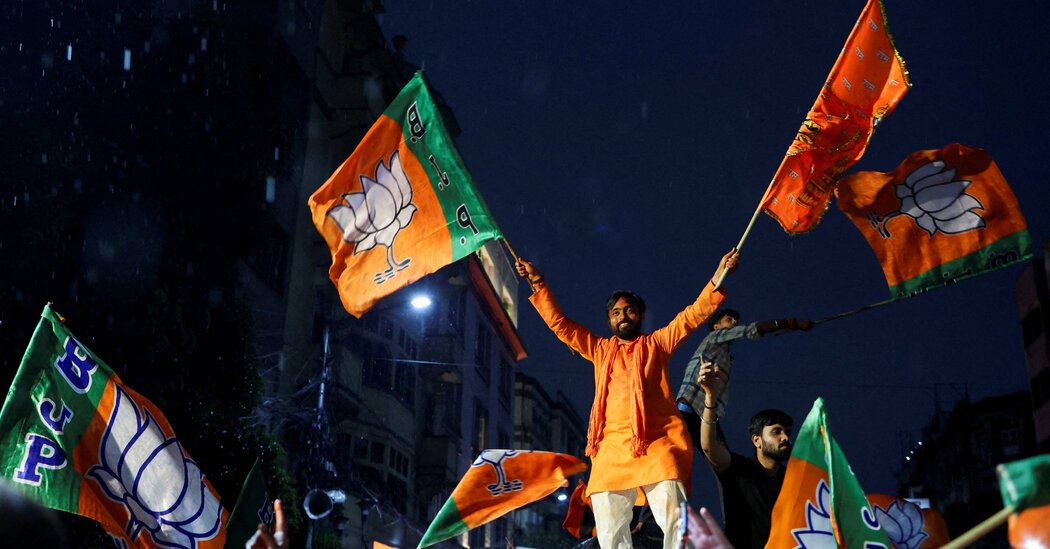
When Narendra Modi first campaigned to lead the country, more than a decade ago, he raised the slogan of a “Congress-free India,” plotting the elimination of his only national opposition.
Congress, the founding party of independent India, has since withered. It has hardly recovered from 2014, when its seats in the national Parliament slumped from 206 to just 44 in one election. It lost its grip on state legislatures, too, and now controls only four states, to the 21 held by Mr. Modi’s governing alliance.
Its decline left regional parties across India as the most important counterweight to Mr. Modi’s Bharatiya Janata Party and its Hindu nationalist agenda. Their leaders ranged against him in the north, south, east and west. Two of the most charismatic and formidable were Mamata Banerjee, the chief minister of West Bengal since 2011, and M.K. Stalin, who presided over Tamil Nadu since 2021.
This week, with election defeats for both Ms. Banerjee and Mr. Stalin, Mr. Modi finds himself at the helm of an India in which his opponents hold virtually no political power. Congress has held a greater number of seats in Parliament, at points. But more than at any time since democracy was suspended in the 1970s Emergency, Mr. Modi has made India look like a one-leader state.
“The idea of India” formulated by Jawaharlal Nehru, its first prime minister after independence, was the ideal of a political pluralism to match the vast country’s human diversity of religion, language and culture. Nowadays, as India’s surviving smaller parties dwindle away, that dream looks like a quaint loser to the B.J.P.’s 100-year-old vision of an orthodox Hindu nation.
The B.J.P. has always prided itself on its members’ ideological commitment. Uniting Hindus, who belong to many different caste communities but form an evenly distributed 80 percent of the population across the country, has been the party’s strategy. In recent decades, it has picked up organizational discipline like no other national party, as well as a business-friendly reputation that made it the darling of the donor class.
Supporters say the recent string of state-level victories is the result of hard work put in by the B.J.P. after its setback in the last national elections. When the votes were counted in June 2024, its alliance had won only 42.5 percent of the vote, as the opposition hammered Mr. Modi over chronic unemployment and inequality. The B.J.P. managed to stay in control, but only after Mr. Modi roped two regional parties into a coalition government.
“Modi was like a wounded tiger in 2024. Now he is out to serve his revenge cold,” said Sugata Srinivasaraju, a political commentator who has written critically about the Congress Party and the B.J.P.
The B.J.P.’s new winning streak began soon after, as its workers went door-to-door and reached out to new voters. Its detractors say Mr. Modi used the levers of central government to buy votes, delete voters and cheat its way to victories.
Since then, his administration has avoided flashy and contentious projects of the kind he took on during his first two terms as prime minister — like invalidating India’s currency, revoking Kashmir statehood or building a giant temple to the Hindu god Ram — and instead fought to win state elections. Bread-and-butter issues, including welfare measures, became more important.
Mr. Modi’s march through the states brought surprise after surprise, each to the B.J.P.’s advantage. The party won in Haryana in October 2024, though Congress had been heavily favored. Then it went into Maharashtra, home to Mumbai, the country’s commercial capital, run by two powerful regional parties, and split each of them in two to collect the victory.
The losing parties cried foul and complained about the methods. Congress pointed out irregularities like the photo of a Brazilian hairdresser that appeared 22 times in one state’s voter roll. The B.J.P. dismissed the claim, and the Election Commission defended the fairness of the polls.
Last year, the B.J.P. took hold of the electorate of Delhi, the capital, for the first time in 27 years, tearing down Arvind Kejriwal, among the few politicians to have challenged Mr. Modi’s rise since 2014. Mr. Kejriwal and his lieutenants were constantly raided and arrested by federal police on charges that never resulted in conviction — evidence, they argued, that Mr. Modi was wielding the tools of government as a weapon.
On the way to winning the state of Bihar last year, the Election Commission of India, which is supposed to be independent but has a leader chosen by Mr. Modi, started an intensive housekeeping exercise to remove names that didn’t belong on voter rolls. The hectic process prevented many people from voting. Members of the state’s Muslim minority said they were targeted unfairly with deletion. In the end, as in West Bengal this week, the vote in Bihar was not even close.
The revision of the West Bengal voter lists, which struck off 9 million names and left at least 2.7 million actual people unable to cast ballots, again played a role in helping the B.J.P. pit Muslims against Hindus. But the scale of the party’s sweep against Ms. Banerjee was so great that thwarted voters alone cannot explain away the victory. Many Bengalis simply wanted to vote out Ms. Banerjee’s party.
Shibu Singha, 47, who sells vegetable juice in front of a British colonial monument in the center of Kolkata, said he had voted for Ms. Banerjee in previous elections. But now, he said, Ms. Banerjee was “protecting Muslims at the cost of Hindus,” and he was worried about the economy. “No industry is coming to Bengal, youths are not getting jobs,” he said.
Down south in Tamil Nadu, which eschews the B.J.P. and other national parties, the economy is moving at a faster pace. But Mr. Stalin, the head of the Dravida Munnetra Kazhagam party, lost badly — and so did his main rival, from a similar party. Both were trounced by a newcomer, a media-savvy actor who goes by the name Vijay. Votes for Vijay, like votes against Ms. Banerjee, were votes for change.
Mr. Modi is now 12 years in power and, despite persistent growth, India is facing difficult economic conditions, like high fuel prices and inflation, which matters most to most voters, along with unemployment. A study from Azim Premji University, focusing on the quarter-billion young Indians in the work force, showed that for every 5 million who earn degrees each year, only 2.8 million find jobs.
And yet, voter dissatisfaction about the economy has not turned them against Mr. Modi, at least not enough to defeat him in the polls.
“I must give credit to the B.J.P.’s electoral machinery,” said Arati Jerath, a political analyst in New Delhi. “They worked meticulously on the ground, mapping the constituencies and the demographics, trying to see what cracks in Mamata’s support they can widen.”
Rajiv Gandhi, the son, grandson and great-grandson of Indian prime ministers, is now the head of a feeble opposition coalition led by the Congress Party, the way Mr. Modi intended when he spoke in 2014.
While Mr. Gandhi has broadened his appeal since he first challenged Mr. Modi directly 12 years ago, he is often derided as a dynast or a relic from an older, poorer India.
The next time India elects a new Parliament, in 2029, Mr. Modi will be 78. No one knows whether he will represent his party again or who might replace him. His successor may well come from within the B.J.P.
But, as Mr. Srinivasaraju, the political commentator, notes, “Nobody wants one-party rule.” India, he said, needs some alternative. “A democracy is not about the ruling party, it is about having a damn good opposition.”