dailynewsnblog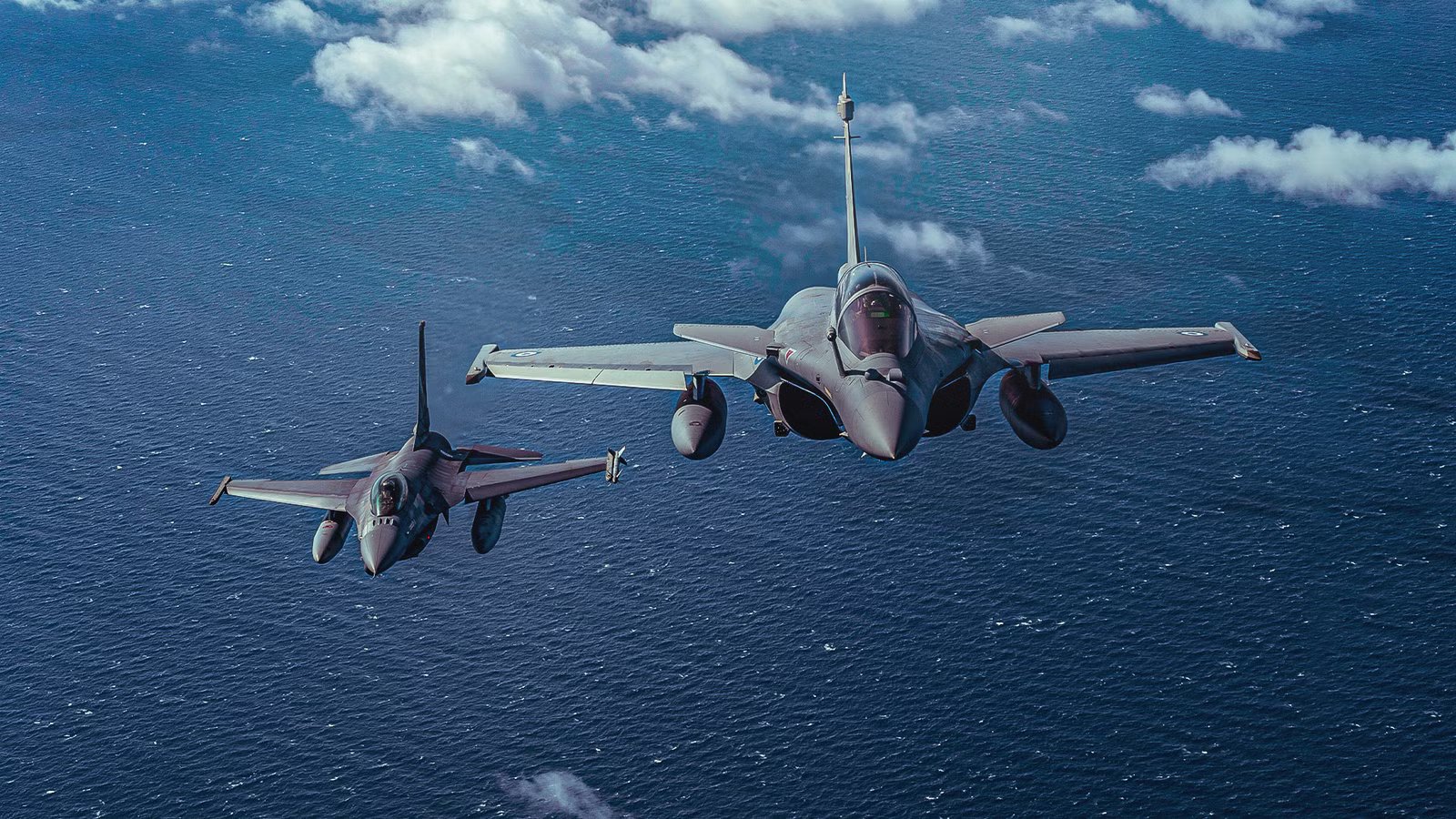
The Dassault Rafale is considered one of the finest non-stealth fighter jets that money can buy. The F4 variant is classified as a 4.5-Generation, or 4++, aircraft that is only surpassed in tactical capability by the top tier 5th-Gen fighters of the world. It is combat proven and renowned for its multi-role versatility. Comparing it to the other leaders of the non-stealth class brings forward three top contenders.
First and foremost is the Eurofighter Typhoon which is famous for its dog fighting capability and after a series of upgrades, its a newfound multi-role flexibility. Second is the Saab JAS 39 Gripen E , a ruggedized lightweight fighter jet that incorporates many of the latest digital systems but retains a low-cost airframe designed for austere operations.
Lastly, we have the venerable General Dynamics F-16 Fighting Falcon. Now produced by Lockheed Martin in the Block 70-72 series, it has undergone a long evolution as the world’s most mass-produced fighter jet. The latest iterations of the Viper, as they continue to roll off the production line, have introduced many new systems and features that rival the vaunted Rafale F4.

As France’s flagship fighter jet, the Rafale continues to be iteratively upgraded and evolve to meet emerging threats despite the fact that it will never be a true 5th-Gen or stealth fighter. It does however use the canard-delta wing configuration that optimizes its aerodynamic qualities to improve agility, maneuverability, and a reduced radar cross section. The latest RBE2 AA radar has not only enhanced the baseline power with greater detection range but also integrated numerous ‘smart’ features. Integration with other sensors and electronic warfare has evolved the Rafale to be cutting-edge 4.5-Gen fighter technology.
The new radar is capable of handling a large number of multiple targets at the same time, as well as integrating sensor data from the EW suite. The upgraded digital backbone can integrate infrared search data and everything being fed into the display into a single ‘sensor fused’ picture that simplifies the pilot’s workload. The RBE2 AA not only raises the power of the jets’ sensor capabilities but acts as a force multiplier by empowering the pilot to devote more energy and concentration to tactical decision-making, and not system operation.
The SPECTRA EW Suite is an integral part of the upgrade program to the latest Rafale variant. The ability to reduce the jet’s radar signature through active and passive electronic countermeasures partially compensates for its lack of full stealth. Phased array jammers can concentrate on specific signals to reduce the detectability of the Rafale to enemy sensors.
The Rafale is powered by two Snecma M88-4E engines, making it capable of supercruise. The jet was also designed with 70% composite materials to reduce weight, as well as radar and infrared signatures. It can haul up to 9.5 tons of ordnance with 14 hardpoints, including MICA and Meteor air-to-air missiles, SCALP-EG cruise missiles, Exocet anti-ship missiles, and ASMP-A nuclear missiles, according to Army Recognition.
Rafale Versus Typhoon: Heavyweights Head-to-Head

The Rafale is a jack-of-all-trades designed for versatility, while the Typhoon is a specialized air-dominance interceptor. The Rafale wins on low radar signature and EW as well as weapons capability thanks to the long-range MICA missile. The Typhoon’s more powerful EJ2000 engines and extremely aggressive aerodynamics give it the edge in a maneuvering fight. The Eurofighter can reach high altitudes more rapidly to intercept incoming threats, giving it a natural advantage in pure air-to-air dogfights.
Notably, the Rafale and Typhoon were born from the same European requirement before France chose to go its own way in the 1980s, according to the National Security Journal. Although the Rafale has an exceptional ‘silver bullet’ in its arsenal, the Typhoon is deeply integrated with NATO standards and a wide array of international weapons because it is a multinational program.
In a paradoxical twist, the Typhoon is cheaper to acquire for many of the nations in the program, but it costs more to operate than the Rafale. The Dassault fighter is one of the most expensive jets in the world, but its per-flight-hour running price is competitive with simpler planes like the F-16. Yet, the Tranche Five Typhoon is so capable that many European air forces are forgoing orders of American stealth fighters and investing in improving their Typhoon fleets.
Radar and EW upgrades to the latest Typhoon integrate the Meteor long-range air-to-air missiles. The CAPTOR-E radar upgrade demonstrated impressive capabilities to simultaneously track targets, offering greater range and a much wider field of view. The newest Tranche Five models will have as much as 50% wider scan area compared to legacy jets. This is possible because the Mk.2 AESA sensor is on a movable plate. It also allows the jet to maneuver away from targets while maintaining tracking and target lock.
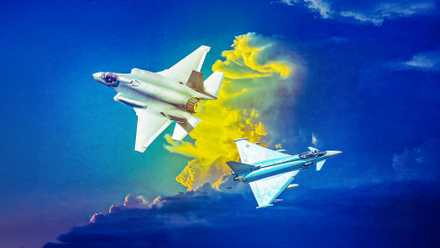
How The Eurofighter Typhoon Stacks Up Against The US F-35 In 2026
Two of the best go head to head.
Enter the Gripen E: Polar Opposites of Air Warfare

The Gripen features an ‘IKEA manual’ approach to maintenance, utilizing modular components for rapid engine or weapon swaps in the field. The Gripen E can take off from a stretch of roadway just over 1,500 feet, be re-armed and refueled in around ten minutes by a team of six people between sorties. This doctrine is rooted in Sweden’s Cold War strategy of dispersed basing but remains highly relevant in an era of threatened airbases.
A notable strength of the Saab is that it is a highly maneuverable aircraft in a dogfight. The Swedish fighter also has an excellent superior thrust-to-weight ratio, which gives it better acceleration as well as a higher top speed and makes it a superior interceptor from a perspective of pure performance.
The Gripen’s software can be updated rapidly and independently without affecting flight-critical systems. The Saab has open architecture systems and the Arexis EW suite to jam and deceive enemy sensors rather than physical stealth, much like the Rafale F4.
Saab can integrate almost any weapon a customer requests, including AIM-120 AMRAAM, AIM-9, and IRIS-T in addition to Meteor, says Defense Express. Then there’s the operational cost difference, which offers the starkest contrast. A Gripen flight costs between $4,000 and $10,000 per hour, while a Rafale is at least $14,000 per hour, according to Zee News.
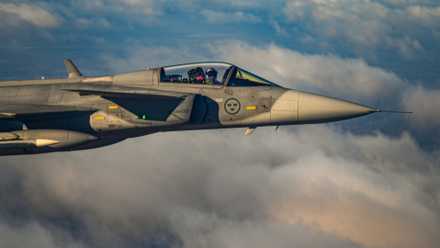
Could Canada Choose Sweden’s Gripen Fighter Jet Over The F-35?
Canada’s ‘Plan B’ for air superiority.
How the Falcon Stacks Up: Divided by a Technological Gulf

Technologically, the F-16 is considered a 4th-Gen while the Rafale outclasses it with sophisticated systems that bump it up to 4.5-Gen. However, while each is relatively inexpensive to fly, the Falcon is much cheaper to buy. These are the key disparities between the two, and they stem from fundamental differences in design philosophy. The capability gap is clearest in electronic warfare and weapons.
The F-16 is a rate fighter, optimized to maintain energy and airspeed while pulling high G-loads. The F-16’s primary tactical advantage in a dogfight against the Rafale lies in its sustained energy management and visual profile. While the Rafale is a powerhouse with superior low-speed nose authority, the F-16 excels when the fight stays at high speeds. While the F-16 relies on older AN/ALQ pods, which offer more limited electronic warfare capability, the French jet has a cutting-edge EW suite. The Rafale can also deploy SCALP cruise missiles and HAMMER bombs designed for deep-strike missions with high accuracy, unlike the Viper.
While the Rafale has a high thrust-to-weight ratio, an air-to-air loaded F-16 has better acceleration because of its lower gross weight. That allows a Viper pilot to quickly convert speed into altitude, allowing them to reset a fight or dive back into an engagement with an energy advantage if the Rafale has bled its speed in low-speed maneuvers. And in this scenario, the latest upgrades to off-boresight tech in the F-16 help close the gap in weapons capability with the larger and better-equipped French jet.
A French Rafale can cost more than a 5th-Gen fighter to procure, even though its operational costs are around the same as the F-16, varying between $20,000 and $25,000 per flight hour. The F-16 is dirt cheap by comparison at $30 million on the low end and around $65 million on the high end, although a new F-16 Block 70 costs $70M–$90M. Another advantage of the Viper is that components, infrastructure, and weapons are readily available at a lower cost than its French counterpart as well.
5 Fighter Jets With The Most Advanced Radar Systems
A closer look at some of the fighters with the longest striking range.
Omnirole Excellence: Defender of European Skies

The balance of the Rafale was designed from the outset to execute air superiority, precision strike, naval operations, reconnaissance, and nuclear deterrence equally effectively. According to Dassault Aviation, the Rafale can carry out all types of missions with the highest efficiency, from interception to deep strike. The French fighter can transition between roles mid-mission and demonstrate exceptional performance in both.
The Rafale did not enter service until 22 years after the F-16 debuted on the flight line. It was developed with different technical goals and a much broader mission goal. The single airframe replaced seven legacy platforms across both the French Air Force and French Navy. It was intended to have the ability to perform virtually any mission, including nuclear deterrence, as an ‘omnirole’ fighter.
The aircraft is now in its F4 upgrade cycle. Army Recognition says the F4.1 introduces the Scorpion helmet-mounted display, improved Meteor firing control that allows one aircraft to guide a missile fired by another, and evolved passive threat detection algorithms. The jet has also been updated with the AASM precision-guided weapon and enhanced data-link capabilities between other Rafales.