dailynewsnblog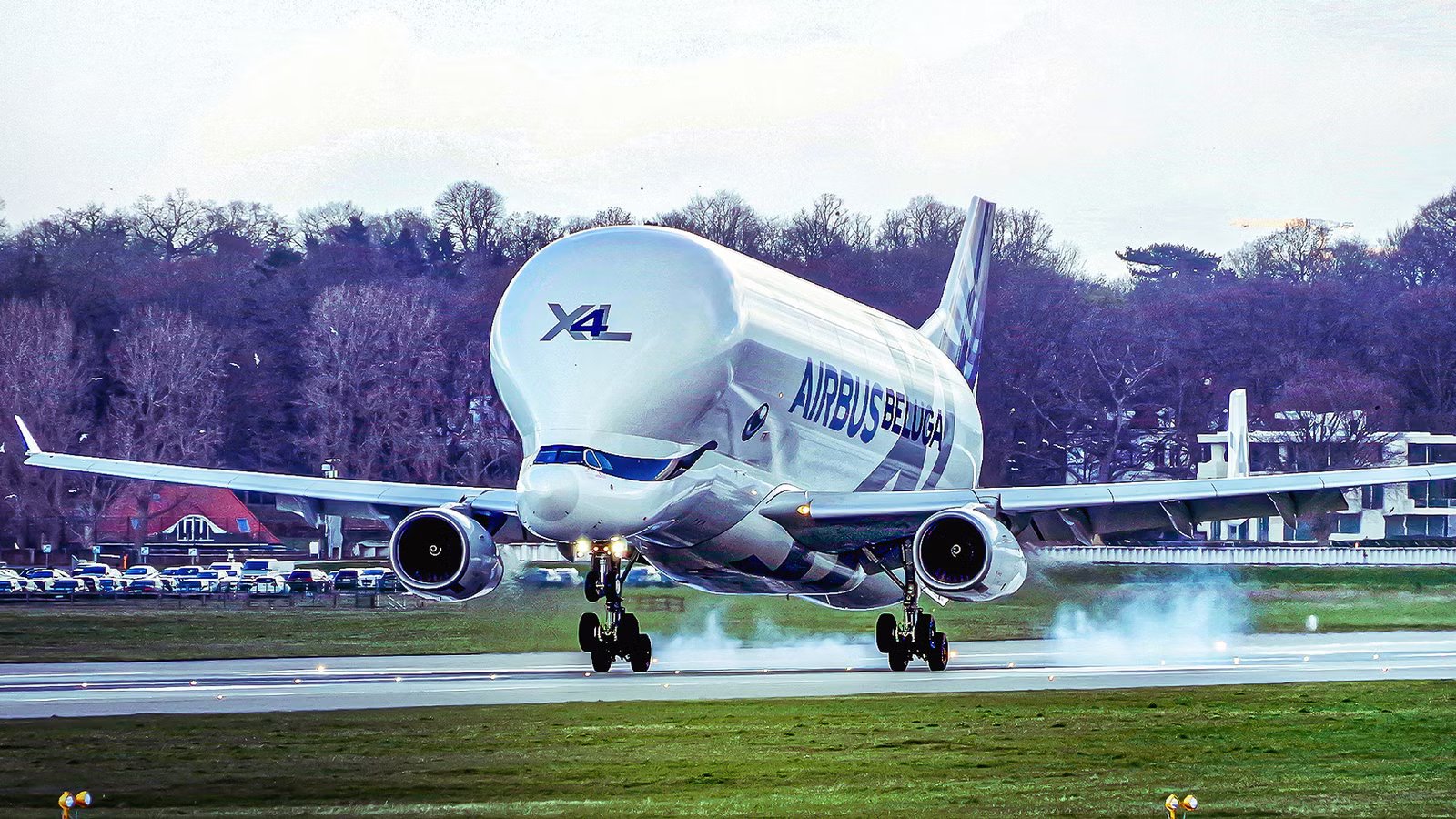
At first glance, the Airbus BelugaXL looks like a flying cartoon. Its bulbous upper fuselage and painted grin have made it a viral favorite, frequently appearing in photos and social media posts that celebrate its uncanny resemblance to a whale. It is a favorite among plane spotters, and is a sight that many enjoy seeing. Yet the Beluga XL’s design is not a stylistic flourish or a marketing gimmick.
Rather, it is the visible result of a deeply complex engineering challenge that Airbus had to solve: how do you attach a cargo hold larger than the aircraft’s original fuselage onto a standard airliner platform and still maintain structural integrity, aerodynamic efficiency, and safe flight characteristics?
That challenge led to one of the most unusual yet purposeful design decisions in modern aviation: the lowered cockpit. While it may seem like a minor detail compared to the aircraft’s massive cargo bubble, it is in fact central to making the entire concept work. Understanding why requires a closer look at how the Beluga XL was conceived, what it carries, and how engineers reshaped an existing aircraft into something entirely new.
From A330 To Beluga XL: Scaling Up An Airframe

The Beluga XL is based on the Airbus A330-200 freighter platform, but calling it a modification understates the scale of the transformation. Airbus needed a successor to its earlier Airbus BelugaST fleet, which itself was derived from the A300. As production demands increased, especially with the introduction of the Airbus A350 XWB program, the existing transport system could no longer keep up. The solution was to create a new aircraft with significantly greater cargo volume.
The Beluga XL offers about 30 percent more capacity than its predecessor, with the ability to carry payloads of up to 51 tonnes. Its cargo hold measures over 150 feet in length, 25.3 feet in width, and nearly 25.9 feet in height. This makes it large enough to transport two A350 wings simultaneously, a task that would otherwise require multiple flights or disassembly. The table below highlights this capability. It is important to note that while the root chord length of the A350-900 wing is wider than the cargo hold dimension, the sweep angle of the wing means this dimension can fit inside the hold with ease when placed at an angle.
|
Aircraft |
Length (feet) |
Width (feet) |
|
BelugaXL cargo hold |
150 |
25.3 |
|
A350-900 wing |
106.2 (semi-span) |
44.2 (root chord) |
However, increasing cargo volume was not as simple as stretching the fuselage. The Beluga XL’s defining feature is its enormous upper fuselage, which sits atop the original A330 structure like a bubble. This creates a fundamental structural problem. Aircraft fuselages are designed as pressurized tubes, carefully balanced to distribute stress evenly. Adding a second, larger structure on top disrupts that balance and introduces new loads that the original airframe was never designed to handle.
To address this, Airbus engineers introduced over 8,000 new parts in the junction area where the enlarged cargo hold meets the base fuselage. Advanced manufacturing techniques, including Peen Forming, were used to shape large fuselage panels with precise curvature. These modifications allowed the aircraft to maintain structural strength while accommodating its oversized cargo compartment.
Why The Cockpit Had To Move

One of the most immediate consequences of adding a massive cargo bubble above the fuselage is access. Traditional cargo aircraft often use side-loading doors or hinged noses to load freight. For the Beluga XL, Airbus opted for a large front-opening cargo door, which allows entire aircraft components to be loaded directly into the hold. This is where the cockpit becomes a problem. On a conventional aircraft like the A330, the cockpit is located at the front of the fuselage, directly in the path of any forward-opening cargo door.
If Airbus had retained the original cockpit position, it would have made front loading impossible without complex and time-consuming procedures to move or work around the cockpit structure. The solution was both elegant and radical. Engineers lowered the cockpit below the main cargo deck, effectively separating it from the loading area. This allows the cargo door to swing open without interfering with the flight deck, enabling uninterrupted access to the full length of the cargo hold. This design has several advantages.
First, it dramatically reduces turnaround time. The Beluga XL can be loaded and unloaded in about 70 minutes, which is critical for maintaining the tight production schedules of Airbus’ manufacturing network. Second, it simplifies ground operations, as there is no need to remove or reposition cockpit components during loading. However, lowering the cockpit introduces its own challenges. Pilots must operate the aircraft from a position that is lower than the cargo deck, which affects visibility and requires careful design of the flight deck windows and instrumentation. Despite this, the benefits far outweigh the drawbacks, making the lowered cockpit a cornerstone of the Beluga XL’s functionality.

Before The Airbus Beluga: What To Know About Boeing’s Giant 377 Guppies
Airbus used to fly four Boeing Super Guppy cargo planes before developing the Beluga.
Aerodynamics And Stability Considerations

Attaching a massive upper fuselage to an existing aircraft is not just a structural challenge. It also has significant aerodynamic implications. The Beluga XL’s bulbous shape increases drag and alters airflow over the wings and tail, which can affect stability and fuel efficiency. To compensate, Airbus made several aerodynamic adjustments. The aircraft features both a modified vertical and horizontal stabilizer to ensure adequate directional stability. Without these changes, the large fuselage could act like a sail, making the aircraft more susceptible to crosswinds and reducing control authority.
The placement of the enlarged cargo hold also shifts the aircraft’s center of gravity. Engineers had to carefully balance the distribution of weight to ensure stable flight characteristics across different loading configurations. This is particularly important given the unusual nature of the cargo, which often includes large but relatively lightweight components like wings and fuselage sections.
|
Main Aircraft Weights |
|
|---|---|
|
Metric |
Pounds (lbs) |
|
Empty weight |
281,089 |
|
Payload capacity |
111,333 |
|
Max. takeoff weight |
500,449 |
Despite its unconventional shape, the Beluga XL performs reliably within its intended mission profile. It has a range of about 2,485 miles (4,000 kilometers) and is powered by two Rolls-Royce Trent 700 engines, each producing around 71,000 pounds (316 kN) of thrust. These engines provide sufficient power to handle the increased drag and weight while maintaining operational efficiency. The result is an aircraft that looks radically different from standard airliners but behaves predictably in flight. This balance between form and function is a testament to the extensive aerodynamic testing and refinement that went into its design.
A Flying Logistics Network Across Europe

The Beluga XL is not designed for commercial cargo operations in the traditional sense. Instead, it serves a very specific role within Airbus’ internal logistics network. The aircraft transports oversized components between 11 production sites across Europe, including Toulouse in France, Hamburg in Germany, and Broughton in the United Kingdom.
This network is essential to Airbus’ manufacturing strategy, which relies on specialized facilities to produce different parts of an aircraft. Wings, fuselage sections, and tail assemblies are built in separate locations and must be brought together for final assembly. The Beluga XL acts as the connective tissue of this system, enabling rapid and reliable transport of these components.
|
Important BelugaXL Locations |
|
|---|---|
|
City |
Significance |
|
Toulouse, France |
Global corporate headquarters of Airbus and final assembly lines |
|
Hamburg, Germany |
Major A320 and A321neo assembly lines and fuselage production |
|
Hawarden, UK |
Main wing manufacturing location |
The fleet consists of six aircraft, with the final unit entering service in June 2024. This marks the complete transition from the older Beluga ST fleet, ensuring that Airbus has the capacity to meet current and future production demands. Efficiency is a key priority. The combination of the front-opening cargo door, specialized loading facilities, and the lowered cockpit allows for quick turnaround times. This minimizes delays and keeps the production line moving, which is critical in an industry where timing and coordination are paramount.

End Of An Era: Airbus BelugaST #5 Set For Final Flight
The aircraft will soon be leaving the skies.
Engineering Tradeoffs And Innovations

The Beluga XL represents a series of calculated trade-offs. Every design decision, from the enlarged fuselage to the lowered cockpit, involves balancing competing priorities such as structural integrity, aerodynamic performance, and operational efficiency. One of the most notable innovations is the use of advanced manufacturing techniques to create large, curved fuselage panels. Peen Forming, for example, allows engineers to shape metal surfaces with high precision, enabling the construction of the aircraft’s distinctive upper fuselage.
This technique is essential for maintaining structural strength while achieving the required geometry. Another key aspect is the reinforced floor of the cargo hold. Unlike standard cargo aircraft, which carry relatively uniform loads, the Beluga XL must accommodate irregularly shaped components with varying weight distributions. The reinforced floor ensures that these loads can be supported safely without compromising the structure of the aircraft.
The lowered cockpit, while primarily a functional solution, also reflects a broader approach to design. Rather than forcing the aircraft to conform to traditional layouts, Airbus reimagined the entire front section to meet the specific needs of its mission. This willingness to depart from convention is what makes the Beluga XL such a unique and effective aircraft.
Conclusion: Function Over Form

The Airbus Beluga XL may be best known for its playful appearance, but its design is rooted in serious engineering. The lowered cockpit, in particular, is not an aesthetic choice but a practical solution to a complex problem. By moving the flight deck below the cargo hold, Airbus enabled the use of a front-opening cargo door, streamlined loading operations, and maximized the usable volume of the aircraft.
More broadly, the Beluga XL demonstrates how engineering challenges can drive innovation in unexpected ways. What began as a logistical requirement to transport larger aircraft components evolved into a complete rethinking of how a cargo aircraft can be designed.
In the end, the Beluga XL is a reminder that aviation design is often about compromise and creativity. Every curve, every modification, and every unconventional feature serves a purpose. And while its whale-like silhouette may capture attention, it is the hidden solutions, like the lowered cockpit, that truly make it remarkable.