dailynewsnblog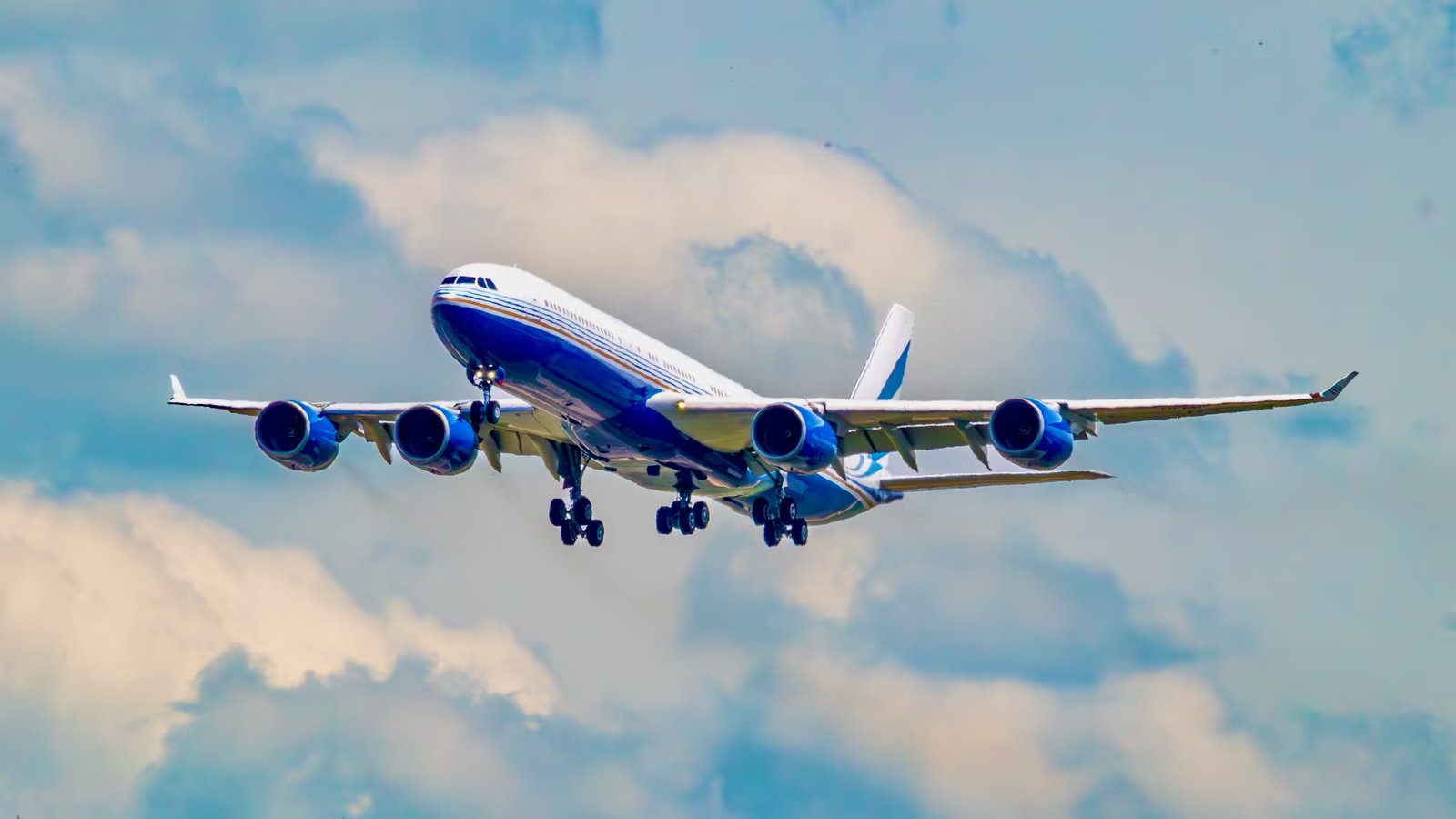
The Airbus A340 is one of the most iconic jets ever produced by Airbus, and it is a long-range wide-body quad-engine passenger airliner that was originally developed alongside the twin-engine Airbus A330 in the 1980s. First launched commercially in June 1987, the Airbus A340-300, the first model to take to the skies, performed its first test flight on October 25th, 1991.
The first two variants to enter service, the A340-200 and the A340-300, both made their first passenger flights in 1993 with Lufthansa and Air France. The aircraft was later upgraded with two larger, longer-range variants, the Airbus A340-500 and the Airbus A340-600, which entered service in 1997 and 2002, respectively.
Designed much like the Airbus A300 with a near-identical cabin cross-section, the Airbus A340-200 and the A340-300 were equipped with four CFM 56 engines, which allowed these jets to bypass restrictions on twin-engine aircraft performing long-haul overwater flights. The aircraft had a three-leg main landing gear that allowed it to maintain a higher maximum takeoff weight in comparison to twin-engine aircraft of the time
The Aircraft Performed Weakly Against Market Competitors

The longer Airbus A340-500/600 introduced larger Rolls-Royce Trent 500 engines, had extended fuselages, and had MTOWs that went up to 380 tons, making them some of the highest-capacity, longest-range jets to ever enter the skies. Between 2004 and 2013, Singapore Airlines used an Airbus A340-500 to perform the world’s longest flight, a nonstop service between Newark Liberty International Airport (EWR) and the airline’s hub at Singapore Changi International Airport (SIN).
The four variants ranged in seating capacity from 210 to 370, depending on cabin configuration, and they had maximum ranges that even exceeded 10,300 nautical miles for the Airbus A340-500. From a technical standpoint, the aircraft was quite impressive and offered passengers unparalleled flexibility. However, there was one key flaw that held the aircraft back from ever achieving its true potential.
Only 377 Airbus A340 jets ever rolled out of Airbus factories, with one variant, the A340-200, performing particularly poorly with only 28 orders ever placed for the type. The aircraft, which featured a four-engine configuration, offered significantly weaker operating economics in comparison to long-range ultra-efficient twinjets like the  Boeing 777. Fuel is airlines’ largest single expense, and spending more on fuel severely limits the carriers’ potential to turn a profit on any given service.
Although slightly more efficient engines were introduced for the Airbus A340’s later variants, these were still simply not enough to overcome the poor operating economics that the aircraft delivered in comparison to competitors, according to an analysis from CNN. This is not to say that an aircraft with 377 units was not profitable, and it certainly was for the manufacturer Airbus. It is fair to say that the decision to produce the aircraft with a four-engine configuration severely restricted its potential.
However, the manufacturer had a few major reasons for producing this aircraft with a four-engine design, all of which pointed to it being a smart decision given market dynamics and regulatory conditions at the time. In this article, we will take a deeper look at the story of the Airbus A340 and examine why the jet was produced with four engines.
Restrictions Limited How Far Twin-Engine Jets Could Fly

Restrictions on twin-engine aircraft operations emerged in the early days of aviation when piston engines offered significantly weaker reliability than today’s engines. The Federal Aviation Administration ( FAA) had put in place its long-standing 60-minute rule in 1953, which restricted twin-engine aircraft from operating flights beyond just 60 minutes of a diversion airport. As a result, airlines really could not operate any flights over long stretches of water using twin-engine jets, which were far more efficient than their three or four-engine alternatives.
Throughout the 1960s and 1970s, the long-haul aircraft most would see at airports were trijets like the Lockheed L-1011 TriStar and the McDonnell Douglas DC-10, alongside larger quad-engine aircraft like the Boeing 747. In 1977, however, the Airbus A300 began operating flights up to 90 minutes from diversion airports beyond US airspace under new approval from the International Civil Aviation Organization (ICAO).
The FAA finally folded in 1985 and began to allow aircraft to fly up to 120 minutes from a diversion airport, introducing Extended-Range Twin-Engine Operational Performance Standards ( ETOPS). The first such approval was awarded to the Boeing 767-200ER, according to the Sheffield School of Aeronautics.
It was at this time that Airbus began putting together the plans for its A340 program, and it decided on a four-engine design based on the idea that these restrictions would be slowly relaxed. The FAA, which had been so careful to relax its restrictions from 60 to 120 minutes, would unlikely be in any rush to push to 180 minutes and beyond. There were still a large portion of routes, especially those across the Pacific, which could not be efficiently completed under ETOPS-120, demonstrating that a market for long-range quad jets would likely still exist.
Airbus had also already decided to build a twin-engine aircraft alongside the A340 that would be more appealing to customers looking for a long-range, high-capacity widebody that offered improved efficiency, even if it was unable to fly as far over water as its four-engine sibling. The A330 was one of the most successful aircraft ever produced by the manufacturer, and would later be upgraded with the A330neo, which is among the most advanced aircraft families in the skies today.

Why Are The Engines On The Airbus A340 So Small?
The total thrust from four engines on the A340 is comparable to that of the two A330 engines.
What Happened With ETOPS Restrictions After Airbus Launched The A340?

Almost directly after launching the original two models of the Airbus A340, the family was immediately dealt a massive blow. The FAA introduced ETOPS 180 in 1988, which allowed a twin-engine aircraft like the Boeing 777 to cover 95% of the earth’s surface, and entered service with these certifications in 1995. However, in this period, Airbus had already secured enough orders to ensure the profitability of its Airbus A340 program, with over 200 A340-300 variants purchased by customers.
When the manufacturer launched its new A340 variants, the company began to switch strategy. It was no longer interested in building four-engine jets that could overcome ETOPS restrictions, but rather in designing high-capacity widebodies that could replace older 747 variants and offer lower per-seat costs. For the Airbus A340-500 and A340-600, the jet’s four engines were not a major concern as they were designed to replace large, four-engine widebodies.
In 2007, ETOPS rules were extended beyond 180 minutes of range, with multiple twin-engine models being certified for ETOPS-240 and ETOPS-330. In 2014, when the manufacturer launched the Airbus A350 XWB, the first ETOPS-370 certification was issued, which allowed the next-generation widebody to fly over 99.7% of the Earth’s surface. By this time, Airbus had already ceased production of the Airbus A340, although over 200 models would remain in the skies at the time of the COVID-19 pandemic.
At the end of the day, the Airbus A340 was designed alongside the Airbus A330 as part of Airbus’ long-term strategy to ensure that it had both a twin-engine and a quad-engine aircraft to offer customers in the 1990s. This strategy allowed the manufacturer to hedge its bets both against what regulators might choose to do in terms of ETOPS regulations and also in terms of what customers might want to add to their fleets. While the Airbus A340 was harmed by twin-engine operational regulations being relaxed, this did significantly help the Airbus A330.