dailynewsnblog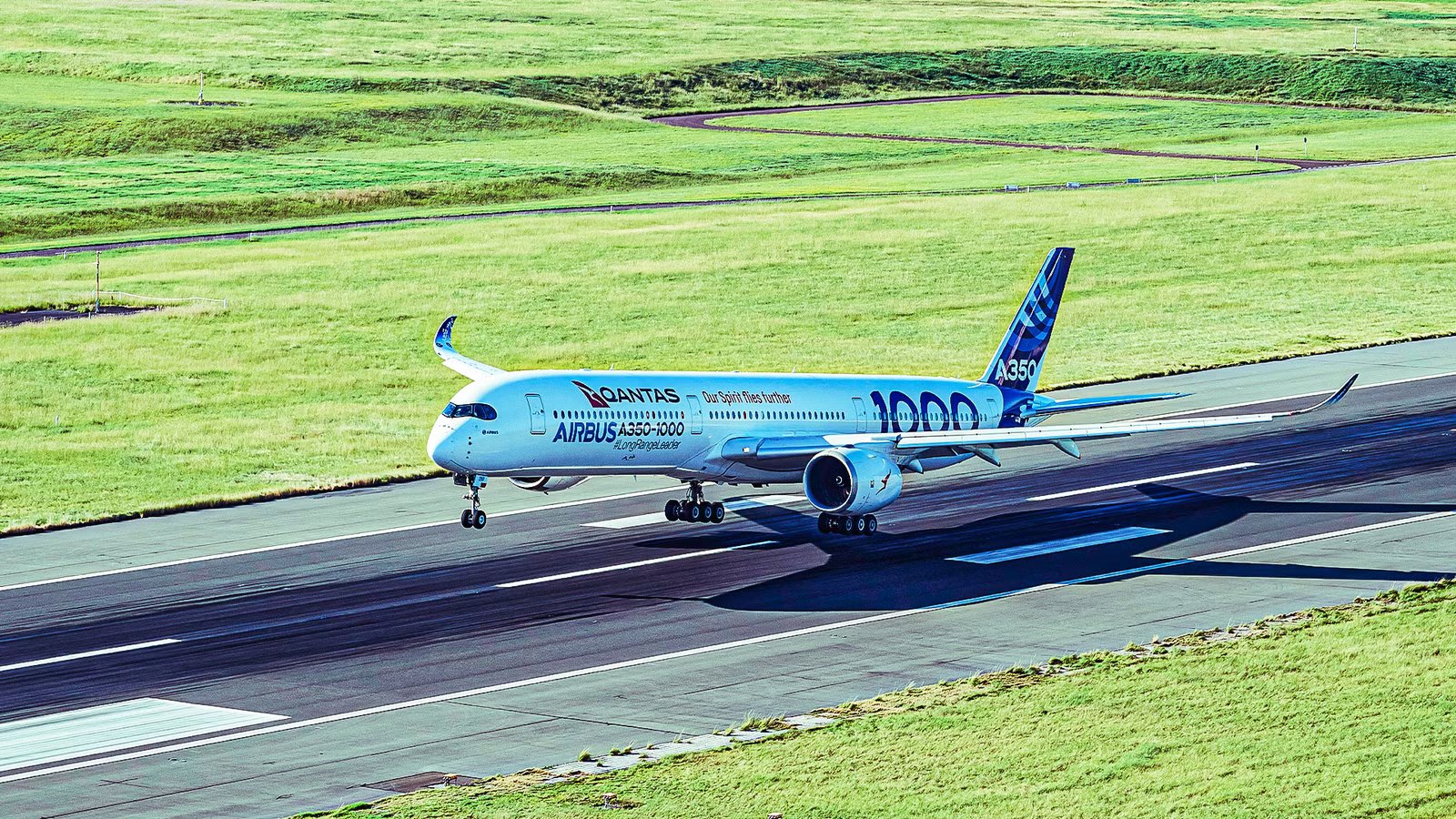
Airbus designed the Airbus A350 family to cover all sorts of long-haul travel, from dynamic long-haul operations between high-capacity trunk markets to record-setting ultra-long-haul connections. There are multiple variants within the family, with the Airbus A350-900 and the Airbus A350-1000 sharing a common airframe philosophy. Both include composite structures, advanced aerodynamics, and Rolls-Royce Trent XWB engines, but both variants have a unique purpose that differs slightly from each other.
Indeed, the A350-900 is a flexible intercontinental workhorse, while the A350-1000 is the larger, longer-range, higher-weight member of the family that is primarily aimed at slot-constrained trunk routes. In Qantas’ upcoming bespoke configuration, the aircraft may even be used for nonstop flights from Sydney to destinations like London and New York as part of ‘Project Sunrise.’ Range is a key differentiator for the aircraft, with Airbus noting the A350-900ULR to have the longest range, followed by the A350-1000 and the standard Airbus A350-900.
The Airbus A350 Family In A Nutshell

The Airbus A350 is Airbus’ latest-generation long-range twin-engine aircraft, and it has been built around a carbon-fiber fuselage and wing with high-efficiency aerodynamics and advanced fly-by-wire systems. Airbus markets a 25% fuel-burn reduction over previous-generation widebody aircraft, something which certainly helped make the aircraft a favorite among operators. The firm is planning 100% sustainable aviation fuel compatibility by 2030.
There are two principal passenger variants of the aircraft on offer: the Airbus A350-900 (which offers a typical three-class capacity of between 300 and 350 seats) and the longer Airbus A350-1000 (which offers typical three-class seating of between 350 and 410). Commonality across the family simplifies pilot training and maintenance, while variant-specific changes, including heavier landing gear and higher-thrust engines (featured on the A350-1000), offer extended-range capabilities.
The Airbus A350-900’s standard range is advertised at around 8,500 nautical miles (15,742 km), while the Airbus A350-1000 is typically advertised at around 9,000 nautical miles (16,668 km). For extreme ultra-long-haul missions, Airbus has yet another trick up its sleeve. The manufacturer created the Airbus A350-900ULR, a factory-designed variant that could operate the world’s longest commercial flights, such as nonstop services from Singapore to New York, flights which typically approach around 19 hours in duration.
Airbus is also building a tailored Airbus A350-1000ULR configuration for Qantas’ Project Sunrise, by adding a 20,000-liter rear center tank and other systems updates for nonstop services from Sydney or Melbourne to New York and London. Deliveries for this specially-configured variant are slated for the end of 2026. Across the board, the A350 has proven itself to be a versatile platform with advanced capabilities.
What Is The Purpose Of The Airbus A350-1000?

The primary purpose of the Airbus A350-1000 is to target long-haul markets that have high amounts of passenger demand. These are universally places where airlines need more seats, more belly cargo, and long legs from slot-constrained hubs. Airbus lists the A350-1000 at 375-400 seats with a typical three-class configuration that maxes out at around 480 seats. The aircraft has 44 positions for LD3 containers (or 14 standard cargo pallets) on the lower deck, which are useful where cargo revenue really matters.
A standard range figure for the aircraft is around 9,000 nautical miles (16,668 km), and 322 tons is commonly cited as the aircraft’s maximum takeoff weight, allowing carriers to sustain long sectors with full cabins and large amounts of cargo. The Airbus A350-1000’s capabilities are underpinned by next-generation high-thrust Trent XWB-97 engines and a strengthened six-wheel main landing gear that assists in the management of loads.
When it comes to Project Sunrise, the flights are set to be operated by a specially modified Airbus A350-1000, which integrates additional 20,000-liter rear center fuel tanks and other system enhancements that can support around 22-hour missions. Certification work on the novel tank design contributes to revised delivery timings. Across the board, the net effect is that the A350-1000 offers higher capacity than the A350-900, with longer-range capabilities on average.

Why The Airbus A350 Has Such A Remarkable Range
It is the result of years of engineering.
What Purpose Does The Airbus A350-900 Serve In The Market?

The Airbus A350-900 is the family’s versatile baseline model, and it blends capacity, range, and economics for the majority of long-haul missions. Airbus typically quotes a three-cabin capacity of between 220 and 250 seats for the type, with an exit limit of 440. The aircraft offers some cargo capabilities, with lower deck space for 36 LD3 units in the lower hold. It comes along with an advertised range of around 8,500 nautical miles (15,742 km) with an MTOW of around 283 tons. The jet is powered by Rolls-Royce Trent XWB-94 engines.
The Airbus A350-900 is optimized for efficiency and overall fleet commonality. A lighter airframe and four-wheel main gears suit operations from a broader set of airports. Common cockpit and systems ultimately ease mixed-fleet flying with the Airbus A350-1000. For some extreme missions, the Airbus A350-900ULR was designed to leverage additional fuel systems and a higher maximum takeoff weight in order to extend the aircraft’s range to 9,700 nautical miles (17,964 km).
 Singapore Airlines uses this particular variant on nonstop ultra-long-haul journeys from Singapore to New York. The aircraft can thus cover pretty much any kind of flight, including major intercontinental connections across all oceans. The aircraft’s exceptional extended-range twin-engine operational performance standards (ETOPS) rating allows it to operate pretty much anywhere without any real operational limitations.
What Are The Key Points Of Differentiation Between These Two Models?

Aircraft range and weight set the tone for the differentiation of Airbus A350 models. The Airbus A350-900 offers around 8,500 nautical miles (15,740 km) of range. The stretched Airbus A350-1000 reaches roughly 9,000 nautical miles (16,668 km). The Airbus A350-900ULR pushes the aircraft’s endurance up to 9,700 nautical miles (17,964 km). Crucially, the aircraft’s higher maximum takeoff weight of around 322 tons helps maintain overall payload viability on these longer sectors.
The Airbus A350-1000 carries up to 400 passengers, with the lower deck’s capacity capabilities (in terms of cargo) rising to 44 pallets. Power and hardware, across the board, also differ. The A350-900 uses Rolls-Royce Trent XWB-84 engines while the Airbus A350-1000 employs higher-thrust Trent XWB-97s. In order to support the extra mass and prevent runway limits, the Airbus A350-1000 has been designed with versatile six-wheel main bogies in place of the A350-900’s four-wheel main landing gear units.
|
Specifications |
Airbus A350-900: |
Airbus A350-1000: |
|---|---|---|
|
Range |
8,500 nautical miles (15,750 km) |
9,000 nautical miles (16,700 km) |
|
MTOW |
283 tonnes |
322 tonnes |
|
Maximum capacity (exit limit) |
440 seats |
480 seats |
Overall, aircraft fuselage length increases across the two models notably, bringing along more seats and overall belly volume. Both impose slightly different aerostructural loads. Simply put, the Airbus A350-900 is the broad, ultra-efficient long-haul platform that many long-haul airlines desire, with an optional ULR upgrade kit for extreme missions. Meanwhile, the Airbus A350-1000 is the high-capacity long-range workhorse that serves as a flagship for many long-haul airlines.

Why The Airbus A350 Has Such An Exclusive Engine
One Engine, One Aircraft: A Match Made in Aviation Heaven
The Aircraft Will Be Crucial To Project Sunrise

Australian flag carrier Qantas has selected a specially-configured Airbus A350-1000ULR to launch its Project Sunrise nonstop flights from Australia’s eastern cities to London Heathrow Airport (LHR) and New York’s John F. Kennedy International Airport (JFK). Airbus and Qantas confirmed that these specially-modified aircraft would feature a new rear center fuel tank and other systems that would enable the aircraft to stay in the skies for upwards of 22 hours.
First deliveries for the type are currently targeted for the end of 2026, after a regulator-requested redesign of the tank itself. Overall cabin density will be lower than that of typical Airbus A350-1000s in order to prioritize rest space and overall well-being on 20-hour flights.
In parallel, the Singapore Airlines Airbus A350-900ULR remains the proven ultra-long-haul platform of today, with a certified 9,700 nautical mile (17,964 km) range that can be used on Singapore-New York nonstop services. The aircraft is fitted with a premium-heavy two-class cabin configuration. Operationally, both models rely on careful payload-range tradeoffs, augmenting fuel capacity and crew provisions in order to manage fatigue over these unprecedented distances.
The Bottom Line

The Airbus A350 offers two pretty clear paths when it comes to range. The Airbus A350-900 is the flexible baseline variant of the family that is used for most long-haul missions. The current range leader for the family is the A350-900ULR. The Airbus A350-1000 is large and adds seats, cargo capacity, and a higher MTOW, and it is designed for long routes where capacity and yield really matter.
Endlessly versatile, the aircraft has been selected for multiple ultra-long-range projects, including flights from New York to Singapore. For Project Sunrise, the aircraft will push into 20-plus-hour territory, operating the longest routes in aviation history.
Airlines choose between capacity and range, as well as comparing operating costs and overall airport compatibility, when acquiring the Airbus A350. Ultimately, the family brings something to the table for pretty much any kind of long-haul operator.