dailynewsnblog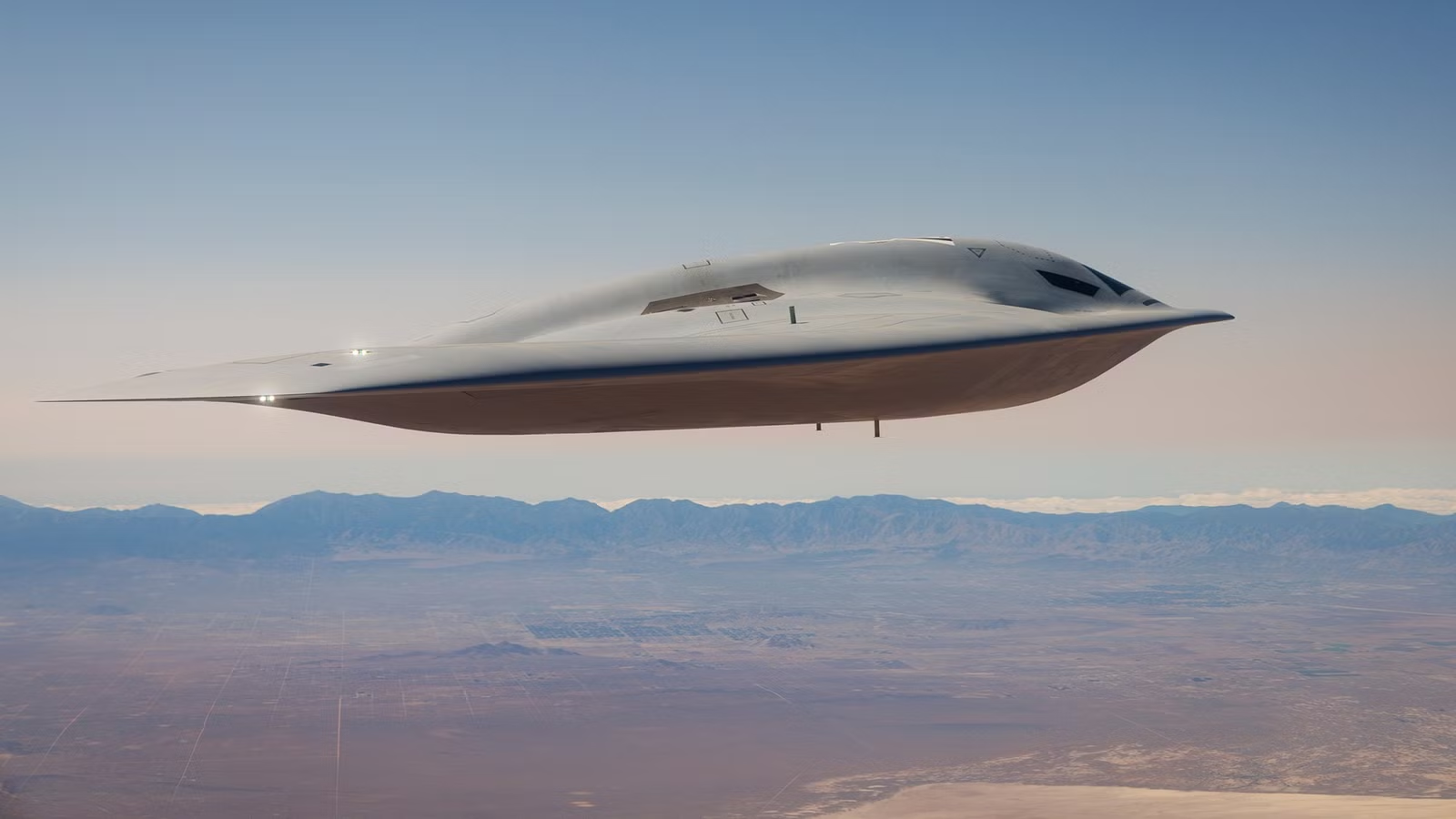
The B-52 Stratofortress is not being replaced because it is a lumbering missile truck with plenty of flight hours remaining and is relatively affordable to operate. The US Air Force also has a need for such a high-capacity lumbering missile truck. However, the equation is fundamentally different with the B-2. The Northrop B-2 Spirit is a high-end stealth penetration bomber that needs to be at the cutting edge and be ahead of enemy air defense improvements.
After being in service for two decades, the 1980s-designed B-2 Spirit remains the world’s only stealth bomber, but it is no longer the cutting-edge marvel it once was. It is acceptable for the B-52 to be an ancient and unsurvivable platform, but this is not the case for the B-2. Making matters worse, the worn-out B-1B Lancers are in need of retirement, and the Air Force needs new airframes to replace them. Let’s examine why the Northrop Grumman B-21 Raider is replacing the B-2 Spirit.
Bomber Evolution

It can be argued that the Northrop B-2 Spirit is the first enduring successful United States strategic bomber in the sense that its next-generation replacement is being designed to serve a similar philosophy. The B-52 Stratofortress can be thought of as the last of the US’s World War II lineage of bombers that includes the B-17, B-29, and B-36. These bombers were built en masse to brute force their way deep behind enemy lines and to sustain losses.
The B-52’s concept was partially superseded by the contemporary Convair B-58 Hustler. While the B-52 was to brute force its way through, the B-58 was able to fly at Mach 2.0 and at over 60,000 feet in altitude. This was to allow it to outrun and outfly intercepting jet fighters. The Hustler’s concept was taken to the next level with the development of the XB-70 Valkyrie. The XB-70 achieved a max speed of Mach 3.1 and had a service ceiling of 77,350 feet.
However, the development of Soviet surface-to-air missiles rendered the XB-70 obsolete before it could enter serial production. The US Air Force then developed the B-1A Lancer to fly under the radar, but the development of look-down radars also made that obsolete. The Air Force then brought the Lancer back as the B-1B with a radically reduced radar cross-section as an interim bomber, as it worked on its stealth bomber project that would give rise to the B-2.
Mission Philosophy

With the Northrop B-2, the US Air Force abandoned supersonic flight, low flying, and high flying. Instead, the B-2 is a high-subsonic aircraft designed to hide in plain sight, flying at between 40,000 and 50,000 feet, and the idea is that you can’t run, but you can hide. The B-2 is the result of the late Cold War’s Advanced Technology Bomber program. It is designed to penetrate the most sophisticated enemy air defenses without being detected.
The B-2 minimizes every detectable signature, not only radar cross-section, but also infrared, visual, acoustic, and others. It retains its ability to conduct long-range strategic strike capability with a heavy payload. Its flying wing design also allows it to increase its aerodynamic performance and increase its range, although this comes at the expense of maneuverability.
The B-2 is designed primarily for high-altitude cruise penetration. Unlike other bombers, it carries all its bombs internally, with the bomb bays only opening briefly to preserve its stealth profile. The usefulness of the B-2 is seen in that it has been used in every major US conflict since 1999, including as the ‘tip of the spear’ at the start of the US’s air campaign over Iran. However, the B-2 is limited by numbers, its age, and the fact that the bomber is a product of the 1980s.

7 Reasons Why The US Air Force Still Operates The B-52
From nuclear deterrence to missile truck missions, the B-52 Stratofortress remains essential to US airpower even in 2026.
Worn Out Lancers

One of the biggest issues with the B-2 Spirit is that there just aren’t many of them. Operating a fleet of highly-specialized out of production aircraft is very expensive and difficult, and the limited size means the Air Force is forced to continue to rely on the B-1B Lancers. The Air Force may plan to keep its B-52s in service until the 2050s as stand-off missile trucks, but there is only so much need for such aircraft.
One issue is that the Air Force also needs penetrator strategic bombers, and another issue is that the B-1B Lancer fleet is wearing out. The Air Force acquired 100 of them, of which only 46 remain in active service. The rest have been sent to the boneyard: in 2021, the US Air Force retired a batch of 16 of them, saying it’s just too difficult and expensive to keep all of these tired airframes operating.
|
United States Air Force bomber fleet |
Number in service (per US Air Force) |
|---|---|
|
B-52 Stratofortress |
76 |
|
B-1B Lancer |
46 |
|
B-2 Spirit |
19 |
|
B-21 Raider |
2+ (in testing) |
The B-1 is a variable geometry bomber designed to fly at low altitudes. This has put a huge amount of stress on the airframe and worn it out far faster than the higher-flying, slower-flying, and lumbering B-52s. Put another way, the Air Force needs to retire 46 Lancers soon, and there has to be a bomber to replace them. It can’t replace them with the B-2s as they are out of production, so there needs to be a new bomber.
Limited B-2 Spirit Production

A major issue with the B-2 is that only a handful were built. The Air Force had planned to procure 132 examples, but in the end, it only procured 21, including a couple of prototypes that were upgraded to be combat-worthy. Of these, two have been lost over the years. One loss was the Spirit of Kansas that crashed on takeoff in 2008 at Guam’s Andersen Air Force Base. The other was Spirit of Hawaii, which crashed in 2022 at Whiteman due to a hydraulic failure, with enough damage to write it off.
This leaves the US Air Force with a fleet of 19 stealth bombers, compared with the 132 it originally wanted. The Air Force reportedly wants at least 100 and perhaps 120 or 150 B-21 stealth bombers. 19 bombers are just not enough to meet the Air Force’s requirements for a high-end penetration bomber, and the Air Force also can’t realistically put the B-2 back into production, as the production lines have been cold for decades, the tooling is gone, and the contractors have moved on.
Furthermore, a B-2 going back into production would require a massive modernization and redesign, and it is easier and cheaper to design and set up the supply chain for an all-new and modern bomber. In other words, it is likely cheaper for the Air Force to purchase next-generation B-21 Raiders than to purchase new-build updated B-2s.

This Is How Powerful The B-2 Spirit Bomber Is
The B-2 is famous for its stealth, but how much punch does it pack? Let’s find out.
The B-2 Spirit Is Eroding Into Obsolescence

When the Soviets developed high-altitude surface-to-air missiles in the 1960s, the XB-60 bomber was effectively obsolete overnight. That is not the case for the B-2, as no radar or other advancement over the last two decades has had this effect on it. However, what has happened is that new radars and detection systems have eroded the aircraft’s stealth and advantages incrementally. While the B-2 may be survivable over Iran, that may no longer be the case for missions over China.
The B-2 pioneered stealth, but mostly focused on radar stealth. Meanwhile, the B-21 adds three decades of development and offers multi-spectral stealth or all-aspect stealth. It drastically lowers its infrared, acoustic, visual, and electronic signatures while using improved radar-absorbing materials and having a better shape overall.
The Raider’s coatings are much easier to maintain, while it makes use of modular and open-mission systems that can be more easily updated without major overhauls. It has vastly improved sensors and sensor fusion, giving it a god’s-eye view of the battlespace. While the B-2 was built to function more as a lone bomber, the B-21 is a command center of a much bigger system and kill chain. The B-21 is intended to restore the B-2’s 1990s magic with a modern networked twist.
Built For Scale

It is unclear how much the B-2 would have cost had it been built at scale. However, it wasn’t, and its minimal production numbers mean that each aircraft cost around $2 billion and was extremely expensive to maintain. By contrast, the United States Air Force plans to achieve a per-unit cost of around $550 million or more for the B-21 Raider. This is partly thanks to a seemingly smooth development cycle that included extensive digital engineering, lessons learned from the B-2, and shifting from ‘exotic and expensive’ to ‘capable and sustainable.’
In February 2026, the US Air Force announced it is now able to boost the production capacity of the B-21 Raider thanks to an extra $4.5 billion from the ‘One Big Beautiful Bill. It explained that “this agreement accelerates the approved acquisition profile by increasing annual production capacity by 25%, compressing delivery timelines while preserving cost and performance discipline.”
The Air Force now has at least two examples in flight testing, and the B-21 Raider is expected to enter service in 2027. The rickety old B-1Bs are expected to start retiring in the 2028 fiscal year, with the last exiting the Air Force around 2032. Meanwhile, the retirement of the B-2s is expected to follow the B-1s, but will be contingent on how many replacement B-21s the Air Force has received and how fast the bomber matures. The B-2 is likely to remain in service for around a decade more.