dailynewsnblog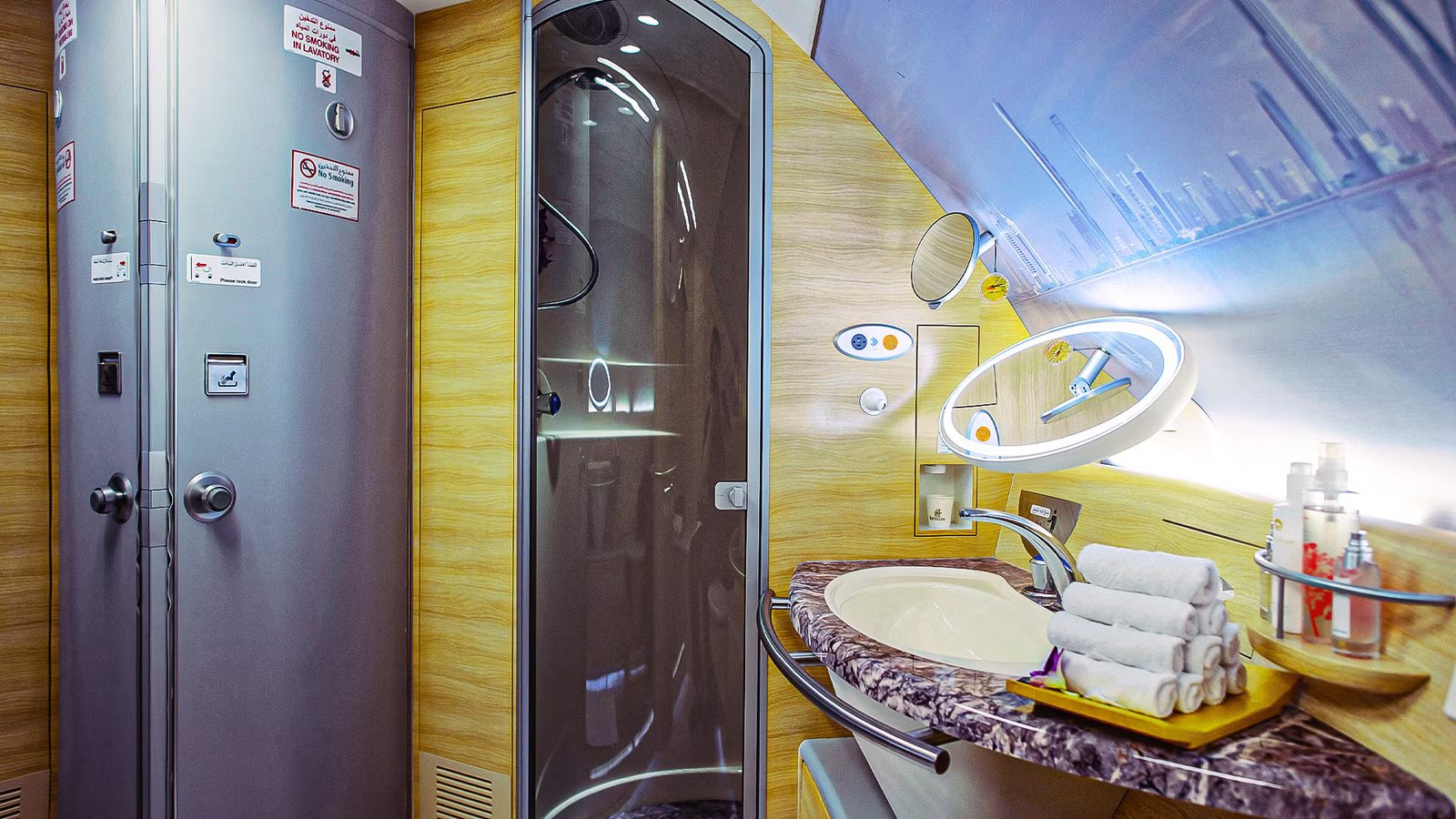
Which airline introduced the first onboard shower to commercial aviation? It is a question that points to the pinnacle of the golden age of modern luxury travel, a period where the industry’s biggest players competed not just on ticket price, but on the sheer audacity of their amenities. In the mid-2000s, as the world prepared for the arrival of the double-decker superjumbo, one carrier decided that a flatbed seat and a multi-course meal were no longer enough to satisfy the world’s most elite travelers.
This article explores the history and engineering marvel of the onboard shower, primarily focusing on  Emirates and its revolutionary Airbus A380 Shower Spa. We will look into the technical challenges of carrying thousands of liters of water at 35,000 feet, the logistical precision required to keep the facility operational, and how this single amenity redefined what it means to arrive refreshed. From the initial 2008 launch to the competitive responses from rival carriers, this guide clarifies why the onboard shower remains one of the most iconic, if impractical, feats in aviation history.
Changing The Passenger Experience Forever

The first airline to introduce a fully functional, scheduled onboard shower for commercial passengers was Emirates. The service officially debuted on August 1, 2008, during the inaugural flight of the airline’s first Airbus A380 from  Dubai to New York’s
  JFK airport. While private jets had occasionally featured showers for decades, Emirates was the first to scale this luxury for a commercial passenger, installing two shower spas at the front of the upper deck for its 14 first class passengers.
The introduction of the shower was a massive marketing victory that fundamentally changed the public perception of the A380. By utilizing the dead space created by the aircraft’s staircase and the curvature of the upper fuselage, Emirates turned a structural necessity into a five-star bathroom. Each passenger is allotted five minutes of hot water, though the total time in the spa suite can last up to 30 minutes, allowing for a complete grooming routine mid-flight.
In today’s market, the Shower Spa remains a definitive symbol of the Emirates brand. Since that first flight in 2008, the airline has maintained a dedicated shower attendant position on every A380 flight to ensure the facility is cleaned and reset between every use. This level of service has helped Emirates dominate high-traffic routes, where business travelers value the ability to head straight from the airport to a meeting without stopping at a hotel.
Why Were There No Showers Before?

The final decision to install a shower on an aircraft had to be weighed up against all of the various considerations that needed to be thoroughly looked into. After all, if it were an easy idea to add, then showers would have been commonplace well before 2008. The most dominant factor is the weight of the water itself, as every liter of water weighs one kilogram, and to provide enough for a full cabin of first class passengers, the A380 must carry an additional 500kg of water specifically for the showers. This is something that must be factored in when choosing not only a route but also an aircraft type, as it directly increases fuel burn.
Technical specifications also play a role in the valuation of the shower system. The A380 features a specialized drainage system designed to prevent pooling during turbulence, as well as heated floors to ensure the space doesn’t feel cold due to its proximity to the aircraft’s outer skin. These more modern amenities allow operators to plan ahead for a premium experience without having to overhaul entire cabins to stay on top of passenger expectations.
The maintenance and personnel requirements have also changed how these costs are handled. Having the shower attendant present at all times moves the risk of a messy or unhygienic facility onto a specialized role, providing the airline with a more stable and high-quality product. In the premium travel industry, this level of consistency is often more important than the weight-saving benefits of removing the system.

The 10 Most-Luxurious Features Of The Airbus A380
Bringing back luxury to the skies.
For The Aspiring Luxury Traveler

Industry experts often credit the onboard shower with being the single most successful marketing tool in modern aviation history. Sir Tim Clark, the President of Emirates, has frequently stated that the decision to include showers was not just for the 14 passengers in first class, but to “attract aspiring economy passengers” who want to fly with the airline that can achieve such a feat. The shower was a decree from the top that required over 8,000 man-hours of certification to prove that a commercial aircraft could safely carry and dispose of shower water at 40,000 feet.
Technical partners like Diehl Aviation, the manufacturer behind the Shower Spa modules, highlight the immense complexity of the project. Engineers noted that because the spa room is so large, it had to be built in two separate pieces and joined during the aircraft’s final assembly. This level of luxury was previously only found on private government jets, and experts from Airbus suggest that the A380 was the only platform capable of providing the structural dead space near the staircase to make such an amenity commercially viable.
The shower, while only a small part of the aircraft, truly redefined the luxury hotel model of air travel. Emirates ensured that the facility remained a pristine brand touchpoint rather than becoming a maintenance burden. The 5-minute water limit is a slightly annoying but technical necessity, but the psychological impact of being able to land after a 14-hour flight feeling refreshed is what allowed Emirates to justify the higher ticket prices that keep the A380 fleet profitable today.
A Middle East Exclusive

When comparing the Emirates experience to other airlines, the only true competitor in the commercial sector is  Etihad Airways. While Emirates focuses on the spa as a shared amenity for all 14 first class passengers, Etihad introduced ‘The Residence’ on its own A380 fleet. This is a three-room private suite that includes its own en-suite bathroom with a private shower. The difference is one of exclusivity; on Emirates, you must book a time slot with the shower attendant, whereas in The Residence, the shower is yours for the entire flight.
However, outside of these two Middle Eastern giants, the onboard shower disappears from commercial aviation altogether.  Qatar Airways, despite operating a luxury A380 fleet, chose not to install showers, opting instead for larger, palatial bathrooms that offer more floor space but no running water.
  Singapore Airlines and
  Lufthansa also bypassed the feature, citing the extreme weight penalties and the reality that most passengers prefer to shower in the arrivals lounge after landing.
This comparison highlights that the shower is a prestige feature rather than a standard one. For airlines like Qatar, the decision was driven by the Qsuite philosophy, which prioritizes the sleeping and dining experience over the novelty of a midair wash. The weight of the water required for a shower could instead be used to carry more cargo or fuel, which is why the onboard shower remains a rare exception rather than the rule, even among the world’s most expensive flight tickets.

Emirates Vs. Qatar Airways Vs. Singapore Airlines: Which Carrier Wins First Class?
The best first class experience depends on what a passenger values most, whether it’s physical space, theatricality, or service and dining.
An Unexpected Leakage

While the onboard shower is a marvel of engineering, it is not without significant operational risks. One of the primary drawbacks for an airline is the potential for water damage to the aircraft’s sensitive electronics. If a seal or a pipe in the shower spa fails, gravity ensures that the water leaks directly into the main deck’s electrical bays located below, and onto passengers. Such a maintenance-induced risk can result in an aircraft on-ground event that destroys millions of dollars in electronic components and takes the aircraft out of service for weeks.
If the aircraft’s water tanks run low due to a leak or excessive use by the galleys, the captain has the authority to disable the showers entirely to prioritize drinking water and hygiene for the rest of the passengers. The A380 can technically be ferry-flown on three engines to a maintenance base, but it cannot operate its full shower service without a fully functional auxiliary power unit to provide the necessary heating and pressure while on the ground or during certain flight phases.
Numerous studies have shown that the water held in aircraft tanks can sometimes fail to meet the same purity standards as bottled or tap water on the ground. This is why many 747 and A380 operators keep a strict schedule of chemical tank cleanings. Despite the water being heated and filtered, it is still part of a closed-loop system that relies heavily on the quality of the water supply at the departure airport, which can vary significantly across the globe.
Redefining Luxury

The introduction of the onboard shower by Emirates in 2008 was, ironically, a watershed moment that proved commercial aviation could match the luxury of private travel. While it remains a niche feature restricted to the A380 fleets of two Middle Eastern carriers, its impact on brand perception has been worth far more than the millions of dollars spent on its engineering and maintenance. It transformed the superjumbo into a flying hotel, allowing Emirates to maintain premium yields on its most competitive routes.
However, the era of the onboard shower may be reaching its end. Newer, more efficient twin-engine aircraft like the Airbus A350 and the Boeing 777X do not have the structural dead space or the excess payload capacity to carry 500 liters of dedicated shower water. As the A380 slowly retires over the next decade, the ability to wash at 40,000 feet will likely return to the exclusive world of private aviation, making the current Emirates and Etihad offerings a unique historical anomaly.
Ultimately, the onboard shower serves as a reminder of a time when airlines were willing to sacrifice fuel efficiency for something extravagant. It remains the ultimate bucket list experience, a five-minute luxury that requires thousands of work hours and hundreds of kilograms of water to sustain. Regardless of how you see it, there is no denying that the airline that introduced it changed the definition of first class forever.

![17-Hour Nonstop Flights: Delta’s 11 New Ultra-Long Routes Revealed [Full List]](https://dailynewsnblog.com/wp-content/uploads/2026/07/1111-1.jpg)