dailynewsnblog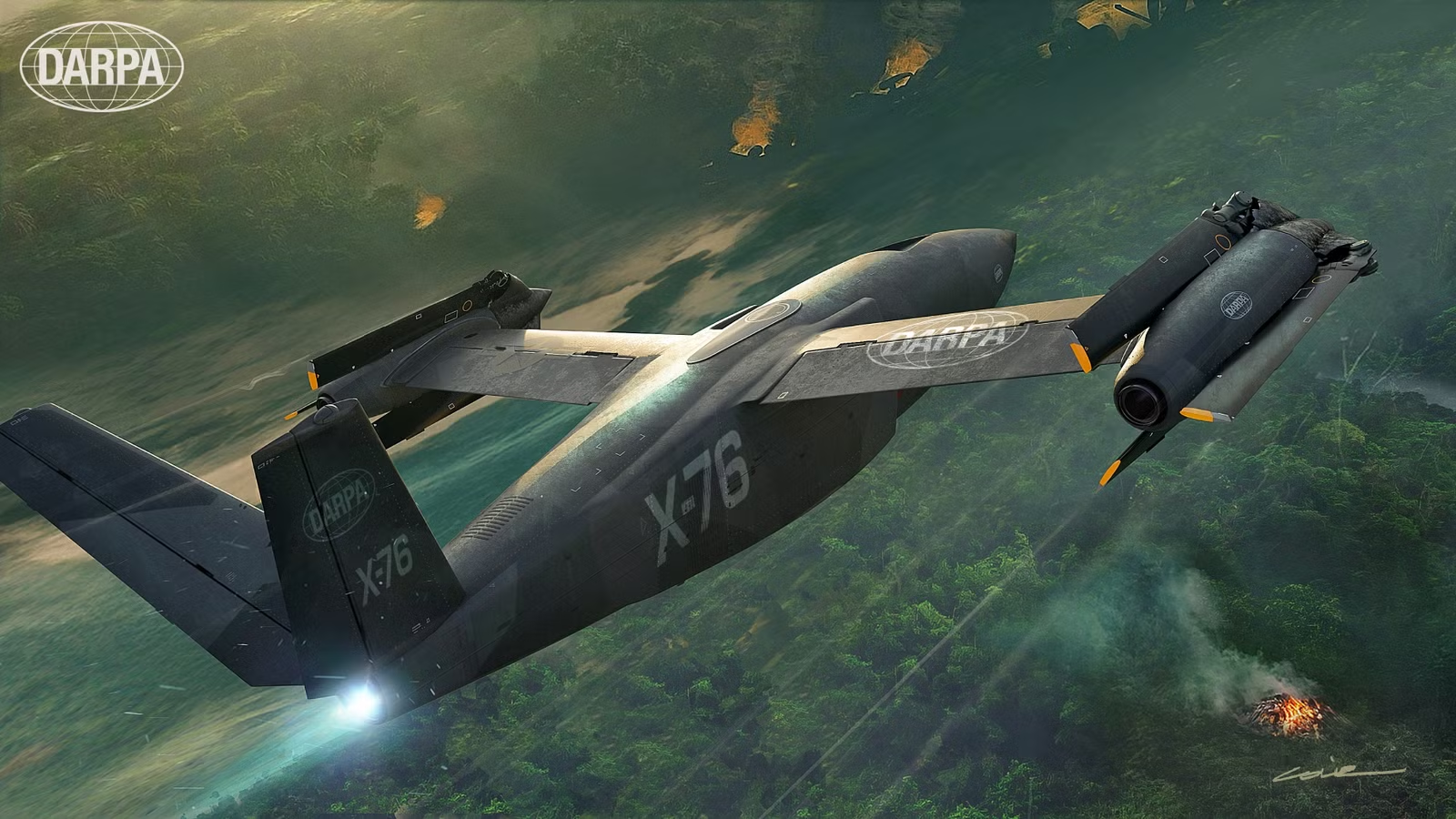
The Bell X-76 was officially given its X-Plane designation on March 9, 2026, in honor of the 250th anniversary of the founding of the United States. The Defense Advanced Research Projects Agency (DARPA) announces the new name for the runway-independent aircraft, as it has been green-lit to begin the building phase of the prototype.
The revolutionary high-speed VTOL (HSVTOL) aircraft utilizes ‘Stop/Fold’ technology to transition between vertical and level flight. Unlike the V-22 Osprey, the new X-76 will not use the propeller engines as primary vertical flight power plants. Instead, it will fold the rotors and ignite a jet engine after it ascends to altitude.
The Ultimate Aerial Advantage: Speed And Versatility

The goal of the SPeed and Runway INdependent Technologies (SPRINT) program that produced the X-76 was to create an aircraft that combined all of the best qualities of a helicopter with a high-speed fixed-wing transport plane. The announcement of the new designation follows the successful completion of the critical design review and official approval to begin construction of a demonstrator.
The Bell V-22 Osprey was a pioneer of this new form of aircraft with the tiltrotor design, it has limitations in terms of both payload and maximum speed that the X-76 aims to surpass. Bell has stated that the technology of its demonstrators is scalable up to an airframe with a maximum weight of 100,000 pounds.
The designation X-76 was a deliberate nod to the American Revolution in keeping with the pioneering spirit of the United States and its legacy of pushing the boundaries of aviation. Commander Ian Higgins of the US Navy, DARPA Sprint program manager, remarked in the official press release with this succinct comment:
“For too long, the runway has been both an enabler and a tether, granting speed but creating a critical vulnerability.”
A New Way To Fly: The Stop/Fold Rotor

The new X-76 is engineered to operate from austere or unprepared surfaces while maintaining jet-like speeds, a combination currently unavailable in modern military fleets. It uses a unique hybrid propulsion system by combining turboshaft and turbofan power in a single airframe. The X-76 will fly in vertical takeoff or landing (VTOL) mode with wingtip ‘proprotors’ for vertical takeoff, landing, and hovering on unprepared surfaces.
Unlike the Bell Boeing V-22 Osprey, which keeps its rotors spinning and tilted forward for cruise. As the aircraft reaches speeds of 150–200 knots, the wings begin to provide sufficient aerodynamic lift. When the aircraft reaches the safe speed range, the clutch disengages the drive shaft from the rotors, and the blades feather and fold back. The wingtip assemblies will have fairings or pods to make the aerodynamics as streamlined as possible.
Once the rotors are folded, the system redirects power away from the rotor shafts and through a conventional jet nozzle at the rear of the nacelle. The X-76 is designed to cruise at 400 to 450 knots (or 460 to 518 mph), which is significantly faster than the V-22 (at roughly 280 knots) or even the new V-280 Valor prototype.

How Will The V-280 Valor Future Long-Range Assault Aircraft Improve US Army Air Tactics?
Starting with the 101st Airborne Division, the V-280 Valor promises to revolutionize the Army’s rapid assault capabilities.
Optionally Manned Or Fully Autonomous?

The X-76 is being developed with a dual focus on autonomous and piloted operations. In the current artist renderings, there appear to be both variants of the platform that will have a flight deck, likely meaning it will be optionally manned, and those that appear to be drones, which clearly have no cockpit. Bell and DARPA have not released any public information that indicates a specific scale difference between the two models, although the manned variant appears to be substantially larger so far.
The project is a joint effort primarily led by DARPA and the US Special Operations Command (USSOCOM). The program aims to address operational gaps for both branches, specifically for missions requiring ‘life-saving speed’ and runway independence in contested regions like the Pacific. The technology, however, will have a wide range of applications once it is fully mature, but the special operations of the US Armed Forces are the first intended operators.
Given the broad mission set intended for the new aircraft, it is likely that more variance in varying sizes and autonomy will develop as the program progresses. The X-76 demonstrator is scheduled for its maiden flight in early 2028. Bell demonstrated the folding rotor and integrated propulsion on a high-speed sled at Holloman Air Force Base in 2023. Ground validation and certification of the airframe are expected to be completed by 2027.