dailynewsnblog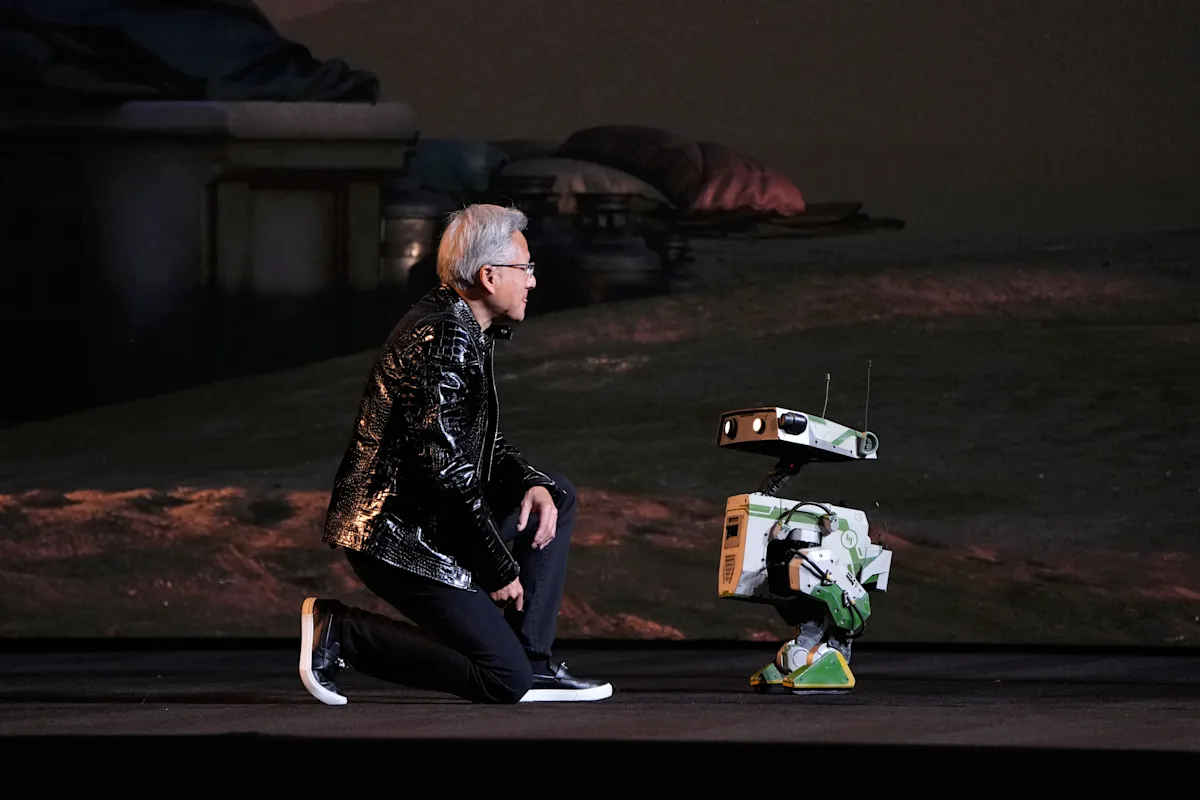
This is The Takeaway from today’s Morning Brief, which you can sign up to receive in your inbox every morning along with:
There was nothing more Jensen Huang could have done this week.
I watched Nvidia’s (NVDA) rockstar CEO crush the CES stage on Monday in an iconic black leather alligator jacket. Jensen always sports a black leather jacket at his keynotes, but this one had some extra flair and shine — leaving the Jensen fanatics on X to speculate that the gazillionaire tech mogul was signaling a huge year ahead!
I respect this group’s passion for a jacket. Love it, actually. I would gladly wear that jacket on my Opening Bid live show and Opening Bid Unfiltered podcast every single day if I had it. Might even sleep in it to save time in the morning.
But the reality is that what Jensen said onstage in three key areas is way more important. It just doesn’t appear that the market was clued into said reality.
Nvidia shares are down by under 2% since Huang gave his highly anticipated CES speech. Keep in mind that this week the markets hit a record, with the Dow Jones Industrial Average (^DJI) knocking on the door of 50,000.
So the weak action in Nvidia has stayed with me mentally.
Here’s where I think you need to be focused on with Nvidia: the fundamentals, not the price action.
First, physical AI is beginning to come out of the testing lab and into real-world settings like autonomous vehicles and robots.
“Wherever the universe has information, wherever the universe has structure, we could teach a large language model, a form of language model to go understand that information, to understand its representation, and to turn that into AI. One of the biggest, most important ones is physical AI, AI that understands the laws of nature,” Huang said.
Second, it’s clear that we remain in the early innings of a fast-moving technology.
“Well, every 10 to 15 years, the computer industry resets a new platform,” Huang explained. “This time, there are two simultaneous platform shifts … At first, people thought AI were applications, and in fact, AI are applications. But you’re going to build applications on top of AIs. But in addition to that, how you run the software, how you develop the software fundamentally has changed — the computer industry is being reinvented.”
Lastly, demand for AI chips and tools continues to be strong — a pushback against worries of expectations not living up to reality.
“The amount of computation necessary for AI is skyrocketing,” Huang said. “The demand for Nvidia GPUs is skyrocketing. It’s skyrocketing because models are increasing by a factor of 10, an order of magnitude every single year.”