dailynewsnblog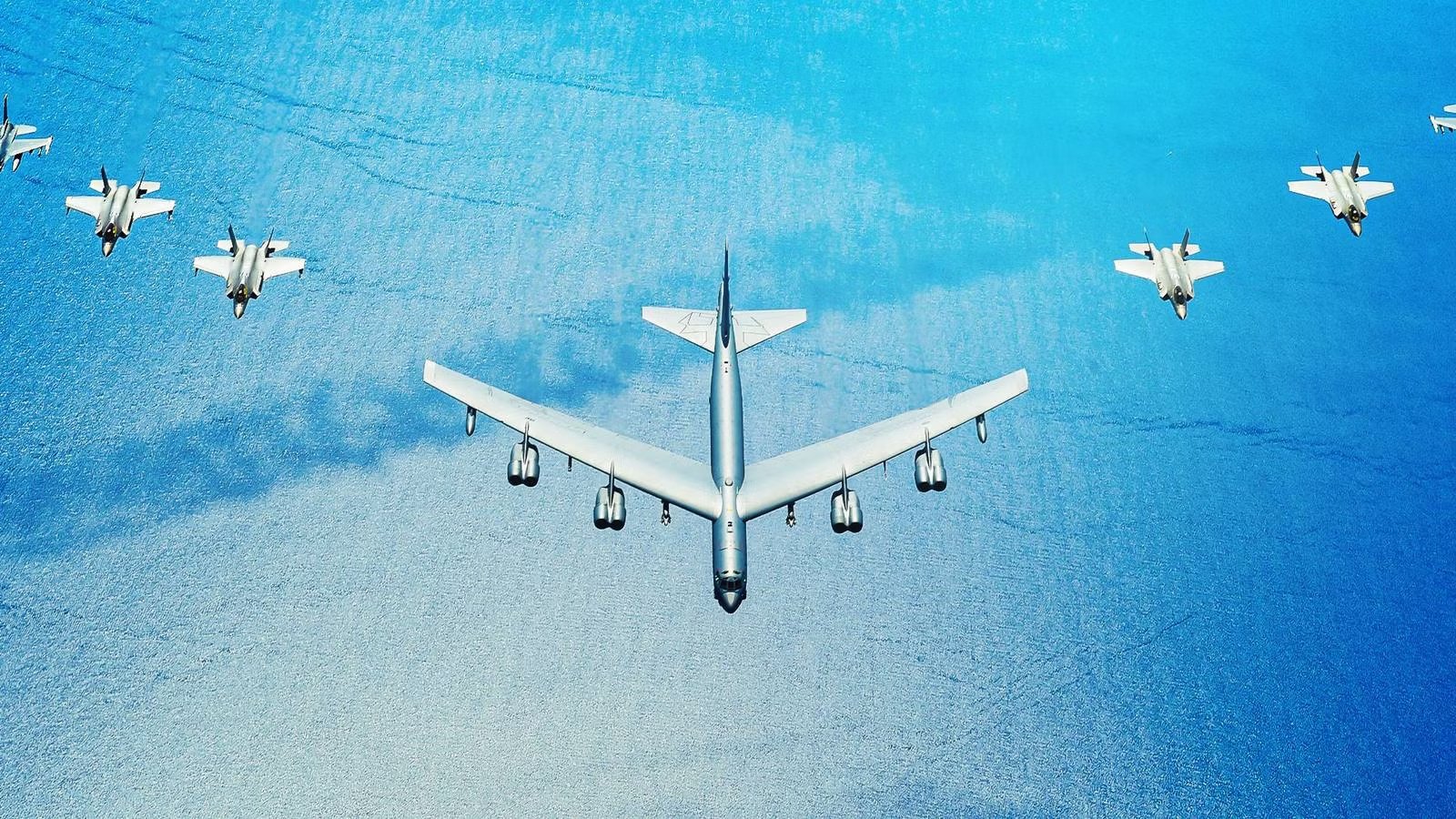
There are few nations in the world which have an operational fleet of strategic bomber aircraft. Those air forces belong to the United States, Russia, and China. Although the United Kingdom was once a member of this tiny club of air power, since the retirement of its last V-bomber in the mid-1980s, only three remain.
In a unique phenomenon for the aerospace world, every one of these strategic strike forces flies Cold War-era planes that would be considered a relic by most standards. The US flies both the oldest and the newest on this list, but notably the bomber squadrons in China exclusively operate airframes made from a vintage design that traces back to the 1950s.
1
Boeing B-52 Stratofortress
40+ years beyond original lifespan

The ‘BUFF’ is a quintessential icon of strategic bombers around the world with its unmistakable silhouette and prolific deployment in nearly every conflict the US has been involved in since entering service in 1955. The current H-variants that the 76-strong USAF fleet is composed of rolled off the assembly line in the 1960s. Although they will soon be upgraded to the J-standard with new engines and avionics, those nearly 70-year-old airframes will not be replaced.
The Stratofortress is being re-engined under the Commercial Engine Replacement Program, receiving Rolls-Royce F130 turbofans to replace the Pratt & Whitney TF33s that have powered it since the 1960s and are projected to become unsupportable after 2030. The re-engining alone is projected to cost roughly $15 billion, with the Pentagon inspector general estimating a dozen separate B-52 modernization efforts combined will run $48.6 billion.
The B-52 was expected to be phased out by the supersonic B-70 Valkyrie or the B-1 in the 1960s or 1970s, but the redesignated B-52J is expected to fly into the 2050s. The current fleet already averages 64 years of age, and Air Force leadership has openly discussed the type reaching 100 years of service.
2
Xi’an H-6 Badger
30+ years beyond original lifespan

The People’s Liberation Army Air Force flies a licensed copy of the Tupolev Tu-16 Badger that is built in China, designated the Xi’an H-6. Like the B-52, these aircraft first took flight in 1952. China’s first operational example constructed solely from domestic components did not take flight until 1968; however, several years after the BUFF. Although the assembly line did stay open until the 1990s, nearly three decades after the last B-52H was produced.
China has built at least 150 H-6s, and current estimates put the active fleet at 200 to 231 aircraft across variants, including the H-6K conventional-strike and H-6N nuclear-capable models. It was never intended to remain the PLAAF’s principal bomber this long. China’s indigenous replacement, the H-20, has been in development for years without a confirmed date or disclosed specifications.
Although the engineers at Chengdu and Shenyang defense aerospace companies in China have successfully constructed stealth fighter jets, it is speculated that the power plants required for a successful stealth bomber are the hurdle preventing the H-20 from entering production. Even the engines in the PLAAF stealth fighters are significantly lower in performance and stealth features than their Western counterparts. Building an engine with fuel-efficiency, high thrust, and low-observable integration required to give a massive flying wing an intercontinental range is believed to be an unresolved roadblock.
3
Tupolev Tu-95 Bear
20+ years beyond original lifespan

Another bomber that took its first flight in 1952, the Bear is a common sight on the western edges of Alaska airspace and the Arctic Circle where fighter jets from the US and the North Atlantic Treaty Organization often intercept them. Entering service just after the B-52 in 1956, these turboprop bombers have been the workhorse of conventional strike, nuclear deterrence, and even maritime patrol since before the Soviet Union fell.
Just like the US planned for its BUFFs, the Bear was expected to be succeeded by supersonic bombers in the late 1980s. That never happened on a large scale, and instead, the Russian Federation chose to continue modernizing and upgrading the existing airframes. A number have been lost to combat, neglect, and scrapping over the years, which leaves the estimated fleet of combat-capable Tu-95s around three dozen.
4
Tupolev Tu-22 Backfire
10+ years beyond original lifespan

First flown in 1969, the Tu-22M3 variant that is currently used by the Russian Air and Space Forces ended production in the late 1970s. This aircraft was one of the bombers hoped to replace the Tu-95, but production was never scaled to a sufficient level to make that a reality. In 1993, the assembly line was shuttered with no successor airframe ordered or designed.
Despite the total absence of any supporting industrial base, Russia actually was believed to have around 50 airworthy examples before the invasion of Ukraine in 2022. Last June, Ukraine took a large number out of action during drone raids on Olenya, Belaya, and Dyagilevo airbases. After-action analysis puts the potential losses as high as 12 during those attacks alone, bringing the total to potentially as high as 24 since hostilities began.
5
Rockwell B-1B Lancer
10+ years beyond original lifespan

Famously championed by President Ronald Reagan, the ‘Bone’ is a unique swing wing bomber aircraft capable of supersonic flight and the highest payload of any platform in the US Air Force. The B-1 first took flight in 1974. After entering service in 1986, the 40 Lancers in service were to be gradually decommissioned over the next few years with the introduction of the new Northrop Grumman B-21 Raider sixth-generation stealth bomber.
Despite that retirement plan already being years later than expected after the B-2 Spirit production was cut short, two have actually been pulled from the Boneyard and made airworthy again instead. The reason is that the USAF has been on an aggressive push with its ‘divest to invest’ plan, which has brought its inventory to below 5,000 airframes for the first time in its history. The Pentagon is now proposing $1.7 billion to upgrade both the B-1B and B-2 fleets to fly through the mid-2030s.
Coupling this historic low point of available aircraft, losses during Operation Epic Fury are expected to take years and cost billions to replace. Although the B-1 does not have a nuclear deterrence role after it was stripped away years ago following the fall of the Soviet Union, it has been one of the most successful bombers ever used in the close air support role thanks to its massive payload, ability to loiter, and rapidly return to base for rearmament between tasking.
6
Tupolev Tu-160 Blackjack
5+ years beyond original lifespan

The Blackjack was expected to be the true successor to the Bear. Its first flight took place in 1981, and fully operational, combat-ready jets began arriving in 1987. Seen as an answer to the B-1, the Tu-160 is also a supersonic swing wing airplane, but entering production just before the end of the Cold War saw production cut short, much like the B-1 in America.
Russia announced a production restart in 2015 with talk of fifty new aircraft, but a 2018 contract covers only ten, and just two were delivered in 2025. Ten Soviet-built and newly assembled airframes have now been brought up to the enhanced Tu-160M standard, with 17 older Soviet-built aircraft still awaiting conversion.
Russia has been very careful not to risk these aircraft during its invasion of Ukraine as well. There have been no recorded combat losses to public knowledge as Tu-160 bombers do not enter Ukrainian airspace. The Blackjacks fly deep within the interior of the Russian Federation or over the Caspian Sea to launch long-range Kh-101 or Kh-555 cruise missiles.
That’s the most advanced strategic strike aircraft available to Russia; these planes are continuing to evolve to integrate new weapon systems like hypersonic standoff missiles. Because they remain thousands of miles away from the front lines, they are completely out of reach of Ukraine’s air defense systems, including Western-supplied Patriots. Although technically they have not passed their airframe service lives, their fundamental design remains a relic of the Cold War that is highly vulnerable to modern integrated air defenses.
7
Northrop Grumman B-2 Spirit
5+ years beyond original lifespan

The B-2 Spirit was a paradigm change in the US Air Force, military aviation, and aerospace history. This plane was the realization of Jack Northrop’s dream to bring a flying wing to full-rate production. It was the first true fifth-generation stealth aircraft to enter service, beating Lockheed Martin’s F-22 Raptor fighter jet by 8 years.
Conceived under the 1980s Advanced Technology Bomber program, its planned production run of 132 aircraft was cut to 21 after the Cold War ended. Still, the unparalleled combat value of the B-2 has seen it preciously guarded to serve until enough of the B-21s arrive to replace the fleet. The Pentagon is now funding an upgrade package that includes $1.35 billion specifically to extend the B-2’s service life to potentially as far out as 2040.
The phase-in of the B-21 Raider to completely replace the B-1 and B-2 is expected to take approximately 13 years. The very first combat-ready B-21 Raider is officially on track to be delivered and on the ramp at Ellsworth Air Force Base, South Dakota, in 2027. To speed up the phase-in, the USAF utilized a $4.5 billion defense reconciliation package to expand production capacity by 25%, according to Air & Space Forces Magazine. Leaving the date for the iconic B-2’s final flight an open question.