dailynewsnblog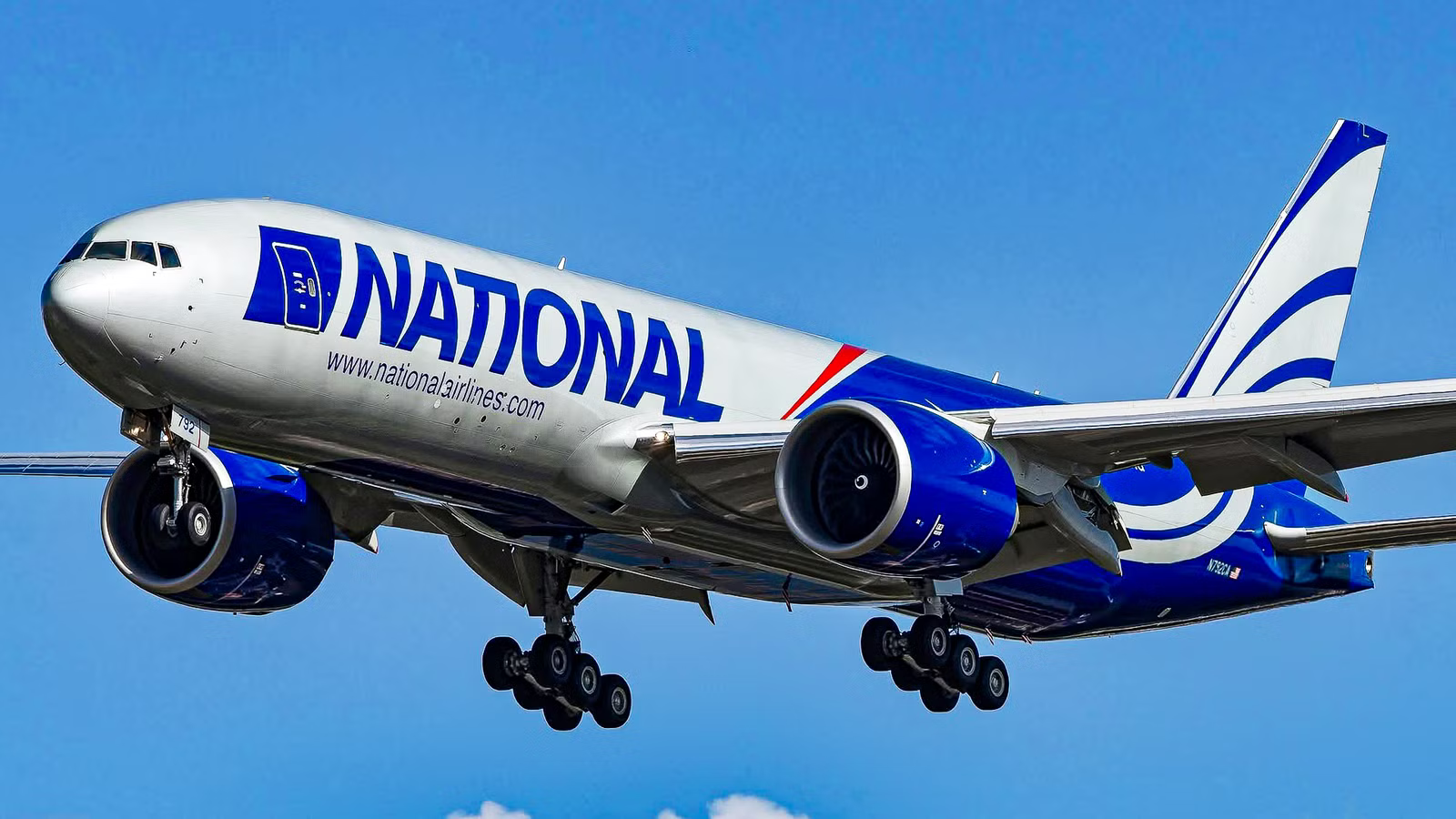
On July 28, a test Airbus A350-1000ULR set a new record when it operated the longest nonstop flight ever flown by a commercial aircraft. The flight, traveling from Melbourne to Toulouse, crossed a distance of 12,460 NM (23,075 km) and remained in the air for over 24 hours, besting the previous record set by the Boeing 777-200LR in 2005.
In a way, however, this wasn’t unexpected: the A350-1000ULR is the longest-ranged commercial airliner ever made, and it’s been designed specifically to operate the world’s longest flights. The more surprising record came a week later, when a National Airlines Boeing 777F flew between Prestwick and Melbourne.
At 9,849 NM (18,240 km), it’s shorter than the records set by the A350-1000ULR or the 777-200LR in 2005, but it is by far the longest flight operated by the 777F. What’s really notable is that the route is far beyond the brochure range of the 777F, published as 4,970 NM (9,200 km). Even more remarkably, the plane didn’t fly empty or with nonstandard fuel tanks.
The Record-Setting Flight For The 777F

On Tuesday, August 4, the Simple Flying Flight Tracker picked up N792CA, a three-month-old Boeing 777F, which was set to operate National Airlines flight N8-820. The filed flight plan indicated that N8 820 was scheduled to fly nonstop from Glasgow Prestwick Airport (PIK) to Melbourne Airport (MEL), a distance of 9,849 NM (18,240 km).
This is greater than the longest scheduled nonstop passenger flight ever (Air Tahiti Nui’s COVID-era nonstops from Papeete to Paris), which lasted 19 hours and 24 minutes. Unlike most other record flights, such as the A350-1000ULR flight between Melbourne and Toulouse, this wasn’t done as a publicity stunt. Rather, the aircraft was chartered by Golden Aviation to carry thrust reverser components for a Jetstar Boeing 787-8 that had been grounded in Melbourne since late July.
The airline lacked the necessary parts, and they were instead sourced directly from Prestwick, where General Electric (supplier of the GEnx engines powering Jetstar’s Dreamliners) operates a major facility. Ordinarily, the components would not have been shipped on a dedicated flight, and commercial freighters almost always make stopovers on longer routes.
However, the cargo was clearly deemed to be extremely time-sensitive, likely since a grounded 787 awaiting crucial repairs not only isn’t making money for the airline, but is also adding costs through parking fees. Given how long the Dreamliner had been on the ground, Jetstar hired Golden Aviation to book a dedicated flight for the reverser components, and the aircraft saved time by flying nonstop to Melbourne.
How This Was Possible (And How Range Figures Are Calculated)

National Airlines, Simple Flying
When aircraft manufacturers publish range figures for their airliners, they’re not advertising how far the planes can fly on a full tank of gas. Instead, they’re calculated to show how far they may fly within airline operations. For a passenger aircraft, this means how far the aircraft can fly with a reasonable number of passengers (around 300 for the 777-200LR) and bags.
However, passengers don’t weigh a lot, and neither do their bags, which means that on an ultra-long-haul flight, fuel will make up a significant component of an airliner’s weight. The 777F, on the other hand, is designed for freight operations, which means that its operators will be loading the aircraft with heavy cargo.
The 4,970 NM (9,200 km) range figure published for the 777F is calculated with a payload of 102 tons, because most 777F customers will fly the aircraft with roughly this much cargo. This number, however, is far higher than what a Boeing 777-200LR normally carries as a passenger airliner, which means that in typical operations, the 777-200LR will fly with far more fuel than the 777F, allowing it to go further.
|
Specifications |
Boeing 777-200LR |
Boeing 777F |
|---|---|---|
|
MTOW |
347 tons |
347 tons |
|
Fuel capacity |
145 tons |
145 tons |
In actuality, the 777-200LR and 777F are essentially the same plane, except that the 777F has a main deck cargo door and an interior designed to carry containers. Because it lacks seats, cabin lavatories, and galleys, the 777F is actually slightly lighter than the 777-200LR when empty. These aircraft are also rated for roughly the same Maximum Takeoff Weight and have the same fuel capacity.
When loaded with the same payload and fuel, the 777F will actually fly further than the 777-200LR, but this rarely occurs because they’re intended for different missions. In this unique case, the only cargo that the aircraft was carrying was extremely lightweight, and the aircraft was flying almost as if it were empty. As such, it could easily operate this route.
Breaking Down Brochure Ranges

The public figures published by aircraft manufacturers are merely estimates published using specific variables that are intended to show a manufacturer’s aircraft in the best possible light for its intended market. These numbers are only really used as a marketing point, and the full data is provided to customers, while estimates can be made from published payload-range charts. The true range of an airliner depends heavily on how it’s configured.
Indeed, a premium-heavy layout weighs more than one with all-economy seats, which increases fuel burn, but adding premium seats also reduces capacity, decreasing the payload that an airliner can carry. Most airlines operating ultra-long-haul flights configure their planes in premium-heavy layouts for this reason. United is placing its latest 222-seat Boeing 787-9 on some of its longest flights and displacing its 257-seat Dreamliners, while Qantas will install just 238 seats on its A350-1000ULRs.
However, in addition to the aircraft’s cabin layout, airlines can spec aircraft with different MTOWs and auxiliary fuel tanks (depending on the model). The 777-200LR was available with up to three extra fuel tanks, but no airline ever selected these.
What’s more, range also depends heavily on winds, with tailwinds allowing aircraft to fly further, while a headwind will cut range. This effect is especially noticeable on transoceanic flights, where winds can make the difference between reliably making a nonstop flight and needing to make a fuel stop.
Catch what other trackers miss
Emergency squawks, holds, NOTAMs — live signals, no signup.
Open tracker
Catch what other trackers miss
Emergency squawks, holds, NOTAMs — live signals, no signup.
Open tracker
Airliners Exceeding Their Brochure Range

The National Airlines 777F flight only comes as a surprise because the 777F’s brochure range is calculated with a heavy payload, as this is how the 777F is normally used. However, this isn’t even the only case of the 777F being flown past its brochure range.
Indeed, before the current conflict in Iran, FedEx Express regularly flew the 777F nonstop between Memphis and Dubai, which spans a distance of 6,697 NM (12,403 km). This was possible because, unlike most cargo airlines, FedEx primarily transports lightweight packages, resulting in relatively low payloads.
The 787-9 is used on several routes that are near its brochure range, such as Qantas’s services from Perth to Europe. This is possible because these jets only have 236 seats, while Boeing’s range figures are calculated with a higher payload. Despite this, the airline still frequently blocks seats on some of its routes to allow for even more fuel, and this is the main reason why Qantas plans to deploy some of its A350-1000ULRs on routes currently flown by the 787-9, as it can carry more payload.
Similarly, there are instances where some airlines struggle to use the full range of their airliners. Wizz Air, for example, is reported to be experiencing difficulties with the Airbus A321XLR’s range. However, the airline has also installed a dense layout on its examples, expecting to carry much heavier payloads than a carrier like United Airlines. What’s more, the A321XLR’s range and MTOW are still much lower than a widebody, meaning that it’s more heavily impacted by factors like headwinds or field conditions.
How Range Is Accomplished & How It Impacts Success

The 777-200LR and 777F have a high MTOW relative to their size, which makes the platform an excellent freighter since most cargo airlines max out on weight before space, and it also allows both types to have exceptional range when carrying a lower payload. However, the platform is also heavy and fuel-thirsty, which wasn’t an issue for the 777F given its strengths for the cargo market.
The 777-200LR, however, proved far more capable than what airlines needed considering the fuel burn, and Boeing only sold 61 units. The Boeing 787-9 has an incredible range, but it’s traditionally been limited by its MTOW, which either cuts into payload or fuel capacity. This is why Boeing upped the aircraft’s MTOW in 2026, further boosting its ultra-long-haul capabilities.
|
Aircraft |
Sales |
MTOW |
Range |
|---|---|---|---|
|
Airbus A350-900 |
1,121 |
283 tons |
8,500 NM (15,750 km) |
|
Airbus A350-1000 |
373 |
322 tons |
9,000 NM (16,700 km) |
|
Boeing 777-200LR |
61 |
347 tons |
8,555 NM (15,843 km) |
|
Boeing 787-9 |
1,465 |
259 tons |
7,875 NM (14,585 km) |
The Airbus A350, on the other hand, is fuel volume limited, which is why the A350-900ULR and A350-1000ULR primarily achieve their added range through boosting fuel capacity. Both of these types are being gradually improved to boost capability, and they’re among the most efficient airliners on sale. Still, ultimately, while the 777-200LR debuted first, the design was much better suited for the cargo market.
The 777F excelled as a freighter that could carry 102 tons of payload across a distance of 4,970 NM (9,200 km), while selling the platform as an ultra-long-haul airliner proved a dead end. The A350 and 787 are tailored for the passenger market and achieve their range through fuel efficiency as well as being just capable enough rather than through brute force, which is why they’re two of the most popular widebody families ever made.