dailynewsnblog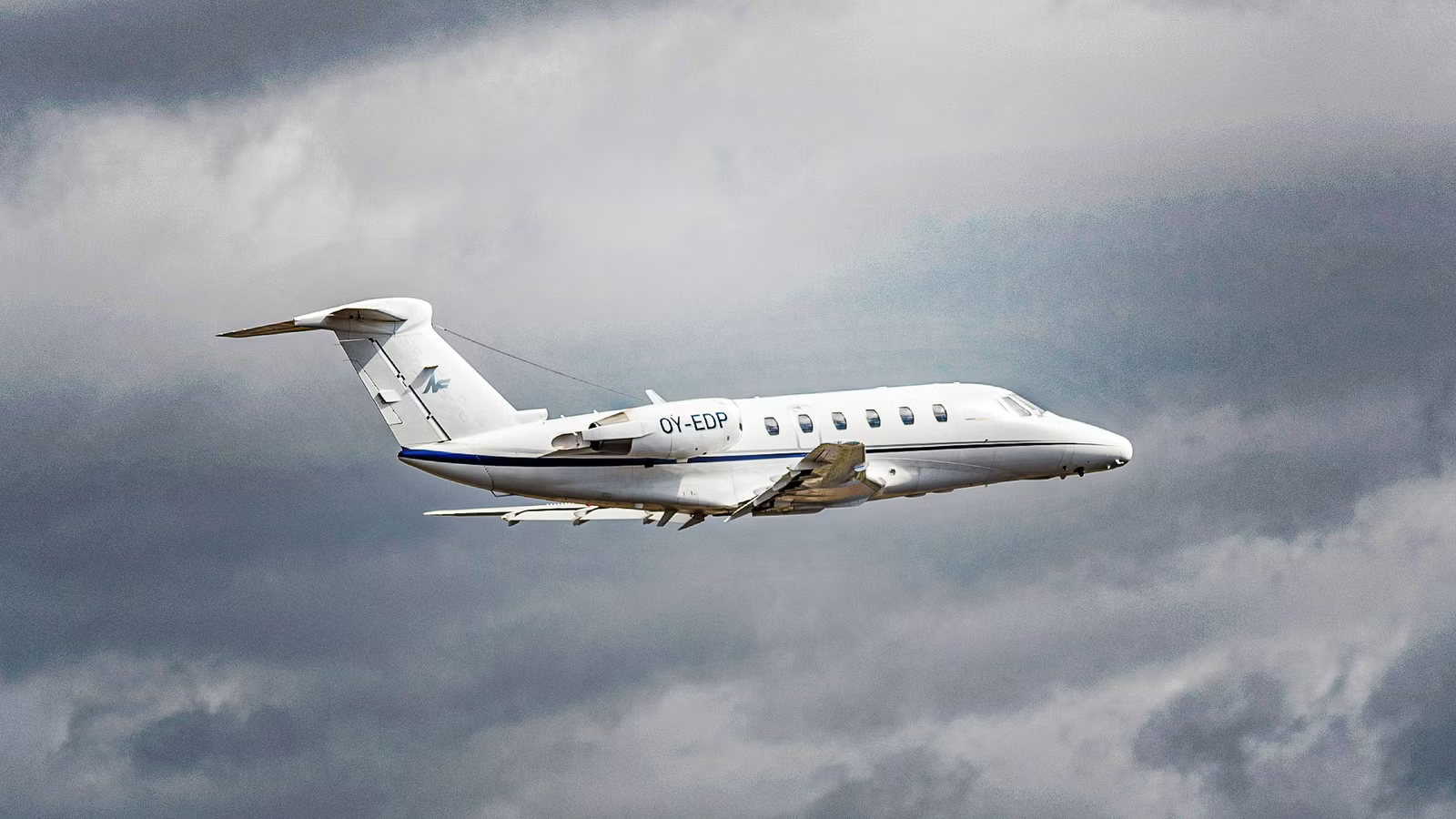
Private jets often cruise above the traffic used by commercial airlines, but the reason is not simply that business aviation has access to a higher layer of sky. The aircraft themselves are optimized for a different mission. A Gulfstream G650, for example, can climb to an initial cruise altitude of 41,000 feet (12,497 meters) and reach a maximum operating altitude of 51,000 feet (15,544 meters), while a Bombardier Global 7500 has the same 51,000-foot ceiling. At those altitudes, business jets can encounter thinner air, lower traffic density, and fewer weather systems, provided their weight, route, and air-traffic-control clearance allow it.
The difference is especially visible with large, long-range business jets. They typically carry far fewer passengers than an airline widebody or narrowbody, yet they are designed to cover thousands of miles at high speed. That combination gives them performance margins that allow higher cruise levels to be useful rather than merely theoretical. It also explains why seeing a Gulfstream or Global several thousand feet above a stream of airliners is a normal feature of the modern airspace system.
Lower Weight Makes High-Altitude Climb Easier
Weight, payload, and climb performance

Weight is one of the biggest reasons a business jet can reach altitudes that are impractical for a heavily loaded airliner. A Gulfstream G650 is certified for up to 19 passengers, although typical configurations carry fewer, while its maximum takeoff weight is about 99,600 lb (45,200 kg). Its two Rolls-Royce BR725 engines each produce 16,900 lb (75.2kN) of takeoff thrust. By comparison, an airline aircraft departing on a long sector may carry hundreds of passengers, their baggage, cargo, and enough fuel for the planned route, reserves, and potential operational contingencies.
Business jets also tend to have long-range missions built around high cruise speeds and high altitudes. The G650, for example, has a long-range cruise speed between Mach 0.85 and Mach 0.90, with a maximum operating speed of Mach 0.925. Its maximum altitude is 51,000 feet, but reaching that level depends on actual weight, temperature, winds, and other conditions. The aircraft does not simply climb to its ceiling on every flight.
Performance Comparison of New Gulfstream Jets and Boeing 787-8 | ||||
|---|---|---|---|---|
Aircraft | Maximum Takeoff Weight | Range | Service Ceiling | Maximum Speed |
Gulfstream G650 | 99,600 lb (45,200 kg) | 7,000 nm (13,000 km) | 51,000 feet (15,544 meters) | Mach 0.925 |
Gulfstream G650ER | 103,600 lb (47,000 kg) | 7,500 nm (13,900 km) | 51,000 feet (15,544 meters) | Mach 0.925 |
Gulfstream G700 | 107,600 lb (48,800 kg) | 7,750 nm (14,350 km) | 51,000 feet (15,544 meters) | Mach 0.935 |
Gulfstream G800 | 105,600 lb (47,900 kg) | 8,200 nm (15,200 km) | 51,000 feet (15,544 meters) | Mach 0.935 |
Boeing 787-8 | 502,500 lb (227,900 kg) | 8,000 nm (14,820 km) | 43,100 feet (13,100 meters) | Mach 0.90 |
Airliners can also climb above 40,000 feet (12,192 meters), and some have certified ceilings higher than their usual operating levels. The difference is therefore one of operational economics and performance, not a hard division between aircraft categories. A private jet’s smaller payload makes high-altitude operations more readily available, while an airliner often gains more from carrying a larger number of passengers efficiently at a lower cruise level.
Engines And Airframes Are Designed For Thin Air
High-altitude engineering

The atmosphere becomes progressively less dense as altitude increases. That creates both advantages and engineering challenges. Less dense air reduces aerodynamic drag, which can improve cruise efficiency, but it also means the wings receive less air to generate lift and the engines have less oxygen available for combustion. An aircraft must therefore be designed to maintain adequate thrust, lift, and control authority as it climbs.
Large business jets are engineered around these requirements. The Bombardier Global 7500, for example, has a maximum operating altitude of 51,000 feet, a maximum takeoff weight of 114,850 lb (52,100 kg), and two GE Passport turbofans. Its certified maximum passenger capacity is also 19, so Bombardier combines a relatively small passenger cabin with long range, high speed, and a high operating ceiling. The Global 7500, and all long-range business jets, are purposefully designed to be light and fast to safely operate in thinner air compared to airliners.
There is also an aerodynamic tradeoff. At very high altitude, the margin between the speed needed to generate sufficient lift and the speed at which compressibility effects become limiting becomes narrower. That is one reason an aircraft’s certified ceiling is a performance boundary rather than simply an altitude target. High-altitude business jets are engineered to operate within that envelope, but they still require appropriate flight planning and weight management. In other words, a 51,000-foot ceiling does not mean every private aircraft flies there. Light and midsize business jets may have lower maximum altitudes, while weather, traffic, aircraft weight, and route requirements can make a lower level more efficient. The aircraft’s design creates the option, rather than guaranteeing its use.
Higher Flight Levels Put Them Above The Main Traffic Flow
Airspace and routing flexibility

Airspace congestion provides another reason private operators value altitude. The FAA’s Reduced Vertical Separation Minimum (RVSM) system covers flight levels from 29,000 through 41,000 feet (8,839 through 12,497 meters) and permits aircraft to be separated vertically by 1,000 feet (305 meters) when the aircraft and operator meet the required standards. Above 41,000 feet, standard vertical separation generally increases to 2,000 feet (610 meters) in US airspace.
This structure creates a useful dividing point. Much scheduled airline traffic is concentrated below or within the RVSM band, while aircraft capable of sustained flight above FL410 have access to additional flight levels. A business jet at FL450 or FL470 is not automatically free from other traffic, but it may encounter fewer aircraft than it would in the busiest portions of the airline cruise structure. The FAA describes RVSM as a means of increasing airspace capacity and allowing more efficient flight profiles.
Higher altitude can also provide dispatchers and crews with another option when selecting a route and cruise profile. A private flight does not necessarily need to follow the exact altitude pattern of a nearby airline flight, because the two aircraft may have different performance characteristics, destinations, fuel requirements, and preferred routing. Controllers still determine clearances, and private operators remain subject to the same separation requirements. The benefit is therefore flexibility rather than unrestricted access. A Gulfstream cannot simply select 47,000 feet whenever it wants. The requested level must be available, compatible with the aircraft’s performance, and approved by air traffic control. On busy routes, weather deviations, military activity, oceanic procedures, or other traffic can eliminate the advantage.
Higher Altitudes Can Reduce Exposure To Weather
Weather avoidance and ride quality

Private jets also benefit from being able to climb above portions of the weather that affect lower flight levels. Most significant thunderstorms are associated with deep convective clouds that can extend through normal airline cruise altitudes, so climbing higher does not eliminate the need for weather avoidance. Crews must never treat altitude as permission to penetrate a thunderstorm simply because the aircraft can fly above it.
For non-convective weather, however, altitude can change the ride and the routing problem. Much of the cloud layer, precipitation, and turbulence associated with ordinary weather systems exists below the highest cruise levels available to large business jets. Flying above those layers can produce smoother conditions when the aircraft is clear of significant convection and other hazards. The FAA notes that aircraft can sometimes fly over thunderstorms when sufficiently above their tops, but crews must otherwise route around hazardous weather.
Weather remains a variable rather than a guaranteed benefit. Jet streams can produce strong headwinds or tailwinds at high altitude, and crews may choose a lower level when winds make it more efficient. Temperature deviations, turbulence, icing during climb and descent, and convective activity can also influence the selected altitude. The practical advantage is ultimately that a private jet has more altitude options available when conditions change. An airliner may already be operating in an altitude band shared by many other aircraft, while a capable business jet can sometimes request a higher level to find better winds, smoother air, or a more favorable route. The decision remains dependent on traffic and controller approval.
Cabins Are Designed To Make High Altitude Comfortable
Cabin pressure and passenger comfort

The final reason is less obvious because passengers do not experience the aircraft’s outside altitude directly. What they experience is cabin pressure. A business jet can cruise at very high flight levels while maintaining a cabin altitude far below that figure, allowing passengers to experience conditions more comparable to a much lower elevation. The Gulfstream G650 provides a clear example. Business Jet Traveler reports a cabin altitude of about 3,290 feet (1,003 meters) when the aircraft is flying at 41,000 feet, rising to roughly 4,100 feet (1,250 meters) at 51,000 feet. Gulfstream’s pressurization design therefore allows the aircraft to operate in extremely thin outside air without exposing occupants to the equivalent atmospheric pressure of 51,000 feet.
That capability is tied directly to the aircraft’s structure and pressurization system. The fuselage must withstand the pressure difference between the cabin and the surrounding atmosphere, while the environmental-control system maintains temperature, pressure, and airflow throughout the flight. Gulfstream also uses a 100% fresh-air system on the G650, with the cabin air replaced approximately every two minutes, cited by Business Jet Traveler.
The lower cabin altitude can be particularly useful on long flights. Passengers are spending many hours in a pressurized environment, so reducing cabin altitude can help create a more comfortable atmosphere than simply maximizing the aircraft’s exterior cruising height would suggest. It also allows manufacturers to make high-altitude performance part of the passenger experience rather than treating it solely as an aerodynamic advantage. This is a design point seen on long-range airliners as well, such as the 787 and Airbus A350.