dailynewsnblog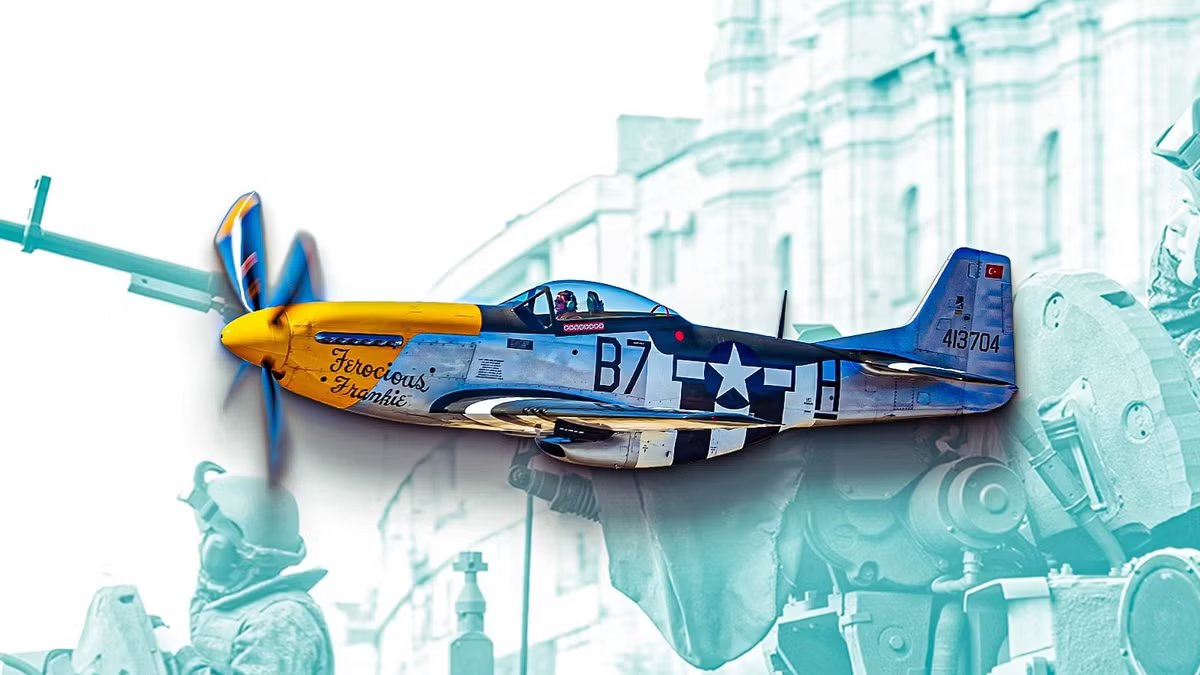
The North American P-51 Mustang is debatably the most iconic and historically significant military aircraft ever constructed. Although the airplane did not begin as a resounding success, its greatest moments took place in the later years of World War II(WWII). Yet after North American teamed up with Rolls-Royce in the United Kingdom, the resulting airplane changed the course of history.
It is not hyperbole to say that the P-51 is in many ways directly responsible for the Allied victory over the Axis forces in WWII. This is because the Mustang dramatically reduced the horrific combat losses Allied bomber crews suffered after it joined the fight. In 1944, the US Army Air Corps 8th Air Force was losing bombers over Germany faster than it could replace aircrew. No fighter escort could make the long trek from Allied airfields into hostile airspace to defend them at that time.
By 1945, the balance of power in the sky over Europe had completely reversed. The Luftwaffe had collapsed in fighter strength and was resorting to desperate measures to continue the fight against an unrelenting adversary. While the P-51D is remembered as the best and most iconic, it was the P-51B that introduced the most important design changes that made it the legendary fighter still renowned today.
Unprecedented Fuel Capacity Plus Drop Tanks
Defending the bombers all the way to the target area and back

It is true that the performance improvements of the P-51D Mustang are among the most important design changes that made it a deadly air-to-air dogfighter, but debatably the range improvements were more strategically valuable. Partway through production of the B model series, North American added 85 gallons of extra fuel in a fuselage tank behind the pilot seat, adding about 30% to total capacity. Combining that with two 75-gallon external drop tanks gave it just a bit more fuel than the twin-engine Lockheed P-38J Lightning.
As a single-engine fighter, that equated to a massive increase in overall combat radius. In the later P-51D variant, the drop tanks increased to 110 gallons, giving the plane a total capacity of 489 gallons, or about 20% more than the P-38. This design change alone saved thousands of lives by providing defensive escort for more bombers flying over hostile airspace. The mere presence of a fighter flying alongside a bomber formation was often enough to deter intercepting Axis pilots from engaging at all.
Strategically, this enabled the Allies to conduct a far more decisive aerial bombing campaign while suffering far lower losses in aircrew and aircraft. Once the Mustang was in hostile airspace, the engine enhancements provided by the Rolls-Royce Merlin engine, license produced by Packard in the US, gave it the performance to dominate enemy planes like the Messerschmitt Me-109 or Focke-Wulf Fw-190.
Laminar-flow Airfoil Innovations
North American teamed up with NASA’s predecessor to cut drag and raise air speed

To refine the wings for the Mustang, North American worked together with the National Advisory Committee for Aeronautics, precursor to the National Aeronautics and Space Administration (NASA) we know today. The new airfoil that they crafted moved the maximum point of thickness from the leading edge of the wing back to a much closer point near the wing cord. This decreased the lower skin friction drag by holding the laminar boundary layer much further aft over the wing surface.
Flank testing showed that the P-51 B’s high-speed drag figures were much lower than the previous variant. With a new engine, the plane recorded test runs at 453 mph (729 km/h) true airspeed at 28,800 feet. The primary benefit of the laminar-flow design was its exceptional energy retention. While the P-51B was relatively heavy due to its massive internal fuel capacity, the improvement meant it accelerated aggressively in a dive and sustained high speeds without burning excess fuel.
To achieve this smooth laminar airflow in combat conditions, North American aviation had to treat the wings meticulously. Factory workers used a plastic Bondo-type filler to smooth out all rivet lines and panel seams across the front of the wing. They then sanded the wings perfectly flat and coated them in thick silver primer.
In a way, this improvement also set a precedent for the high maintenance nature of many following American fighter designs. While the performance enhancement was valuable and tangible, it required more care on the ground between sorties to maintain the advantage. If a crew chief let mud, crushed bugs, or chipped paint accumulate on the leading edge, the laminar flow broke down into turbulent air, costing the pilot a noticeable margin in top speed.
The Meredith Fuselage Radiator
The Meredith Effect almost entirely canceled out the aerodynamic drag caused by the radiator itself

Liquid-cooled fighter engines had always paid an aerodynamic tax: the radiator needed to sit in the airstream, and the drag of pushing air through it scaled with speed. North American engineered a workaround that drew inspiration from research published earlier in 1935 by aerodynamicist FW Meredith in the United Kingdom. The theory was to use a diverting duct ahead of the radiator to slow incoming air, which would absorb waste heat, and then accelerate the hotter expanded air through a nozzle.
The combined effect of the diverting inlet in front of the radiator with the exhausting nozzle behind it created a balanced system. While the frontal surface area incurred a drag penalty, the nozzle at the aft produced a small amount of thrust. Together, the two forces effectively canceled each other out and allowed the radiator to cool the Mustang’s engine without diminishing the overall aerodynamic profile.
How close that thrust came to fully canceling cooling drag remains genuinely disputed. Some published estimates claim the Meredith duct offset as much as 90% of the P-51’s cooling drag at speed, while others put the recovered thrust at about 250-400 pounds (113-181 kg). More importantly, the radiator allowed the P-51B Mustang to carry the massive, immensely powerful engine that made it an unmatched high-altitude dogfighter.
Supercharged Packard V-1650 Merlin
The Merlin 65’s two-stage mechanical supercharger was optimized for 441 mph at 29,800 feet

Pairing the P-51B Mustang airframe with the Rolls-Royce Merlin V-1650 engine introduced a two-speed, two-stage supercharger. By American test pilots’ own accounts, the original Allison-engined P-51 was an excellent aircraft below about 15,000 feet and a mediocre one above it. The engine could produce as much as 1,400 horsepower, transforming the Mustang from a mediocre low-altitude platform into a powerhouse of air superiority.
The National Museum of the US Air Force records a Merlin-converted Mustang reaching 441 mph at 29,800 feet in testing, or about 100 mph faster than the Allison-powered P-51A. The first re-engined P-51Bs arrived in late 1942, when Mustangs on both sides of the Atlantic were experimentally re-engined with the Rolls-Royce Merlin. The new powerplant used two successive impellers to compress thin high-altitude air, maintaining massive horsepower up to 30,000 feet.
The technical elegance of the two-stage Merlin masked a long list of engineering nuances. The Merlin engine was bigger, heavier, and more mechanically complex than the Allison that came before it. The intercooler alone required its own dedicated radiator and circulation loop. Hence, the innovative design for the radiator inlet was such a vital modification. None of that mattered because for the first time, an American fighter could out-climb, out-run, and out-fight the Luftwaffe’s best interceptors at the altitudes where the bombing campaign was being decided.
Automated Aiming For American Dogfighters
The K-14 gyroscopic computing gunsight’s rapid accuracy

Much of the emphasis in accounts of why the P-51 Mustang made such a difference in the air battle over Europe during WWII focuses on the airframe and engine, yet the cockpit also held an innovative piece of technology that shifted the balance of power in favor of the Allies. The K-14 gyroscopic gunsight arrived in the later batches of the P-51B with its automatic lead-computing reticle display.
According to ww2aircraft.net, estimates suggest that only about 5% of pilots could master the spatial awareness required to mentally calculate the speed, distance, and angle of an enemy aircraft during a dogfight. The other 95% of fighter pilots underestimated the necessary lead and missed many of their burst fire salvos, wasting large portions of their ammunition reserve.
The K-14 made every single bullet fired from the Mustang more deadly by eliminating guesswork for the pilot pulling the trigger. Instead of relying solely on tracer rounds and estimating how far to lead the target, the new gunsight provided an analog mechanical computer that did the math. It displayed this calculation as two circles on the windscreen: one fixed crosshair and a dynamic moving ring known as the ‘pipper.’
The only thing a Mustang pilot had to do was to adjust the mechanical lever on the gunsight which input the known wingspan of a target aircraft. Aircrew just had to remember one number, like ’30’ for the 30 feet (9.14 meters) wingspan of a Bf-109, and set the K-14’s compensation to ’30,’ while the pipper automatically adjusted. The Mustang’s improved accuracy meant less wasted ammo and more destroyed enemy fighters, keeping planes on station longer and greatly increasing their aerial victory rate.