dailynewsnblog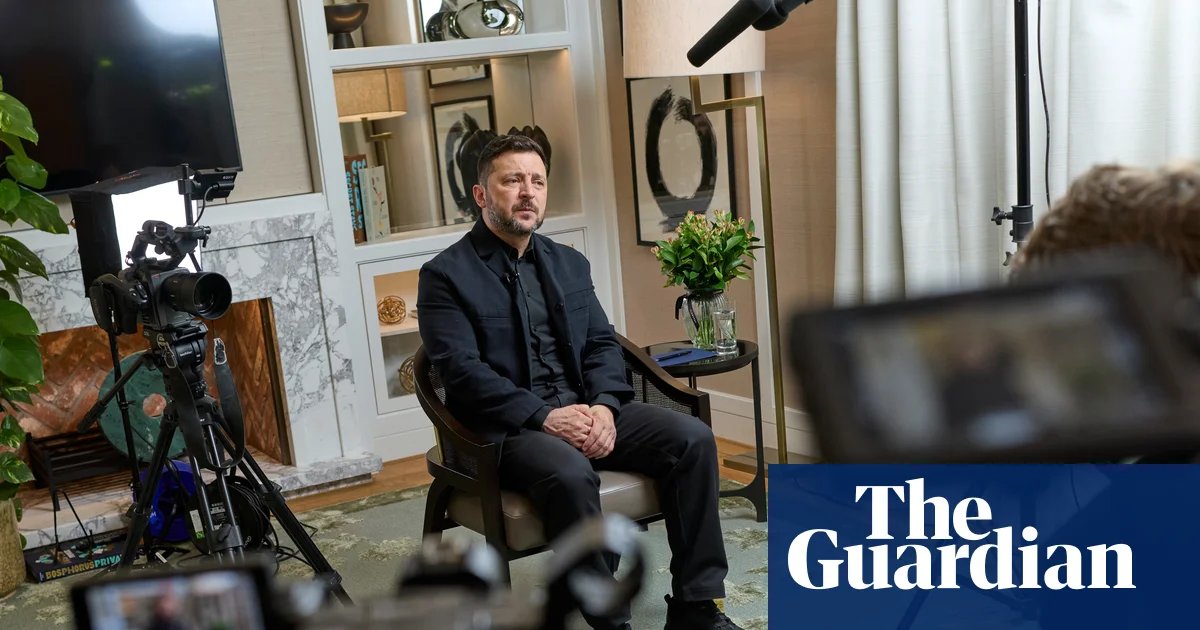
Volodymyr Zelenskyy has said the decision by some Reform UK councils to take down the Ukrainian flag was the kind of “small mistake that can break a big friendship”, as he underlined the significance of strong bilateral relations.
The Ukrainian president tempered his rare foray into UK domestic politics by stressing how much the two countries “need each other” in the battle against Russia, which he said posed a threat not only to Ukraine but to Britain too.
In an interview with the Guardian after talks with Keir Starmer, Emmanuel Macron and Friedrich Merz in London to discuss the next steps in the conflict, he said Ukraine’s military position was the strongest it had been for more than two years. “Russia is not winning,” he declared.
Zelenskyy revealed that he planned to invite the king, whom he met later on Monday at Buckingham Palace, for a state visit to Ukraine as early as this year, after Charles’s public show of support over personal attacks by the US president, Donald Trump, at the White House last year.
The Ukrainian president also disclosed he had pressed Starmer over funds from Roman Abramovich’s £2.4bn sale of Chelsea FC, which the government has earmarked for humanitarian purposes in Ukraine, and that he wanted the UK to be aligned with the rest of Europe on sanctions.
During his visit to London, Zelenskyy attempted to reassure Britons that continuing to support Ukraine was in their national interest – after successive UK governments spent more than £20bn on military, humanitarian and economic assistance since Russia’s full-scale invasion in 2022.
“British people helped us from the very beginning of this war, it’s true. It’s because of security, not only values … But it’s about security in Europe. It’s in the interests of the UK,” he said.
Asked whether Reform UK should put Ukrainian flags back on council buildings in a display of solidarity, after Nigel Farage’s party said only the St George’s and union flags would be flown, he said: “I hope they will put it back.”
He added: “I don’t want to be involved in any political things, but you know, the world is so sensitive today. Sometimes little, small mistakes can break big friendship or huge contacts.
“I think people have to not make mistakes, not to do anything which can break a friendship, and even if people do it [I would say:] ‘OK, so you did it, please let’s come back to the table, let’s speak, let’s understand each other.’”
Zelenskyy said that with Russia as a neighbour, European nations must stand together. Putin had maintained control in the country for three decades on the basis of “pressure on his society and pressure on Europe” rather than on economic success, he said.
Resistance to Russia’s war in Ukraine represented a “big chance to be really independent” from Moscow’s influence on Europe, he added, saying: “So we can’t lose each other with UK.”
With the UK government under intense pressure to increase military spending, Zelenskyy also highlighted the importance of Ukraine’s allies continuing to invest in their own defence, adding that his country would share its “priceless” technological experience with them.
“It’s very important to invest not only in military, to invest in Ukrainian military … because of this war, we have such experience. There is no price of this experience. It’s not about money, it’s about people’s lives. We will share this priceless information and experience with our allies.”
Before a Nato summit in Ankara, Turkey, next month that could prove a pivotal moment for the alliance, Zelenskyy reiterated that it would be in the interests of western allies, as well as Kyiv, for his country to join.
“We spoke a little bit about it with the E3 countries [France, Germany, and the UK]. They understand that today to have Ukraine in Nato, it’s in the interests of Nato. Of course, it’s in also the interests of us, to be a part of big alliance, and to be with our friends who helped us during the war, to strengthen Nato.”
Zelenskyy suggested that turning over the proceeds of the sale of Chelsea to Ukraine, could help fund antiballistic missiles to shoot down Russian weapons, often fired at Ukraine’s energy infrastructure.
Officials are preparing for a possible court case after the Russian billionaire failed to release the funds by the deadline, amid a dispute over how it will eventually be used.
“The prime minister told me that he’s trying his best, and I know that our diplomatic teams speak about it, and of course, it’s difficult moment. We need more security, and we are trying, through the Purl programme, to buy antiballistic missiles from the United States,” he said.
“They are very expensive, and of course this money can help, and it’s fair between us. So Russia began this war. Why not use Russian money?”
He joked that Abramovich had not brought the money with him when they met in Kyiv last month. “He didn’t bring this money. I said: ‘We need your money.’”
Zelenskyy said he had asked Starmer and allies for more help “closing the sky” from Russian attack and for funds to put Ukrainian soldiers on professional contracts, rather than enlisting them sometimes against their will.
After the UK was forced to reassure Kyiv its new sanctions policy on Russia – which allows the temporary import of Russian oil and jet fuel via third countries – did not weaken restrictions, Zelenskyy said “of course” he would like to see Britain and Europe closer aligned on the issue.
Although he welcomed UK sanctions against Russia’s shadow fleet, he said Ukraine needed more sanctions against Moscow “as quickly as possible”, to deter Putin from escalating his military attacks to “fight to the end” in the conflict.