dailynewsnblog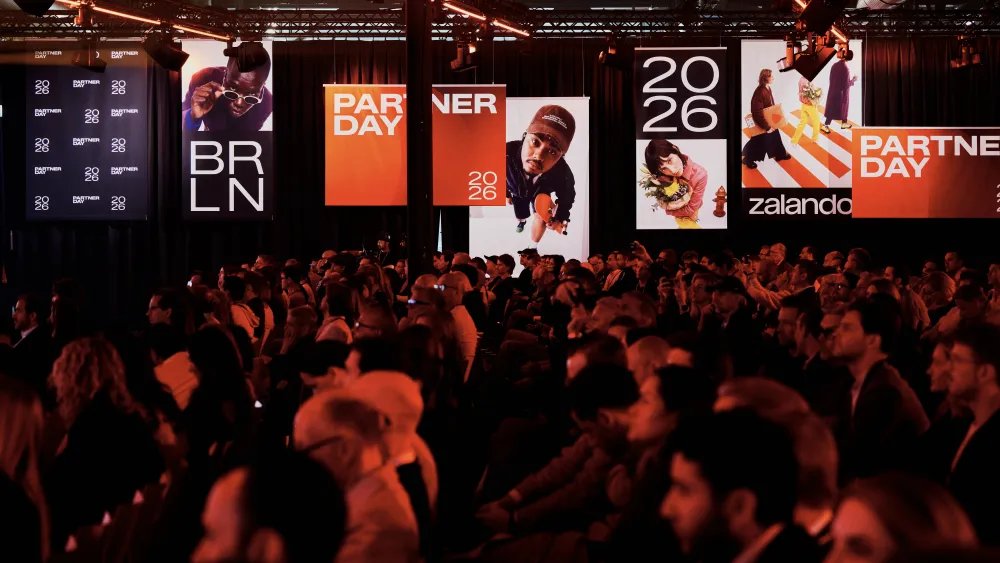
German online fashion retailing giant Zalando last week held its annual “Partner Day,” an event at which senior managers from the world’s biggest brands come to hear about the latest developments in online shopping and platform technology.
Zalando has held the event since 2014 and this year about 750 people attended talks and workshops in Berlin. Attendees included representatives from a variety of fashion brands, from Adidas, Calvin Klein, Levis, Lagerfeld, Lacoste and Guess to New Balance, Nike, Next and Triumph.
Given Zalando is one of Europe’s largest online fashion retailers, it was perhaps not surprising that the present and future use of artificial intelligence, or AI, was a major topic at the event.
“AI is changing everything we do,” Zalando co-founder David Schneider proclaimed from the main stage at the start of the event. “The rise of mobile [technology] changed customer behavior… the rise of AI is much deeper, a fundamental change.”
“Does AI help create awareness for my online shop? Does AI help me convert traffic into orders?” Tarek Mueller, managing director at About You, the German online fashion retailer that Zalando acquired in July 2025, asked in his opening remarks. “Does it help me to get more efficient and improve margins?”
The answers to those all-important questions are not all affirmative.
Mueller explained that right now, commonly used AI applications like ChatGPT by Open AI or Claude by Anthropic — also known as large language models or LLMS — send less than 0.5 percent of traffic to online fashion stores. Google and Meta, the owner of Facebook and Instagram, are still the main drivers of traffic for online fashion, Mueller said.

About You managing director Tarek Mueller (left) on the main stage at Zalando’s ‘Partner Day’ event in Berlin.
But there is another area where AI has already made a serious difference and where it is boosting sales and improving margins – content production, for both product detail pages and for more complex marketing campaigns and materials.
Zalando and About You have both almost completely eliminated the dedicated studios they previously ran to produce content and catalogue-style product pictures.
“Around 70 percent of what you see behind me was created with AI,” Matthias Haase, Zalando’s vice president for content solutions, said in another seminar, gesturing at the room-sized video panel behind him. It was covered in colorful pictures, some moving, others still. Among the only areas AI isn’t used is on content featuring real-life talent such as Zalando brand ambassador, actress Lily Collins, Haase noted. Collins was also in Berlin for the partner day event.
There’s going to be a lot more AI-created lifestyle content coming, too, James Rothwell, the firm’s senior vice president for marketing and content, told the audience during his keynote address in which he explained how advertising and marketing had changed. “Eighteen months ago, Zalando was not a content publisher,” Rothwell said. But, thanks to AI, Zalando has been moving away from traditional advertising and into things like making its own short films.
Using generative AI to present products instead of actually photographing them has reduced spend on that by around 90 percent, Mueller said. About You used to spend around 7 million euros on this budget line and AI has saved it around 6 million euros, he told attendees.
About You had been working with AI-generated model and product shots for about 18 months but it was only about six months ago that the “real breakthrough” came, Mueller stated.
That breakthrough meant that AI wasn’t just reducing costs but also increasing the platform’s conversion rate.
Muller explained why. A brand might find a fashion model that really worked with their products, that consumers related to, who made them want to buy more, he recounted. “But then they move to Milan and you can’t book them again,” he argued. “Or the stylist has a bad day, or certain products are not available. It’s very hard to replicate what works. But AI is learning what works — and it can replicate it.”
About You is also home to Scayle, dedicated software for e-commerce, and Scayle Studio, which uses AI for content creation.
Scayle Studio offers brands a variety of AI-generated models of all ages — although admittedly quite a few do look like different generations of one very beautiful family with dark eyebrows and big lips. These models have poses like “open laugh” or “confident cool.” Styling options, like shoes and sunglasses, can be added as well as lifelike backgrounds; the models will then move around in the garment in a video.

An example of campaign content Zalando created using generative AI.
Made with Google AI
One garment or look can be shown in dozens of pictures and the AI will decide what works best and how to present this. How the advanced algorithms make that decision can be based on A-B testing by its owners but it’s also increasingly based on fine-grained data gathered from shoppers, something Zalando has been doing for 18 years.
Mueller points out that they already know some looks, styling or even poses work better in certain marketplaces than others.
“It’s a very individual thing. It’s the same for styling, it really depends on who and what you are,” Mueller told WWD during an interview. And this will become part of how AI is used to increasingly personalize what each customer sees, he noted.
“The algorithm becomes much better in recommending you things but also in recommending them to you in a way that is personalized. So it might recommend me a product I like, but also styled in a way I like it, or even styled on me, or maybe a model I relate to.”
Zalando has also been able to use this kind of AI-fueled content creation to react more quickly to trends and seasonal events, Haase told WWD. Previously Zalando would shoot a product once. “And then it stays there until it’s sold out,” he said.
Now Haase gets a special report every morning around 7 a.m., compiled by an AI agent that’s been crawling social media for what’s popular or trending. “They pull the five most relevant of what we call ‘micro-trends’,” he explained.
The AI agents will also predict the potential life cycle of the trend — that is, whether it will last longer or be gone by tomorrow. Haase’s team also checks if Zalando customers might be searching for the trend, as a way of validating the agents’ information.
Haase namechecks the most recent Met Gala in New York as an example. After picking up on the trend for “arty fashion,” Zalando launched a marketing campaign the day after the gala, which resulted in a consequential uptick in wish lists and followers for relevant brands.
Zalando already had a fast turnaround on campaigns, Haase noted, somewhere between six to eight weeks for the fastest. “But even six to eight weeks is too long to grab a micro trend.”

Matthias Haase, Zalando’s vice president for content solutions, speaks at a seminar during Zalando’s ‘Partner Day’ event in Berlin.
The use of AI to replace live models and catalogue photographers obviously has an impact on human resources. Haase addressed this, saying that of the 90 positions that were lost when Zalando’s product studio was closed, around 60 people were able to be relocated elsewhere in the company.
And human creativity does remain important, he argued: “Maybe [what the AI selects] fits the trend, it fits the style but it just doesn’t look good. That’s where the human comes in and says, ‘out, out, out’.”
In the future, company insiders say, the algorithms will get even better at analyzing your data and predicting what you want before you want it.
The more data an LLM is trained on, the smarter it becomes — and there is still more customer data incoming at Zalando.
For example, right now, Zalando isn’t really using the text conversations shoppers are having with its online assistant but is likely to do so in the future.
And the more people shop, the larger data trail they leave behind from which personalized recommendations can be made. At another keynote during the Zalando event David Fisher, founder of media and fashion brand High Snobiety, spoke about how beauty, sport and groceries are markers of status and offer even more usable insights. Zalando is working hard on pushing the two former categories.
But there are other aspects of AI in online fashion shopping that are not yet fully operational and likely won’t come as fast or possibly ever be as useful. One of those is AI-powered shopping assistants or agents.
An AI agent is basically a program or software that uses an LLM’s computing power and reasoning to execute a certain task for its owner. Mueller pointed out that Open AI has already moved away from plans for AI-driven shopping assistants and has instead been selling advertising. Google continues to work on a shopping assistant but at the moment, while those sorts of assistants can search for a product, they cannot do the transaction for you. Mueller thinks that even when those shopping assistants do improve —he predicts within five years or so — they might not be much help to anybody truly looking for wardrobe inspiration.
“I think shopping can be divided into two [use] cases — one that’s about transactions in general, like booking flights or hotels. It’s a job to get done. But in fashion, the majority of money is not spent like this,” he pointed out. It’s more about inspiration and style and the shopping “journey.”
That’s the background to Mueller’s three predictions for the near-term future of AI in fashion.
AI-driven content creation is the first because what he calls “a combination of a fashion magazine and e-commerce” is important for inspiration and the shopping journey.
“Secondly, everything becomes more personalized,” Muller continued. “So through things like virtual try on, what your online shop recommends to you, everything will become much more personalized and tailored to you. That’s a mega trend. And I would say the third trend we are seeing is on the delivery side. Recycling gets faster, more reliable, and everything becomes more frictionless.”
The future of AI involves a combination of all three, he concluded: “More inspirational, more personalized and less friction.”