dailynewsnblog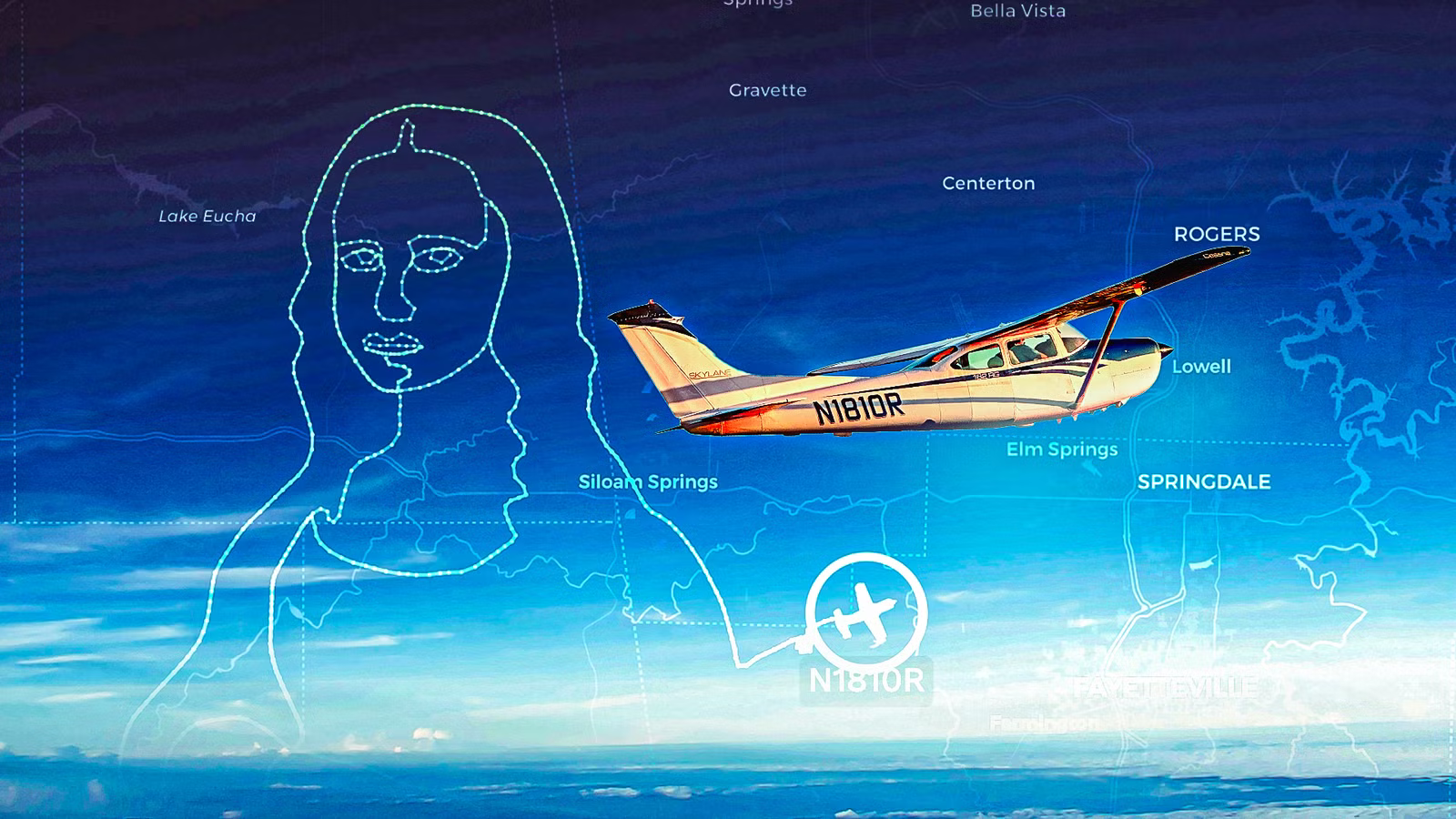
An aircraft is normally expected to leave point A, follow a planned route, and arrive at point B, as can be seen from our flight tracking data. But for some pilots, the flight path itself has become an adventure, using aircraft to turn the sky into a giant canvas for drawings, words, and recognizable shapes.
That sounds simple until the drawing becomes something as intricate as Leonardo da Vinci’s Mona Lisa. Benjamin McDaniel has taken aircraft-based sky art to that level, using a Cessna R182 Skylane RG to recreate one of the world’s most famous paintings and other works of art. But how do you turn a portrait into something an aircraft can actually fly, and what happens when you can’t erase a mistake?
Why Pilots Are Turning Flight Paths Into Art

Aircraft drawings in the sky are not a completely new phenomenon. Pilots have used aircraft to create visible messages, particularly through traditional skywriting, in which smoke released from an aircraft forms letters and words against the sky. The practice dates back to the early 1920s, when British pilot Captain Cyril Turner demonstrated skywriting over Epsom Downs in England before later writing “Hello U.S.A.” over New York City.
Traditional skywriting and modern flight-path art, however, are very different. A skywriter is effectively using an aircraft as a pencil and smoke as the ink, with the finished message visible from the ground. Modern “sky art,” by contrast, uses the aircraft’s actual track as the drawing, with flight-tracking services and digital mapping allowing people to see the resulting shape after the flight, or even during it.
The growing availability of sophisticated flight-planning software has made this form of aviation art much more accessible. Flightradar24, for example, documented a 2023 flight in which a Piper PA-28-161 created a ballerina in the sky. The drawing measured approximately 25 miles (40 km) tall and 11.7 miles (18.8 km) wide, while the entire flight lasted 1 hour and 33 minutes. Flightradar24 blog noted that advanced flight-planning software was helping pilots make their sky art more intricate.
For some pilots, there is also a practical reason to experiment with these flights. Sky art can also give pilots another reason to spend time in the aircraft while practicing navigation, planning, and precise flying. That was certainly part of Benjamin McDaniel’s motivation, although his experiments eventually progressed far beyond simple shapes and words.
Catch what other flight trackers miss
Emergency squawks, holds, NOTAMs — live signals, no signup.
Open tracker
Catch what other flight trackers miss
Emergency squawks, holds, NOTAMs — live signals, no signup.
Open tracker
Benjamin McDaniel Started Sky Art As A Way To Build Flight Hours

McDaniel’s route into aviation began in 2020, following a discovery flight that changed his plans for the future. He then attended Auburn University, where he graduated in Aviation Management, before building his flight experience as an instructor. His instructional career included flying for Auburn and later working for WaterWings Seaplane School as a multi-engine sea and multi-engine land instructor. Away from instructing, he kept looking for opportunities to fly, and during this time the idea of creating drawings with an aircraft began to emerge.
“I started sky art as a fun way to build hours and stay sharp outside of instructing,” McDaniel told Simple Flying. Around fall 2023, he began experimenting with simple shapes and words. What began as a practical exercise quickly became something he genuinely enjoyed.
The designs became increasingly ambitious. In summer 2026, McDaniel flew a Lord of the Rings piece that drew online attention and encouraged him to push the concept further. Instead of simply creating a recognizable symbol or word, he wanted to see whether he could reproduce one of history’s most famous paintings.

“The Mona Lisa is the favorite right now,” McDaniel said. “It’s the most ambitious one I’ve finished.” His choice was also intended to give the project a distinctly personal connection. “It’s one of the most recognizable pieces of art in the world. I wanted a modern twist on it by doing the thing I love, flying.”
That decision created a very different challenge from drawing a simple geometric shape. A human face contains curves, proportions, and subtle features, all of which had to be translated into a route that an aircraft could physically fly.
Turning The Mona Lisa Into A Flight Plan

Before taking off, the first step in creating McDaniel’s Mona Lisa is figuring out whether the image can be converted into a practical flight path.
“I start with an idea, then break it down into a drawing an airplane can actually fly,” McDaniel explained. His primary planning tools are ForeFlight, an electronic flight bag application, and an Apple Pencil, which he uses to draw and annotate the proposed route.
There is an important difference between planning the image and simply programming a series of points into an aircraft’s navigation system. McDaniel says he hand-flies all his tracks and does not use GPS waypoints for the artwork.
That means considerable work has to happen before the aircraft leaves the ground. He has to determine headings, distances, and turns that he can realistically fly in his small Cessna. The route has to function as both an artistic composition and a legitimate flight path.
“If I can’t fly it cleanly, and more importantly safely, it doesn’t go in the plan,” McDaniel said.
The Mona Lisa’s face presented one of the greatest challenges because small deviations can disproportionately affect the finished picture. The aircraft must follow a continuous path, so the pilot can’t stop at one point of the drawing and reposition the aircraft for the next stroke.
“Planning took longer than the flight,” McDaniel explained. He had to find a way to draw the entire piece in a single continuous path, which becomes particularly complicated when reproducing detailed facial features.
The final flight represents only the visible portion of a much longer process. Before McDaniel begins drawing in the sky, he must first determine whether every individual line can be converted into a sequence of headings, distances, and turns. And once that planning is finished, the hardest part remains: actually flying it.
The Aircraft Has To Follow The Artist’s Instructions

Benjamin McDaniel | Simple Flying
McDaniel flies his sky art in a Cessna R182 Skylane RG, and the aircraft’s characteristics directly influence what he can create. The airplane’s speed, how long it can stay airborne, and how much fuel is available all factor into the equation.
“Speed and how long I can stay in the air are the big factors,” McDaniel said. “Fuel, weather, and focus are the real limits.”
Unlike an artist working on a canvas, McDaniel cannot make the aircraft wait while he considers the next line. A turn has to happen at the right point, at the right rate, and under conditions that let him maintain control of the aircraft while staying aware of everything else happening around him.
The flights are conducted as normal VFR operations. McDaniel says no special clearance is required as long as he remains outside certain airspace, and he plans his drawings so that he can remain VFR without needing to communicate with ATC specifically for the artwork.
That does not mean he ignores the surrounding airspace. He monitors the closest approach, departure, or center frequency, together with the nearest airport CTAF, allowing him to listen and communicate with traffic in the area when necessary.
Weather is another variable that cannot be incorporated into the artistic design in the same way as a heading or distance. McDaniel plans his flights for days forecast to be clear and sunny, but forecasts cannot eliminate the possibility of changing conditions.
“Safety comes first. If weather rolled in, I would head back to the airport or divert, depending on the conditions,” he explained.
That is also why some planned flights have been postponed. McDaniel says there have been days when he intended to fly a design but decided that the weather was not suitable and pushed the flight to the following week.
“You Get One Shot”: Why The Most Complicated Designs Are So Difficult

The greatest challenge in McDaniel’s work is ensuring that the aircraft can reproduce the drawing closely enough for someone looking at the finished flight path to recognize it. He said:
“There is not a lot of margin. Drift a little, turn too late or too early, turn too sharp or not sharp enough, and the drawing stops looking like Mona Lisa.”
That margin shrinks as the drawings become more detailed. McDaniel identified both the Mona Lisa’s face and his full Spider-Man drawing as particularly demanding designs because one incorrect turn can throw off the entire image.
“One wrong turn and the whole drawing is off,” he explained.
There is also an element of psychological pressure involved. The pilot knows that a mistake made several minutes into the flight cannot simply be erased from the finished drawing. The route continues, and every subsequent section has to connect with what has already been flown.
“These flights take a few hours. You get one shot. No redos.”
Despite that pressure, he says he has never had to abandon a design once airborne. The times he hasn’t flown a planned design have involved deciding before departure, especially when weather conditions were unsuitable. That preparation has allowed McDaniel to keep pushing the complexity of his artwork. The Lord of the Rings project showed what was possible, while the Mona Lisa marked another significant step forward. Spider-Man and other designs have provided additional challenges.
There are already more pieces planned. McDaniel also accepts requests from people who want their ideas turned into flight-path artwork, and prospective commissions can reach him through his social media account, @thepilotpicasso, as embedded throughout the article.
The project will likely continue in the same direction: ambitious artwork constrained by what a real aircraft and pilot can safely accomplish.
Other Pilots Have Also Turned Aircraft Into Flying Pencils

McDaniel’s Mona Lisa belongs to a much longer history of pilots using aircraft as artistic instruments. Early skywriting focused mainly on communication and advertising rather than reproducing pictures, but the underlying concept was remarkably similar: the pilot had to treat the aircraft as a pen moving through three-dimensional space.
Pepsi-Cola became one of the most prominent users of traditional skywriting. According to the Smithsonian’s National Air and Space Museum, the soft drink company contracted for or owned 14 aircraft during the late 1930s and mid-1940s, and in 1940 alone it contracted for 2,225 skywriting messages across 48 states as well as Mexico, Canada, South America, and Cuba.
One of the best-known pilots associated with that operation was Suzanne Asbury-Oliver. She became a Pepsi skywriter in 1980 after already building an impressive aviation background, and she and her husband, Steven Oliver, eventually became America’s only husband-and-wife professional skywriting and aerobatic team. Asbury-Oliver spent more than two decades writing Pepsi messages across the United States and Canada.
Airlines have also used the concept for memorable occasions. On November 3, 2019, EL AL‘s final Boeing 747-400 commercial flight, LY1747 from Rome to Tel Aviv, followed a specially planned route over the Mediterranean that traced the outline of a Boeing 747. The maneuver took nearly two hours, with the aircraft slowing to around 180–200 knots and using more than 80 additional waypoints to form the shape, showing how the same basic idea can scale from a general-aviation hobby to a widebody airliner. The difference is that an aircraft like the Jumbo Jet requires extensive operational planning, while McDaniel hand-flies his designs in a Cessna R182 and treats the aircraft’s movement as his brushstroke.
For McDaniel, what began as a way to build hours and stay sharp has grown into a unique blend of navigation, aircraft handling, and art. With more designs already planned, the next question centers on how detailed the drawings can become before the airplane’s limitations determine where the artist must stop. Pilots have turned aircraft into pencils for generations; now the challenge is seeing how far they can take the art.