dailynewsnblog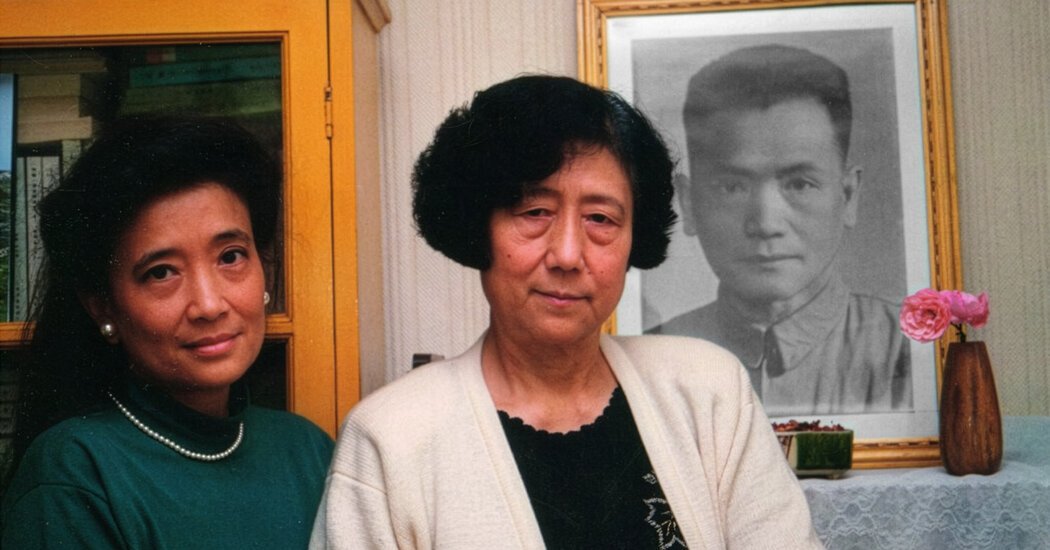
Xia De-hong, who survived persecution and torture as an official in Mao Zedong’s China and was later the central figure in her daughter’s best-selling 1991 memoir, “Wild Swans: Three Daughters of China,” died on April 15 in Chengdu, China. She was 94.
Ms. Xia’s death, in a hospital, was confirmed by her daughter Jung Chang.
Ms. Chang’s memoir, which was banned in China, was a groundbreaking, intimate account of the country’s turbulent 20th century and the iron grip of Mao’s Communist Party, told through the lives of three generations of women: herself, her mother and her grandmother. An epic of imprisonment, suffering and family loyalty, it sold over 15 million copies in 40 languages.
The story of Ms. Chang’s stoic mother holding the family together while battling on behalf of her husband, a functionary who was tortured and imprisoned during Mao’s regime, was the focus of “Wild Swans,” which emerged out of hours of recordings that Ms. Chang made when Ms. Xia visited her in London in 1988.
Ms. Xia was inspired as a teenager to become an ardent Communist revolutionary because of the mistreatment of women in the Republic of China, as well as the corruption of the Kuomintang nationalists in power. (Her own mother had been forced into concubinage at 15 by a powerful warlord.)
In 1947, in Ms. Xia’s home city of Jinzhou, the Communists were waging guerrilla war against the government. She joined the struggle by distributing pamphlets for Mao, rolling them up inside green peppers after they had been smuggled into the city in bundles of sorghum stalks.
Captured by the Kuomintang, she was forced to listen to “the screams of people being tortured in the rooms nearby,” her daughter later wrote. But that only stiffened her resolve.
She married Chang Shou-yu, an up-and-coming Communist civil servant and acolyte of Mao, in 1949.
It was then that disillusionment began to set in, according to her daughter. The newlyweds were ordered to travel a thousand miles to Sichuan, her husband’s home province. Because of Mr. Chang’s rank, he was allowed to ride in a jeep, but she had to walk, even though she was pregnant, and suffered a miscarriage as a result.
“She was vomiting all the time,” her daughter wrote. “Could he not let her travel in his jeep occasionally? He said he could not, because it would be taken as favoritism since my mother was not entitled to the car.”
That was the first of many times that her husband would insist she bow to the rigid dictates of the party, despite the immense suffering it caused.
When she was a party official in the mid-1950s, Ms. Xia was investigated for her “bourgeois” background and imprisoned for months. She received little support from Mr. Chang.
“As my mother was leaving for detention,” Ms. Chang wrote, “my father advised her: ‘Be completely honest with the party, and have complete trust in it. It will give you the right verdict.’ A wave of aversion swept over her.”
Upon her release in 1957, she told her husband, “You are a good Communist, but a rotten husband.” Mr. Chang could only nod in agreement.
He became one of the top officials in Sichuan, entitled to a life of privilege. But by the late 1960s, he had become outraged by the injustices of the Cultural Revolution, Mao’s blood-soaked purge, and was determined to register a formal complaint.
Ms. Xia was in despair; she knew what became of families who spoke out. “Why do you want to be a moth that throws itself into the fire?” she asked.
Mr. Chang’s career was over, and both he and his wife were subjected to physical abuse and imprisoned. Ms. Xia’s position was lower profile; she was in charge of resolving personal problems, such as housing, transfers and pensions, for people in her district. But that did not save her from brutal treatment.
Ms. Xia was made to kneel on broken glass; paraded through the streets of Chengdu wearing a dunce’s cap and a heavy placard with her name crossed out; and forced to bow to jeering crowds.
Still, she resisted pressure from the party to denounce her husband. And unlike many other women in her position, she refused to divorce him.
Twice she journeyed to Beijing to seek his release, the second time securing a meeting with the prime minister, Zhou Enlai, who was considered a moderate. Ms. Xia was “one of the very few spouses of victims who had the courage to go and appeal in Peking,” her daughter wrote in “Wild Swans.”
But Ms. Xia and her husband never criticized the Cultural Revolution in front of their children, checked by the party’s absolute power and the fear it inspired.
“My parents never said anything to me or my siblings,” Ms. Chang wrote. “The restraints which had kept them silent about politics before still prevented them from opening their minds to us.”
She was held at Xichiang prison camp from 1969 to 1971 as a “class enemy,” made to do heavy labor and endure denunciation meetings.
The camp, though less harsh than her husband’s, was a bitter experience. “She reflected with remorse on the pointlessness of her devotion,” her daughter wrote. “She found she missed her children with a pain which was almost unbearable.”
Xia De-hong was born on May 4, 1931, in Yixian, the daughter of Yang Yu-fang and Gen. Xue Zhi-heng, the inspector general of the metropolitan police in the nationalist government.
When she was an infant, her mother fled the house of the general, who was dying, and returned to her parents, eventually marrying a rich Manchurian doctor, Xia Rui-tang.
Ms. Xia grew up in Jinzhou, Manchuria, where she attended school before joining the Communist underground.
In the 1950s, when she began to have doubts about the Communist Party, she considered abandoning it and pursuing her dream of studying medicine, her daughter said. But the idea terrified her husband, Ms. Chang said in an interview, because it would have meant disavowing the Communists.
By the late 1950s, during the Mao-induced Great Famine that killed tens of millions, both of her parents had become “totally disillusioned,” Ms. Chang said, and “could no longer find excuses to forgive their party.”
Mr. Chang died in 1975, broken by years of imprisonment and ill treatment. Ms. Xia retired from her government service, as deputy head of the People’s Congress of the Eastern District of Chengdu, in 1983.
Besides Ms. Chang, Ms. Xia is survived by another daughter, Xiao-hong Chang; three sons, Jin-ming, Xiao-hei and Xiao-fang; and two grandchildren.
Jung Chang saw her mother for the last time in 2018. Ms. Chang’s criticism of the regime, in her memoir and a subsequent biography, made returning to China unthinkable. She told the BBC in a recent interview that she never knew whether her mother had read “Wild Swans.”
But the advice her mother gave her and her brother Xiao-hei, a journalist who also lives in London, was firm: “She only wanted us to write truthfully, and accurately.”