dailynewsnblog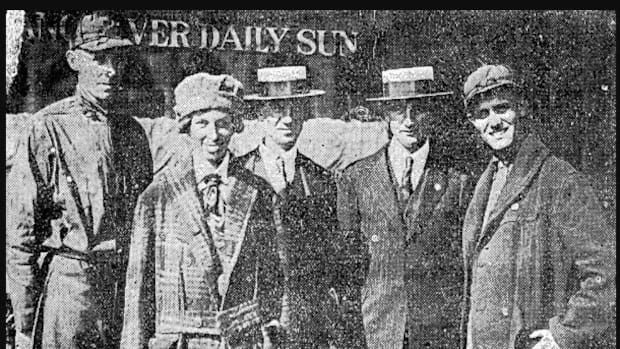
In a tree-shaded section of Camp Hill Cemetery in Halifax, a stone grave marker lies flush with the ground, strewn with dirt and ringed by dandelions.
It bears an intriguing inscription: “Jennie Dill, 1897-1942. Wife of Sgt. W.T. Tarbox. Famous Hiker from Coast to Coast. Gone but not forgotten.”
But her story has largely been forgotten.
It was 105 years ago today, on June 14, that Jennie Dill and her husband, Frank, arrived in Vancouver after an arduous cross-country walk. She became the first woman to walk across the country.
The race made Jennie Dill one of the most famous women in Canada.
Crowds gathered to meet the couple on their journey; they were feted by parliamentarians, and newspapers eagerly charted their progress.

Today, her grave marker is one of the few reminders of the 1921 foot race from Halifax to Vancouver that captivated the nation and then slipped from memory.
In 1921 Canada was deep in an economic recession following the end of the First World War. With jobs scarce and youth unemployment high, the Halifax Herald published an editorial lamenting that young people were becoming “soft” and that exercise was the key to success in life.
Charles Burkman, an amateur sportsman, announced he would walk from Halifax to Vancouver to prove that Atlantic Canadians still had grit. The Herald loved the idea and promoted it heavily.
What started as a one-man walk turned into a fierce race when two other teams jumped in. Jack and Clifford Behan, a father and son from Dartmouth who were both war veterans, announced they would compete.
At the end of January, Frank and Jennie Dill decided to enter.
Frank was a former competitive runner from Windsor, N.S., who had served in the Canadian Ordnance Corps. Jennie, his wife of two years, was a 23-year-old from Bayers Settlement, who, the Herald noted, liked to skate, hunt and fish.
At the time of the race the couple were living in Dartmouth, N.S.

By all accounts, the Dills were the most popular of the competitors. A 1956 Maclean’s magazine retrospective on the race described the scene as the couple set off.
“Two thousand people met in front of the Halifax Herald building to see the couple make their start,” it said.
“Jennie created a sensation dressed in riding breeches, boots with high leather leggings, and a mackinaw jacket and cap. In 1921, it was unheard of for women to be seen in men’s clothing.”
At the time, Canada’s highway system consisted mostly of disconnected mud and gravel roads, so the hikers followed the Canadian Pacific Railway tracks. They stepped along wooden ties for thousands of kilometres through blizzards, subzero temperatures and the isolated wilderness of northern Ontario and the Rocky Mountains.
They relied on railway station agents, church groups and small-town mayors for hot meals and places to sleep.
When the Dills reached Ottawa in March, the capital embraced them. Nova Scotia parliamentarians and their wives competed to show the couple a good time.
Wolf encounter
After leaving the capital, the Dills had a less welcoming encounter in Ontario when they crossed paths with a wolf.
In her book The Amazing Foot Race of 1921, Shirley Jean Roll Tucker cites Jennie Dill’s account of the incident to the Herald.
“Walking peacefully along the track, our attention was suddenly attracted by the baying of an animal a hundred yards or so behind us, and before we could say Jack Robinson, a big timber wolf sprang at Frank,” Jennie Dill recounted.
“I drew a revolver from my belt and fired. The bullet stopped the wolf and Frank killed it seconds later with his .35-calibre pistol.”
The Dills arrived in Vancouver in June 1921. They left Halifax a week after the Behans but finished faster, completing the journey in 134 days.
The grand prize was $500 — enough to buy a new Ford Model T.
The fame did not last. The couple returned to Nova Scotia and settled near Jennie’s roots in Bayers Settlement.

On May 31, 1927, she gave birth to a stillborn daughter, Bessie Geraldine.
Frank died on May 24, 1929, at age 36. He had contracted tuberculosis while serving in France during the war. His death certificate notes that he had been living with the disease for a decade, meaning he walked across Canada with the condition.
Jennie remarried, becoming the wife of Sgt. Walter Thomas Tarbox. On Sept. 23, 1942, she died of diphtheria at age 45.
Her gravestone carries her famous maiden name — perhaps a deliberate choice to preserve her identity as the woman who had captivated the nation. She was buried next to her first husband in Camp Hill Cemetery.

Visitors to the cemetery walk past her stone every day, most not knowing what a trailblazer she was.
Despite entering the race with Frank as a fun challenge, Dill knew that as the only woman in the race, she was making an important statement.
Women had won the right to vote in federal and Nova Scotia elections only a few years earlier.
Tucker quotes Dill’s telegram to the Herald as she and Frank reached the outskirts of Vancouver.
“I was thinking today of those people who laughed at us when I started out from Halifax last winter: She who laughs last, laughs best,” Dill wrote.
“I think I have proved that a woman can do any athletic stunt that a man can.”
MORE TOP STORIES