dailynewsnblog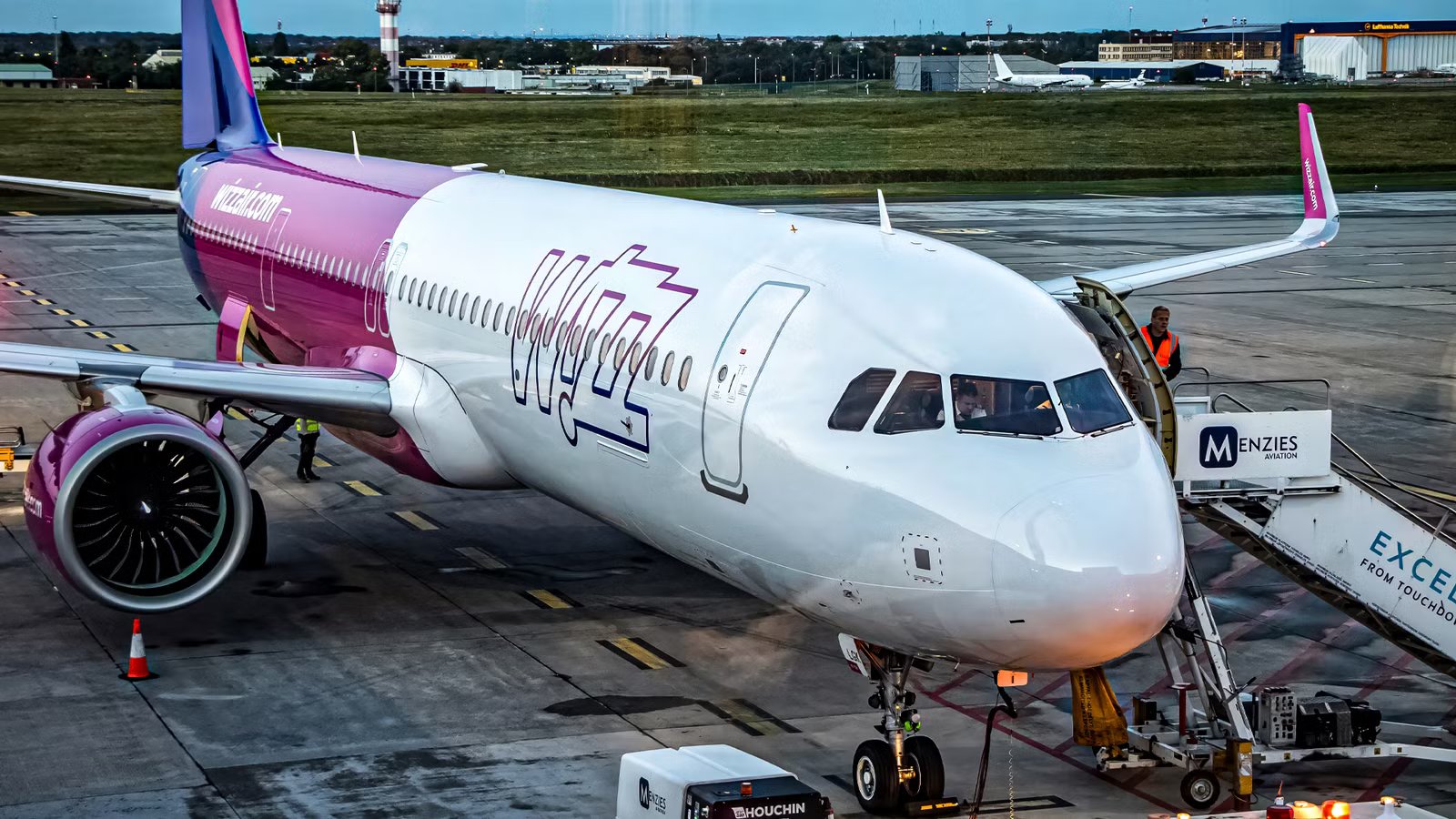
Something odd is happening in Poland, as three Wizz Air Airbus A321XLRs are currently parked at Bydgoszcz Ignacy Jan Paderewski Airport (BZG). These are brand new aircraft, and the A321XLR is the newest commercial aircraft in service, yet three of Wizz Air’s examples are not flying.
What’s more, the airline has pulled the engines off all three aircraft, essentially cannibalizing them for these components while installing the engines on its standard A321neos. The reason why Wizz Air did this is that its A321neo and A321XLR fleet is powered by the Pratt & Whitney PW1100G engine. Although these are two different aircraft variants, they are powered by the same engine.
The PW1100G has faced significant durability issues, resulting in frequent shop visits, and Pratt & Whitney has been unable to repair the engines in time, resulting in grounded planes. The reason why Wizz Air pulled off engines from its A321XLRs is to power more A321neos, but what’s odd is that it’s using its A321XLRs to do so.
Wizz Air And The A321XLR

Wizz Air currently operates 208 Airbus A321neos, including nine A321XLRs. The oldest of these, 9H-XLA, is just over one year old, and Wizz Air intends to fly 11 examples in total. These aircraft are configured with 239 seats in an all-economy layout, identical to the carrier’s A321neos.
Apart from the exit rows, Wizz Air configures these planes with 28 to 29 inches (71.1 to 73.7 centimeters) of pitch, and the seats do not include seatback screens, power ports, adjustable headrests, or recline. The airline uses the PW1100G on all of its A321neos, which is problematic considering the issues with this engine.
The carrier has close to two dozen A321neos parked largely because of engine issues, or nearly ten percent of its fleet. Pratt & Whitney lacks MRO capacity to quickly repair engines and is experiencing difficulty in producing new engines, leading to new aircraft being rolled out engineless while in-service planes remain grounded. For Wizz Air, this is where three of its A321XLRs come in. These aircraft feature essentially brand-new engines, and so Wizz Air has stripped them of their PWs.
Indeed, it has placed them on standard A321neos instead. The A321neo is perhaps the most economical narrowbody airliner in service today, and it makes sense for Wizz Air to prioritize keeping as many of these planes in service as possible. What’s odd about this decision is that it’s cannibalizing new A321XLRs, which are essentially the same aircraft but optimized for longer flights. However, the truth is that Wizz Air has fallen out of love with the A321XLR.
Buyer’s Remorse For The XLR

Despite the celebratory image above, Wizz Air’s experience with the Airbus A321XLR has been far from ideal. The planes themselves have been reliable, and they’re practically identical to the carrier’s familiar A321neos, but the economics of the plane have not worked out as hoped.
The airline has canceled its routes from the UK to the Middle East, and the five A321XLRs currently flying (a fourth XLR is currently parked for maintenance) are primarily flying within Europe, as well as a handful of routes from Italy to the Middle East (which are hardly stretching the XLR’s legs).
Wizz Air’s CCO stated that the aircraft doesn’t fit its business model without a premium cabin, while the airline’s CEO stated that the aircraft was underperforming on range and payload capacity. However, what’s most telling is that Wizz Air originally held 47 orders for the XLR, but then converted 36 of these orders to the standard A321neo.
Wizz Air Fleet | Number |
|---|---|
Airbus A320-200 | 21 aircraft |
Airbus A320neo | Six aircraft |
Airbus A321-200 | 34 aircraft |
Airbus A321neo | 199 aircraft |
Airbus A321XLR | Nine aircraft |
Total In Service | 269 aircraft |
The aircraft aren’t really being pushed to their limits, and Wizz Air is now taking their engines off to keep older A321neos flying, while only two more A321XLRs are set to arrive in the future. Although they are very similar, the A321XLR is a heavier aircraft than the Airbus A321neo because it’s designed for longer routes and heavier payloads, which means that it burns slightly more fuel.
Therefore, on two- or three-hour routes within Europe, like the kind that Wizz Air’s XLRs are mainly flying, the standard A321neo is more economical, which is why the XLRs are losing their engines. Instead, the bigger story is that Wizz Air doesn’t have a real use for the XLR, which is why they’re being used in this suboptimal way.
Changes To Wizz Air’s Network

The main issue for Wizz Air with the A321XLR is that it lacks the need for a long-range airliner in the first place. The large A321XLR order was placed, in large part, to facilitate growth for the airline’s Abu Dhabi subsidiary, which first began operating in 2021. This coincided with an increase in XLR orders, from 20 to 47 units, and the company had major plans for the subsidiary.
However, in July 2025, Wizz Air announced that it would shut down the Abu Dhabi operation. It cited issues such as geopolitical instability, degraded engine performance in the region, regulatory challenges, and general operational constraints. With the loss of the Abu Dhabi operation, the carrier suddenly had much less of a need for the A321XLR, considering that many of the planes were intended to fly out of the Middle East.
The A321XLR is fundamentally designed for seven to eight-hour routes, even with Wizz Air’s dense layout. The airline was depending on the aircraft’s range for growing the Abu Dhabi network, but without it, the airline now has to base its A321XLRs out of Europe. Considering the high competition and the fact that Wizz Air’s network doesn’t focus heavily on Western Europe, the A321XLR simply doesn’t work for the carrier in large numbers.
Underperforming Or A Mismatch In Business Strategy?

The Airbus A321XLR is heavier and has less range than originally advertised. EASA required additional fire reinforcement in the aircraft’s new integrated Rear Centre Tank, which added weight. This is a fact, but the weight gain also isn’t enough to turn the aircraft from a revolutionary machine to one that can’t economically serve seven-hour routes from the UK to the Middle East.
Instead, there are other factors in consideration with the XLR. Wizz Air configures its A321XLRs with 239 seats in an all-economy layout. This makes the planes lighter than those flown by American Airlines, for example, but they also carry up to 84 additional passengers. When fully loaded, the aircraft wouldn’t be able to fly anywhere near its advertised 4,700 NM (8,700 km) range, which is fully known.
This is true of any aircraft type, because brochure ranges are calculated using relatively premium-heavy layouts and optimal weather conditions. Wizz Air would have been aware that its A321XLRs wouldn’t be able to fly such long distances with 239 passengers, because this is simply an unrealistic proposition.
We don’t know exactly what issues Wizz Air experienced with the plane, but one possibility is that passengers are more likely to check luggage. The airline positions itself as an ultra-low-cost option with à la carte pricing, and many passengers avoid paying surcharges for optional extras on its flights.
On longer flights, however, passengers are usually more willing to pay fees for items like checked bags. Given that this isn’t as common throughout the rest of Wizz Air’s network, this may have caught the carrier by surprise, and the XLR’s real-world range may have been less impressive as a result because of the higher payloads being carried, leaving less room onboard for fuel.
The Challenging Economics Of Long-Haul Narrowbody Flying

The selling point of the Airbus A321XLR is that it brings modern narrowbody operating costs to long-haul flying. However, the problem is that it’s also only bringing as much revenue as a narrowbody. With an aircraft like the Boeing 787, which is now everywhere, the aircraft costs dramatically less to operate while earning about as much revenue as an Airbus A330 or Boeing 777-200ER.
However, with the A321XLR, airlines are spending less to buy and operate it, but they’re also earning less compared to a widebody. Wizz Air’s business model centers around extremely low ticket prices, optional add-ons, and high-density aircraft, which can be a tricky model to pull off because revenue can be quite low.
Successful low-cost carriers make this work by keeping costs low and generally avoiding direct competition to preserve pricing power. However, long-distance routes are expensive to operate regardless of how hard an airline may try to keep costs low. With the A321XLR, Wizz Air is still facing relatively limited revenue, while operating costs rise due to the higher fuel and labor costs that come with flying a seven-hour route.
As such, profit margins will be razor-thin, and considering that the airline has discontinued the Abu Dhabi operation, it’s not surprising that the aircraft doesn’t serve a purpose for Wizz Air anymore. Meanwhile, full-service carriers like Aer Lingus and Iberia have been more pleased with the XLR, as their business models more closely align with what the XLR offers.