dailynewsnblog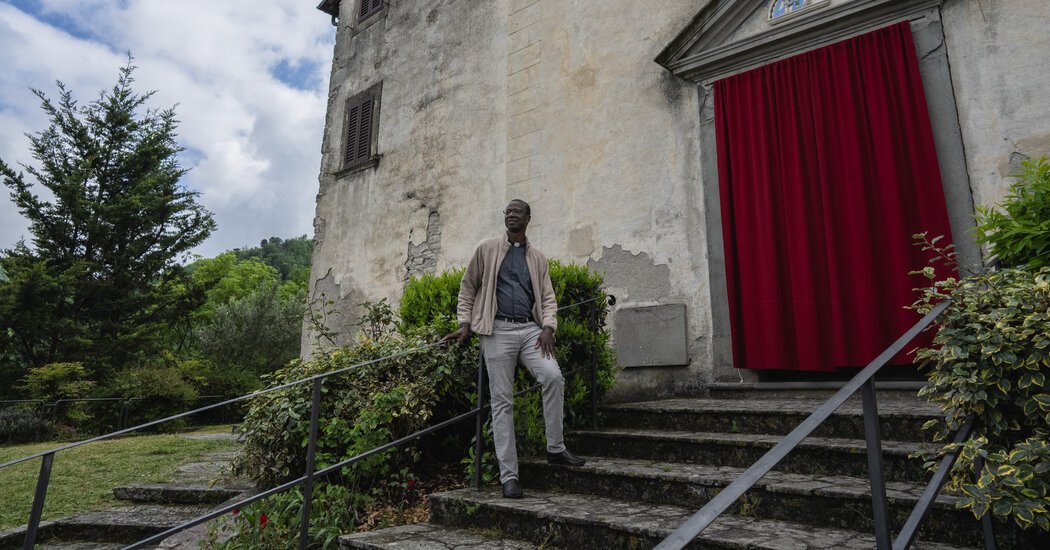
The priest stepped into the bedroom where his 90-year-old parishioner lay sleeping in a hospital bed, flanked by oxygen tanks. The pastor towered over the bed and leaned down to move close to the patient, Carlo Martini, as the old man’s eyes fluttered open briefly.
“How are you?” the priest, the Rev. Vincent Souly, asked, a bit too loudly.
Mr. Martini’s wife, Renza Giagnoni, stood to the side and watched. “It looks like we’re the United Nations!” she said, also a bit too loudly.
Father Souly is one of the few Black faces in the province of Prato, a mountainous region of Tuscany, in central Italy, where he has served for 15 years as a Roman Catholic priest. He has built warm relationships with his predominantly Italian flocks and is embraced by many parishioners. Born in Burkina Faso, and raised and ordained in the Ivory Coast, he is now an Italian citizen and is committed to staying in Prato as long as he is needed. Yet, he said, his Italian passport does not necessarily make others see him as Italian.
“Where I’m from, we say, ‘A piece of wood, no matter how long it stays in water, will never become a crocodile,’” he said. “You’re accepted, up to a point. But there’s this unspoken part, right? You remain what you are.”
He felt a flash of that otherness when Ms. Giagnoni referred to the United Nations, he told us later, or when parishioners referred to him as a “prete di colore” or “priest of color.”
He would prefer that people refer to him by his country of origin rather than by the color of his skin, he said. “When you say, ‘He is an African priest,’ it’s already more elegant, it’s more cultured,” he said. “That means that you’ve tried to locate where Africa is on the world map. If you say, ‘He is from the Ivory Coast,’ that’s even better. Using the color is a shortcut.”
As fewer Italians take the vows of priesthood, Father Souly is among about 1,130 African priests who oversee Italian churches — approximately 4 percent of Italy’s clergy, not including more junior church positions.
Father Souly is part of a historic wave of immigration that is changing Europe. Roughly one in seven people in the European Union was born outside their country of residence, the highest rate since the bloc started compiling such statistics nearly two decades ago. Italy, with 12 percent born overseas, has one of the largest immigrant populations on the continent — a remarkable reversal for a nation that once helped to fuel mass emigration to America.
The priest’s life highlights a nuance of that changing Italy. In the common consciousness, immigrants are typically filling labor shortages in the country’s many depopulated and aging communities — mainly across the agricultural, manufacturing and service sectors, and often on the peripheries of Italian life.
Yet Father Souly is helping to shore up an institution at the heart of Italian history and national identity — the Roman Catholic Church. Unlike foreigners working on the sidelines of Italian society, Father Souly stands front and center in his community. He is there out of spiritual mission rather than economic desperation. And his work helps sustain his parishioners’ religious lives, even if some of them feel ambivalent about the implications of his presence.
Weekends find Father Souly — a tall, gentle man with a quiet smile — careering around mountain roads in a 19-year-old silver Fiat hatchback as he races between churches and Masses.
On the weekend we visited, he conducted services in two villages on a Saturday afternoon before holding a happy hour at his rectory, hosting several couples for Prosecco and beer, and potato chips piled on paper plates. In the evening, he attended a pizza dinner at a social club run by one of his parishes. The following morning, he led Mass at three churches before noon, delivering three distinct homilies that he said he had improvised on the spot, before spending the afternoon visiting families across his district.
“Giving reason to our hope will be a fight every day,” he said in one homily. “It will be strained by many things every day.”
Throughout the weekend, his parishioners spoke of him with clear warmth.
Gabriela Tabusso Morini, one of the guests at the happy hour, recalled first meeting Father Souly as he hoed the garden outside a church near her home. Days later, he saw Ms. Morini and her husband at Mass and welcomed them by name. “This struck us so much, that he remembered us,” she said. “We weren’t just any old faces, we were people.”
Yet for all of his popularity, Father Souly still feels a sense of loneliness.
“We are all isolated, each in his own world,” he said, standing in the rectory kitchen after finishing the Sunday Masses. He stirred simmering pots of carp and chicken stews — both recipes that his mother had taught him how to cook. Slicing cucumbers, avocado and red onion for a salad, he said that he shopped for special ingredients like cow hooves and a West African variant of eggplant at shops run by immigrants from China or Pakistan.
Occasionally, people ask him when he intends to return to the Ivory Coast. Some ask because they hope he will never leave, he said. Others “ask when you’ll go home because they are looking for confirmation that you are, indeed, going home one day.”
‘He Had to Work a Bit’
Father Souly is the third of six children of a cook and a homemaker in western Ivory Coast. As a child, he said, he never imagined that he would travel so far from home. He entered seminary when he was 18 and was ordained at 32. In 2007, when he was 35, he received a Vatican scholarship to pursue a master’s degree in canon law in Rome.
He landed in Italy speaking only French and Mooré, an official language of Burkina Faso, and got lost on the way from the airport to his dormitory. For the first three months after he arrived in Rome, he took intensive grammar classes for seven hours a day, he added, and once he started his academic degree, he continued classes with nuns and priests from across Africa, Eastern Europe and a few from China.
Although his scholarship covered tuition, he struggled to pay for room and board. He took a job as an assistant pastor in northern Italy, eventually transferring to a similar post at one of the four parishes where he is now the main priest. After receiving his doctorate in 2014, he decided against returning to the Ivory Coast.
Local residents, who had gone without a priest for some years, helped to furnish the rectory where he lived and bought him a bed to accommodate his lanky frame.
Parishioners have varied recollections of how they felt about him when he first arrived.
According to Maria Lucarini, 41, the mayor of Vernio, the village that hosts Father Souly’s largest parish, “He had to work a bit because, after all, this is a mountain community, not used to seeing — maybe at the beginning when he arrived — many people of color.”
“When people got to know the person and saw how much he commits himself to the community, maybe that initial barrier of his different skin color collapsed,” Ms. Lucarini added.
Ilaria Tonini, 46, said that an Italian priest, born and raised in the area, “would certainly be better,” as the community had previously been accustomed to a locally born pastor who had served for over 30 years. But she praised Father Souly because he “really fit right in.”
Others had less complicated memories. Father Souly’s heritage “didn’t make any difference,” said Osanna Becherini, 79, after a recent Saturday afternoon Mass. “Religion is religion. Rightly so, white, Black or yellow,” she said. “What’s important is that he is present. He baptized all my grandchildren.”
Because of the changing demographics, a handful of Father Souly’s congregants are also from Africa. Lena Ehika, 37, moved from Nigeria five years ago to join her husband, a factory worker in the region. She said it “doesn’t make any difference to me” that she and Father Souly came from the same continent.
“Most of the Masses I’ve attended here are celebrated by Black priests,” she noted.
Some parishioners are so accommodating that it can be hard for foreign priests to return to their home countries at the end of a posting, said the Rev. Cyril Arnaud Meba, 35, a Cameroonian who assists Father Souly during Masses.
“Here we can find people who welcome us, generous people, people who give us so many things. And then we get used to receiving this, and then we don’t want to return anymore because it feels good to live here,” said Father Meba, who said he was nevertheless determined to return to Cameroon. “We all have a good life.”
Still, Father Souly said that some Italians looked down on him because he came from a poorer part of the world. They did not realize, he said, that they were often spiritually impoverished — having lost touch with their extended families and having forgone human companionship for digital media.
“There is material poverty, and there is spiritual, intellectual and cultural poverty,” Father Souly said. “But explaining that in a place like this is difficult. The fact of having electricity, these roads, the development, the modernity — they think that is enough to say, ‘I am better than you.’”
‘He Has to Rush Away’
Father Souly’s biggest challenge is spending enough time in his various parishes.
At every Mass, rows of empty pews outnumber filled benches. Yet the remaining churchgoers still struggle to get his attention before he races off to the next village. His focus is divided even further by his duties as the head canonical legal officer for the diocese.
“Before, apparently, the priest who actually lived right in the town knew everyone,” said Pietro D’Amore, 42, who owns a second home near one of Father Souly’s churches. Mr. D’Amore’s eldest son serves as an altar boy, but he lamented that he saw the priest only during Mass “and then he has to rush away.”
Father Souly does his best. He has tried to visit every member of every church at their home, he said.
At the pizza dinner hosted by the parish social club recently, he sat at the center of a long table surrounded by those who had attended Mass an hour earlier. Ms. Lucarini, the mayor, sat across from him with her husband and young daughter, who had brought a sketchbook. Father Souly tried to show an interest in what the girl was doing, but she barely seemed to pay attention to him before producing a drawing of a smiling brown man wearing glasses and a priest’s collar.
The next day, Father Souly shuttled from house to house throughout the afternoon. He visited a sexton and his wife to check on preparations for a first confession ceremony. As he left Mr. Martini’s sickbed, Ms. Giagnoni tried, multiple times, to persuade him to take a zuccherino, a traditional sugar cookie, until he finally explained that he was pre-diabetic and should not eat sweets.
Father Souly dropped by the home of Sara Orlandi, 46, a legal secretary, and her husband, Alessandro Ballotti, 57, who manages a mechanics’ shop.
They warmly greeted Father Souly and invited him to stay for dinner. When he politely turned them down, telling them that he planned to visit a cancer patient in another village, Ms. Orlandi gently ribbed him.
“Give me a break,” Ms. Orlandi joked. “Who are you, the pope?” Mr. Ballotti asked Father Souly to come back the following week to watch a soccer match, but the priest said he would not have time.
Father Souly, perched on a couch, told them that he hoped the bishop would soon send an Italian-born priest to help him serve the parishes.
“Keep coming to us once in a while, please, even if there’s a change,” Ms. Orlandi said.
Later, Father Souly said that he believed it would help to work with a native Italian partner. People would always think of him as foreign, he said.
“It’s remained in people’s minds,” he said. “It’s difficult to remove it.”