

 dailynewsnblog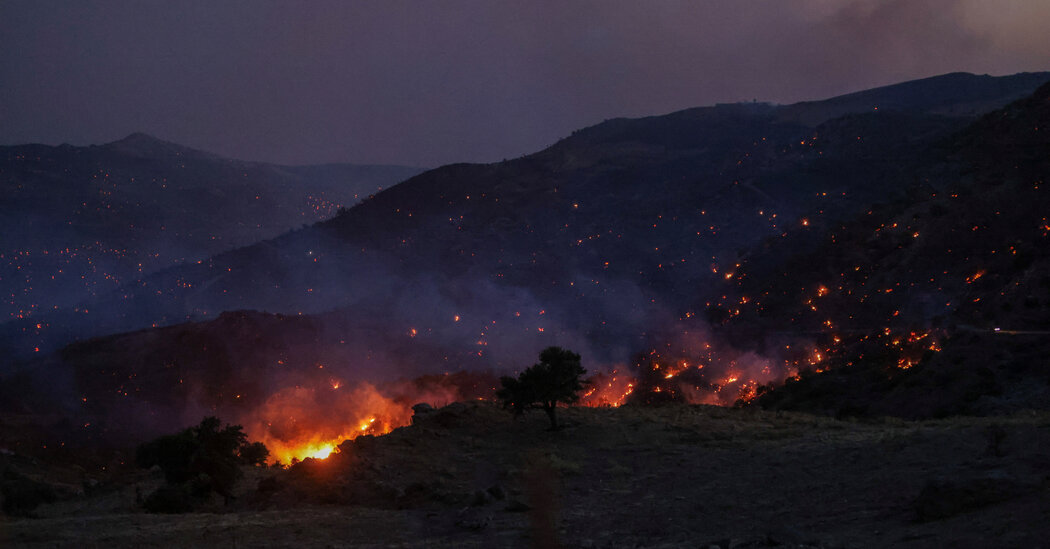
Greece battled a wildfire on Thursday on the island of Crete that has killed two firefighters and forced thousands to flee. The flames were the latest in a series of blazes that have charred Europe this summer and tested its ability to deal with increasingly extreme weather.
More than 220 firefighters were tackling the wildfire in Crete, which broke out on Wednesday in the area of Krya Vrysi, in the south of the island. The fire, one of several that the Greek authorities were trying to contain on Thursday, was being fueled by strong wind, complicating efforts to put out the flames.
“The winds are so intense that aircraft can’t operate,” Giorgos Tsapakos, the deputy regional governor for Crete, told state television on Thursday morning. He said that the fire front stretched over nearly 10 miles but that residential areas were not currently under threat.
Evangelos Tournas, Greece’s minister of climate crisis and civil protection, said late Wednesday that the two firefighters who died in Crete were aged 58 and 25. The circumstances of their deaths were not immediately clear.
Summertime wildfires are common in parts of southern Europe. But the blazes in Greece came as fighters were still working on fires in France and Spain. Those had been mostly contained by Thursday, officials said, but they have caused alarm across the continent, where climate change is fueling extreme temperatures and making wildfires more widespread.
Maria Lioni, the deputy regional governor of the Rethymno region of Crete, spoke of “a nightmarish day and a nightmarish night” in comments to state television on Thursday, adding that the authorities had evacuated “many villages, large and small.” She said that it was too early to assess the damage fully but that it appeared to be extensive.
About 8,000 people were evacuated from the southern coastal area of Agia Galini, Ms. Lioni said, although Greece’s Ministry for Climate Crisis and Civil Protection later announced that visitors who had been evacuated from the area had started returning to their hotels.
Many residents stayed with relatives or friends in other parts of Crete, while visitors to the island, a popular vacation destination, were moved to hotels in safe areas. About 700 people took shelter at a gymnasium, where mattresses were set up and food distributed.
The Greek authorities were also bolstering efforts to douse wildfires in other parts of the country. Many Greek areas remained at high fire risk on Thursday, including greater Athens, Crete, the Cyclades islands and much of the Peloponnese, according to civil protection authorities.
On the island of Lesbos, nearly 100 firefighters were still putting out flames that broke out near the town of Plomari. In the Peloponnese, a firefighter died on Wednesday on the sidelines of a blaze in the area of Gytheio.
Much of Western Europe is in the grip of another spell of intense heat, the continent’s fourth since May. Officials have warned that a combination of prolonged dry weather, gusty winds, extreme temperatures and low humidity would significantly increase the risk that wildfires will spread and new ones will ignite.
On Thursday, the European Forest Fire Information System said that “very extreme” fire danger conditions — the highest category in its forecast — were expected to dominate a large area of Western and Central Europe through Aug. 5. Britain and Ireland were facing the same elevated risk.
In Scotland, firefighters have been battling a two-week conflagration that has ripped through moorland and forest and destroyed cherished natural scenery. Large parts of central, eastern and southern England were declared officially in drought on Wednesday. On Thursday, scores were evacuated from their homes in Suffolk as fire crews tackled a wildfire at Dunwich Heath.
In France, Laurent Nuñez, the interior minister, told reporters that the situation “remained complicated” and that no one should “let their guard down,” despite a slight improvement in weather conditions, with a rise in humidity and less wind. Overall, more than 14,000 fires have been reported since the start of summer, he said.
Four fires are still active, Mr. Nuñez said, including a massive one in the Gironde area in the southwest. Firefighters there are focusing on treating the edges of the blaze and preventing embers from reigniting. The local prefect said that about 84,000 people who had been evacuated could return home, after more than 220,000 were forced to flee.
Fires in Spain near Madrid have been largely stabilized, allowing almost all of the 60,000 people who had been displaced to return home. Prime Minister Pedro Sánchez declared an end to the national wildfire emergency in the area, returning responsibility for firefighting operations to regional authorities. Spanish firefighters have also managed to contain a blaze in Castellón Province, near Valencia.
But officials have warned that high temperatures and low humidity could quickly ignite other blazes. New wildfires in Zamora and León, in northwestern Spain, have already forced hundreds of people to evacuate.
“In any case, the emergency is not over,” Mr. Sánchez said.
Ségolène Le Stradic contributed reporting from Paris, Carlos Barragán from Madrid and Stephen Castle and Nazaneen Ghaffar from London.






![Major Expansion: Condor Unveils 1st-Ever Flights To USA’s Busiest Airport [Map]](https://dailynewsnblog.com/wp-content/uploads/2026/07/condor-a330-900-landing1.jpg)