dailynewsnblog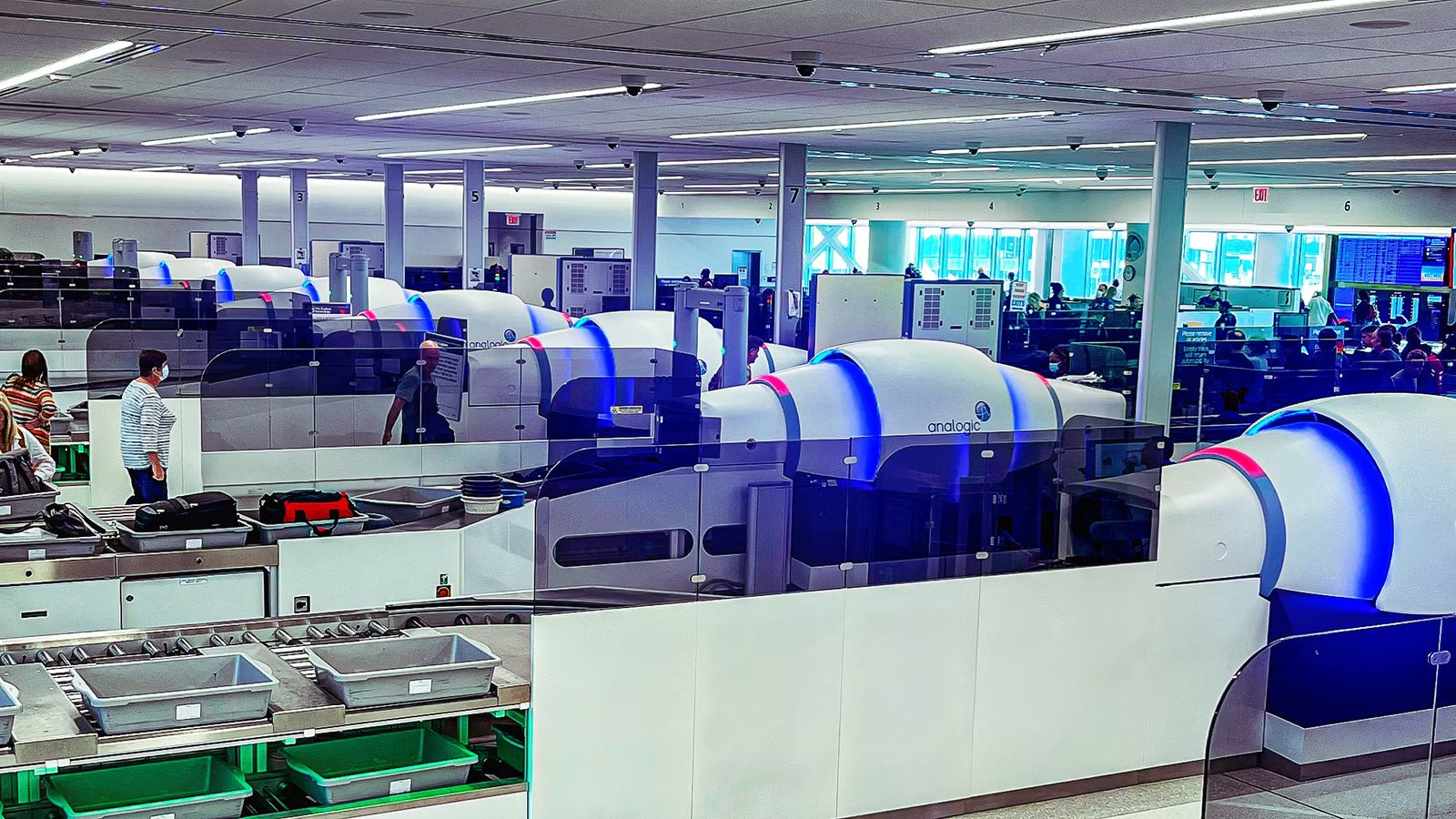
The Transportation Security Administration (TSA) is installing new bag check machines across the US. They’re called CT 3D scanners (Computed Tomography), and they’re the next innovation in airport security. They use X-rays to create hundreds of 2D images at different angles to create a single 3D model on the security officer’s screen that can be rotated. The scanner can detect the shape and density of items inside, allowing TSA officers to view the full contents of a bag being passed through, which isn’t true of older scanners.
The rollout of the scanners is streamlining the infamously difficult security screening process in the US. Officers no longer need to physically scan bags nearly as often, because they scan much more thoroughly than older X-ray machines, and they also see through objects that have traditionally cast ‘shadows’ when scanned by standard X-ray, such as laptops and fluids. However, while they’re generally much better at performing the task than their predecessors, CT 3D scanners aren’t always faster.
New Scanners & PreCheck

Traditional X-ray machines simply don’t scan passenger bags as effectively as 3D CT scanners. The latest generation of security screeners allows officers to actually view the contents of each bag digitally, and they’re typically paired with software systems that automatically flag prohibited items, while also flagging any potential abnormalities with each bag.
This has allowed the TSA to permit passengers to keep large electronics in their bags at lanes equipped with 3D CT scanners, while some countries have increased liquid tolerances at equipped airports. The challenge, however, is that they’re not always fast. These machines tend to be smaller than older X-ray scanners, and this can cause bottlenecks in security lanes when a passenger’s bag becomes stuck or is simply too big.
In addition, the actual process of scanning each carry-on is not necessarily faster than sending it through an older X-ray machine. The primary benefit of the new 3D CT scanners is that they’re more accurate and they reduce the need to manually check bags, but they don’t always save time. This creates a challenge when deciding where to install the innovative new machines, and more specifically, with TSA PreCheck.
At first, you’d think that the TSA’s premium screening lanes would be a prime area to widely implement the agency’s newest, most advanced scanners. However, the new machines are also expensive, and with over 400 commercial airports in the country, the TSA needs to be selective as to where 3D CT scanners should be installed. For TSA PreCheck, meanwhile, the new scanners actually slightly hurt the selling proposition.
The Point Of TSA PreCheck

TSA checkpoints in the US are notorious for being long, stressful, and a little intense. TSA PreCheck is the agency’s product for quicker, less intrusive security checks, requiring an interview and a new application fee for a five-year membership. Those who get approved for PreCheck are enrolled in the TSA’s Trusted Traveler Programs, and you can also opt to be enrolled in Global Entry (this is not automatic when applying for PreCheck).
Upon being approved, you are given a Known Traveler Number. The thing about PreCheck is that the TSA inherently increases risk compared to the standard procedure, as passengers can keep their bags and electronics in their bags while only going through a metal detector rather than a millimeter wave scanner.
TSA PreCheck also allows you to keep your light jacket and belt on, while in the past you weren’t required to remove your shoes (this now applies to all passengers). Passengers are therefore being screened less thoroughly, in favor of speeding up screening times. The TSA maintains safety by running background checks and collecting fingerprints of approved applicants, accepting the added risk by ensuring that members are trustworthy.
This works for passengers by speeding up checkpoints, while the TSA earns extra revenue from the program and faces less congestion in all security lanes. For both parties, however, the main benefit of the PreCheck program is the speed, first and foremost.
Slowdowns In PreCheck

Despite TSA PreCheck primarily selling based on speed, the lines have become longer. The math is simple: the program has become increasingly popular with customers, as more people become aware of the program and its benefits. Meanwhile, the TSA has been facing staffing shortages and isn’t always able to add more PreCheck lanes to keep up with demand.
As such, wait times for PreCheck have generally risen, to the point where wait times can be nearly as long as the standard lane. Part of the reason why TSA PreCheck has become more popular is due to heightened awareness, as the program itself was introduced less than 15 years ago.
Programs For Individuals With Issued Known Traveler Number | Descriptions |
|---|---|
TSA PreCheck | Quick TSA process |
Global Entry | Quick Customs & Border Protection process |
NEXUS | Quick land travel between the US and Canada |
SENTRI | Quick land travel between the US and Mexico |
Many credit cards, including co-branded airline cards, now offer TSA PreCheck application fee credits as a benefit, and now there’s another company using PreCheck lanes. CLEAR is a private company that uses biometric data to verify ID rather than having TSA officers check documents, and then CLEAR customers use the PreCheck lane for the actual security screening. As a whole, PreCheck lines are getting longer, and the trend is unlikely to reverse significantly in the near future.
With this in mind, the TSA isn’t prioritizing PreCheck lanes for its newest scanners. While some PreCheck lanes have received 3D CT devices, the TSA is generally looking to install them in as many airports as possible, and PreCheck lanes would benefit the least. The new scanners may increase security times in some cases, and the added safety benefit is less useful considering that the demographic is meant to consist of the US’s most trustworthy passengers.
How The TSA Is Deploying New Scanning Equipment

Most airport security operators have been introducing 3D CT scanners in a fairly straightforward way: the machines get installed in all security lanes in a given airport, and this happens across the operator’s airport portfolio. The US, however, is a little different because security at most of the nation’s airports is operated solely by the TSA, which means that it has hundreds of airports under its jurisdiction.
It therefore has to allocate advanced, pricey screeners differently than operators in other nations. Rather than fully equip a small number of airports, the TSA has been opting to install new scanners lane-by-lane. It’s installing a handful of 3D CT scanners per airport, which means that many passengers traveling through Atlanta, JFK, or Denver won’t actually use them, but they are present at nearly 300 airports in the US.
It’s a deliberate attempt to cover a high number of airports rather than ensuring full coverage in one location or maximizing the number of passengers that will use each scanner. A typical 3D CT scanner can cost around $800,000 per unit (although exact prices negotiated between the TSA and its suppliers are unknown), making them far more expensive than an older X-ray unit that can cost as little as $65,000.
In addition, although the TSA is working with multiple suppliers (in part to receive the machines faster), production capacity is still challenging when considering the sheer size of the TSA’s orders. The agency therefore has to be picky about where to install the new 3D scanners.
The Introduction & Rollout Of 3D Scanners

The TSA first began looking at 3D scanning in the 2010s and installed the first CT units at its airports in 2017. The initial trial run saw the scanning units installed at Phoenix Sky Harbor International Airport (PHX) and Boston Logan International Airport (BOS). Meanwhile, it also subsequently began piloting the technology at John F. Kennedy International Airport (JFK).
This program was significantly expanded in 2018, and then the TSA began placing large-scale orders. The first major order for 3D CT scanners was placed in 2019, and the agency subsequently ordered 3D CT units in 2021, 2022, and then in 2023. The 2019 and 2021 orders were relatively small in scale, but the 2022 order saw the TSA agree to purchase nearly 1,000 3D CT scanners.
TSA CT Scanner Order Years | Monetary Value Of The Order | Total Number Of CT Scanners Ordered | Supplying Companies |
|---|---|---|---|
2019 | Not stated | 300 scanners | Smiths Detection |
2021 | $198 million | 300+ scanners | Analogic |
2022 | $781.2 million | 938 scanners | Analogic |
2023 | $1.3 billion | 1,214 scanners | Analogic IDSS Holdings Smiths Detection |
Meanwhile, the 2023 order saw the TSA agree to buy over 1,200 units collectively worth over $1 billion from three vendors, and the TSA is moving full steam ahead in installing these scanners. The TSA’s lane-by-lane approach means that passengers receive an uneven experience at the same airport, but at the same time, they’re present at nearly 300 airports across the country.
The TSA has been implementing the scanners at an impressive rate, but it still handles security at over 400 airports in the US. It’s currently estimated that the TSA won’t complete its full roll-out of 3D CT scanners until the late 2030s or even early 2040s, given the sheer number of airports and security lanes in the country.