dailynewsnblog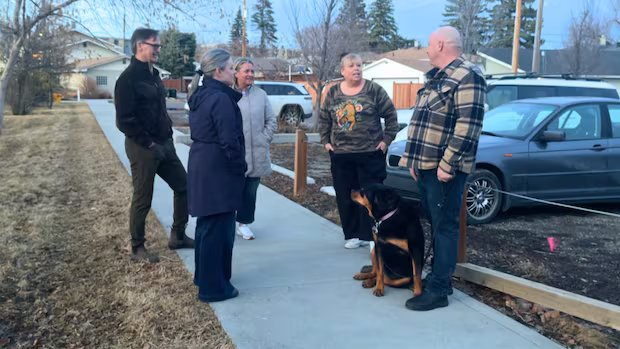
Have you felt unsafe in Calgary? Click the “Join the Conversation” button above. On the app? Join here. Read CBC’s full series on the impact of social disorder at cbc.ca/yycsafety.

In a quiet city park next to Calgary’s biggest shopping mall, five homeowners and a dog have gathered for an evening patrol.
They’re all members of Meadowlark Park Crime Chat, a WhatsApp group that monitors crime and social disorder in the tiny neighbourhood on the west edge of CF Chinook Centre.
The WhatsApp group started a couple of years before the pandemic, but really got going once people were in lockdown and looking to connect and keep their neighbourhood safe, according to moderator Amanda Lovig Hagg.
“Since COVID, things have really ramped up with disordered people, activities, the opioid crisis, drug use,” said Lovig Hagg, noting many of the issues spill out from the mall and the nearby CTrain station.
The group currently has more than 130 members — not too shabby when you consider Meadowlark Park only has 610 residents, according to the 2021 census.

“There are some who just want to be aware of what’s happening,” Lovig Hagg said of the chat group’s members. “There are some who want to share their opinions or advice. And then there are those who get in their car or run out their front door and deal with something that might be happening in the moment.”
Andy Hill is one of the members who does regular patrols in his truck.
“At two, three in the morning, you’ll see on the video cameras people up to no good in the alleyway,” Hill said. “So a lot of times, I just jump up — pajamas, no shoes — jump in the truck, fire it up and down the alley I go.
“Usually, when we talk to each other and share our feelings, we have a clear understanding, and they’re quite happy to move along.”

About 10 members of the Meadowlark Park Crime Chat do daily patrols, both on foot and in vehicles. Sometimes, it’s a simple look around the area on a dog walk. Sometimes, it’s a concerted sweep along the winding streets and through the back alleys after dark.
“Other times, it’s somebody posting, saying, ‘I’m out of town, but I just saw on my ring camera [that] somebody is trying to break into my house.’ Then we all just up and offer to call the cops or check it out or whatever,” says Lovig Hagg.

Liane Medwick grew up in Meadowlark Park and moved back to the neighbourhood in 2003. She says it’s important to have a presence in the community.
“Because the one thing that the criminals do not want is for us to have eyes on them and call the police. The more that we call the police, the more police presence we get in the community.”
Calgary Police Supt. Scott Boyd says more calls from a particular area does have an influence on where policing happens.
“We try to be data-led and go to where the hot spot data is,” he said.
“We want to know that when you were walking down X street, that this happened to you. Because we may not know there’s a bit of a hot spot emerging here.”
The more people call to report concerns around social disorder or crime in their neighbourhood, the more aware police are of new trends in particular areas.
Calls about social disorder have risen in Meadowlark Park. In 2025, police received 415 reports of disorder in that neighbourhood, compared with 243 reports three years earlier.
It’s a drop in the bucket compared with busy areas like the Beltline, which saw 8,245 reports of social disorder last year. But when you compare the number of reports with the number of residents, Meadowlark Park’s rate of social disorder is the third highest in the city after East Village and the commercial core.
Meadowlark Park only has 278 single-family dwellings.
Lovig Hagg likes to talk to everyone, and encourages others to do the same. But it’s more than just recognizing faces, she says. The crime chat group has morphed from simple crime prevention to helping out with anything.
“Your basement’s flooding; I’ll bring you a fan. Or your babysitter dropped out; you need somebody else. Or my dog got out; everybody’s out on the street with a leash trying to catch it for you.”

John Amonson says the WhatsApp group has given him and other residents a sense of empowerment and collective reassurance.
“It’s been really powerful in terms of helping people feel engaged and that they do have a bit of influence from a positive perspective on a community,” he said.
Their efforts might be making a tangible difference, too. Overall crime has gone down in Meadowlark Park since the end of the pandemic, led by a drop in property crime of almost 50 per cent. Across the city, property crime has decreased by 37 per cent over the same time period.
Boyd says he supports community involvement in monitoring crime, but noted that crimes in progress should always be reported to police.
“We need all Calgarians to be invested in helping solve this problem. It’s the ‘see something, say something’ mentality. These groups can be really impactful for helping Calgarians feel safe.”
But, he said, “we need them to be safe, and we certainly would not condone any vigilante-ism that may be generated by well-intended individuals who get caught up in a moment. We just encourage them to call the police with what they’re seeing and let us deal with the situation.”
Meadowlark Park isn’t the only area keeping an eye out. A decade ago, Tracy Koudys created a Facebook group for her southeast neighbourhood of Ogden, following a spate of Christmas decoration thefts. It’s since morphed into a citywide group with more than 30,000 members.
“With the crime that’s going on in the city, we truly believe that people should have a voice somewhere,” said Koudys, who has lived in Ogden for 40 years.
She encourages people who run other neighbourhood watch groups to considering opening their access so that people across Calgary can see and share information about crime.
This article is part of a four-part series on the impact of crime and social disorder in Calgary. Read the full series and share your thoughts at cbc.ca/yycsafety.