dailynewsnblog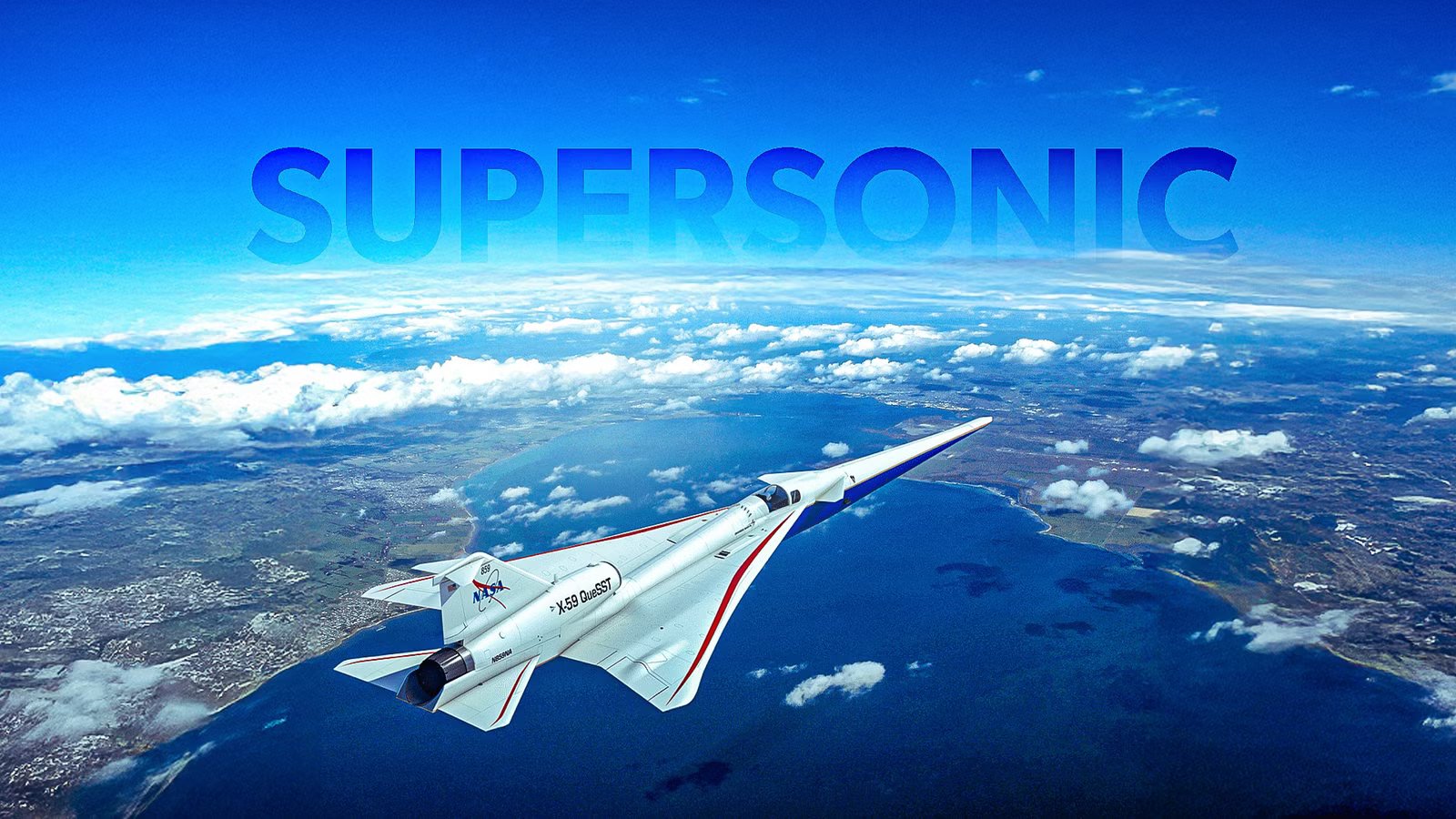
The NASA X-59 QueSST (Quiet SuperSonic Technology) is now flying and soon will start test flights aimed at reducing the sonic boom to a thump for people on the ground. While this seeks to overcome one of the greatest barriers facing supersonic flight, it is far from the only one. Sonic booms are often credited as the top reason for the failure of Concorde, although the reality is more complicated.
Even if supersonic jets get FAA approval, that doesn’t automatically mean they will be permitted to fly in other countries, something critical for this type of jet. After all, the US provided Boeing a five-year reprieve on new ICAO regulations coming into force soon, but as this hasn’t been replicated by other international regulators, Boeing still has to deliver the last of its 737-300F freighters by the original deadline. Here is what to know about how the X-59 will be the first aircraft to fly with a quiet sonic boom and why this is just one major challenge facing supersonic aircraft.
The X-59 QueSST’s First Flight

In October 2025, Lockheed Martin Skunk Works announced it had successfully completed the first flight of its experimental X-59 QueSST. The aircraft took off from its facility at the US Air Force Plant 42 in Palmdale, California, and landed near NASA’s Armstrong Flight Research Center at Edwards, also in California. Skunk Works says the aircraft flew “exactly as planned,” verifying initial flying qualities and air data performance.
Skunk Works wrote it is “a revolutionary, quiet supersonic aircraft designed to pave the way for faster commercial air travel.” The X-59 is designed to reduce the sonic boom to a “gentle thump” (roughly 75 PLdB). If this can be demonstrated, it will remove one of the biggest barriers to supersonic commercial flight. It could set the stage for passengers to zip around the world at double the speed of today.
The contractor said it will continue to lead the aircraft’s initial flight test campaign and work with NASA. The aircraft has yet to perform its first supersonic flight, which will be carried out at the optimal speed and altitude to achieve a quiet boom. NASA says that it will then survey how people respond when the X-59 flies overhead, “sharing these reactions to the quieter sonic “thumps” with national and international regulators to inform the establishment of new data-driven acceptable noise threshold.”
How QueSST Will Reduce Sonic Boom

The issue is the N-Wave generated by aircraft like Concorde and fighter jets as they fly supersonic. This pushes air molecules out of the way faster than they can react and creates shockwaves at the nose, cockpit, inlets, and tail of the aircraft. As they travel through the atmosphere, they coalesce into two massive shocks, with one forming at the front and one at the back. These are called N-Waves due to looking like the letter N on a pressure graph.
To humans, the two near-simultaneous pressure changes from the N-Waves sound like “Boom Boom.” The aim of the QueSST is to generate S-Waves instead of N-Waves. To that end, the long nose of the aircraft spreads out the initial shockwaves. Meanwhile, the engines are mounted on top of the aircraft so that the shockwaves from the engine intake and exhaust are directed upwards and shielded by the aircraft’s wings.
|
Lockheed Martin X-59 QueSST (per Lockheed, NASA) |
|
|---|---|
|
First flight |
October 2025 |
|
Primary user |
NASA |
|
Primary role |
Low-sonic boom demonstration |
|
Supersonic test flights |
Planned 2026 to 2027 |
|
Target boom |
Approx. 75–85 PLdB (peak overpressure) |
On the T-Tail and Canards, there are more flight surfaces to create interference shockwaves to smooth out the pressure signature of the aircraft’s main body. Put another way, the core idea of the X-59 is shock shaping, not shock elimination. It doesn’t eliminate sonic booms; it redistributes them. The target signature is a peak overpressure of around 75–85 PLdB vs Concorde’s boom of 105–110 PLdB.

What Is NASA’s Quesst Mission?
The test phase of the Quesst mission is set to begin this year.
NASA’s QueSST Mission

The sonic boom was one of the major factors that ultimately doomed Concorde, as regulations banned it from flying over land, drastically reducing its available routes. NASA says it has two goals with the X-59. One is to reduce the loudness of the sonic boom to a gentle thump, and the other is to fly it over US communities and seek feedback.
After flying it over populated areas in the United States, NASA will gather data on public responses to the sound generated during its supersonic flight. It will then hand that data set to national and international regulators. It says this will allow a new data-driven acceptable noise threshold for supersonic flight over land to be established.
In June 2025, the US President signed a federal executive order directing the FAA to repeal the prohibition of civil supersonic flight over land and calling for an interim noise-based certification standard for supersonic aircraft. But it should be noted that this does not take immediate effect, and it could take the FAA years to comply, and as of the time of writing, the regulations remain in place.
Challenges Of Up-Scaling The Demonstrator

The X-59 is a demonstrator designed for a single pilot and not to operate in the real world of commercial passenger aviation and associated FAA regulations. Scaling the technology to a 50–100-seat commercial airliner will require even more precise aerodynamic modeling so that the extra lift doesn’t create a thicker shockwave. Another challenge will be to integrate much larger engines needed for a commercial aircraft.
Scaling the X-59 will not be linear, and some of the low-boom shaping scales will conflict with a commercial airliner’s requirements to carry passengers. For example, the slenderness ratio of the demonstrator gives it an extremely long needle-like nose, but this is the wrong shape to fit a large cabin with many passengers. This issue becomes increasingly difficult to solve as the aircraft becomes larger, accommodating a few dozen passengers.
Another issue is that an airliner’s nose will require a cockpit, a bird-strike structure, radars, and more; this will likely require it to become fatter. Of course, most issues can be solved with enough time, money, and creative engineering, but a successful sonic-thumbing X-59 is not the same as a ready-made blueprint to be upscaled to a passenger airline. When it comes to the timeline, NASA is planning for its flight testing phase to last from 2026 through 2027. New supersonic rules are not expected to be ready until the late 2020s or the early 2030s.

“We’ve Proven We Can Do It”: Boom Supersonic’s XB-1 Breaks Sound Barrier In Historic Flight
The demonstrator aircraft reached the speed of sound not once, but three times in under 15 minutes.
Far From The Only Supersonic Issue

It is difficult to weigh the issues of why Concorde failed beyond being a nationally sponsored Anglo-French vanity project. The sonic boom was certainly one of the most important factors, but it wasn’t the only one, or even necessarily the most decisive one. That said, it would be noted that the 1973 US ban on supersonic flight over land, with similar bans over Europe and Asia, eliminated 90% of the world’s potential routes, so its importance should not be understated.
Another important issue was fuel costs, with Concorde burning around as much or more fuel as a Boeing 747 while only carrying around a quarter of the passengers. The aircraft was also developed at the time of the 1973 oil crisis, which was catastrophic for the program. The massive airframe strain and enormous maintenance requirements of the stress of supersonic flight on the airframe were other major factors.
Yet another issue was that it was marketed for the very wealthy, but it was unable to offer luxury on board. Its selling point was that wealthy passengers would get there a bit sooner. Inside, the aircraft was cramped and noisy. It was just more comfortable to fly slower in a 747. Other big issues for the aircraft were that its design limited the number of seats it could carry, and it was extremely noisy taking off and landing at airports, even without considering the boom.
The Enormous Challenges To Be Overcome

Regardless of whether the sonic boom is overcome or not, new aircraft like the Boom Overture and Spike S-512 need to solve each of these problems in the context of today’s (tomorrow’s) environment. The Overture is built with the drastically more efficient Symphony engines, is to fly slower at Mach 1.7, and use sustainable aviation fuel (SAF) from day one. Using SAFs allows the company to claim the aircraft is “Net Zero” even though it will remain less efficient than subsonic jets.
Heavy maintenance and fatigue can be reduced thanks to modern carbon fiber composites, and the use of digital vision allows the aircraft to engineer around Concorde’s droop nose. Boom Supersonic is now building its prototype Overture, and NASA now has the flying X-59 demonstrator. But even if the engineering challenges of reducing the boom to an acceptable thump are achieved, this is just one of many challenges that need to be overcome.
The tight regulatory environments that exist now in Europe (like Amsterdam Schiphol) leave many unanswered questions about how they will be received in Europe, even if they are accepted in the US and other places like the Middle East. Aircraft are required to conform to the Stage 4 noise limit. Geopolitics is a leading concern for aircraft manufacturers. For example, China’s COMAC C919 may be in service in China, but as long as the FAA refuses to grant it the type certificate, it can’t operate in the United States. If the US okays supersonic jets, there’s no guarantee the EU will follow suit.