dailynewsnblog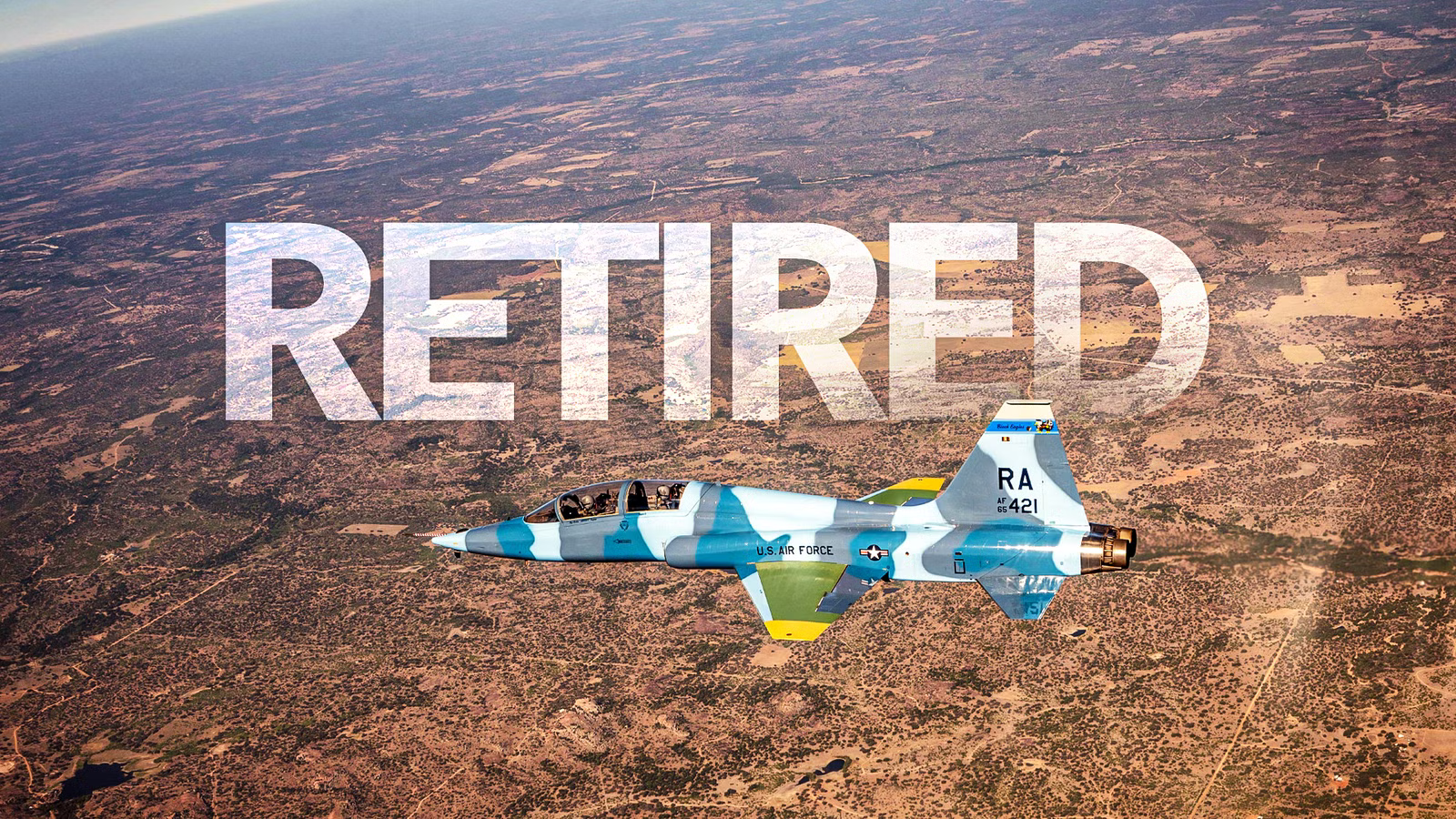
The United States Air Force is not quietly retiring its T-38 Talon trainer (based on the Northrop F-5) fleet ahead of schedule. As of the time of writing (September 2026), the United States Air Force has not yet even begun phasing the aircraft out and doesn’t plan to retire the first batch of Talons until Fiscal 2028, the same year that its first Red Hawks enter service.
There does appear to have been some confusion about a precautionary measure that the Air Force took in May to ground the entire fleet for ten days, but they returned to service after checks were carried out. The Boeing-Saab T-7A Red Hawk has now been cleared for production, and Boeing has received the first order for Lot 1. These are set to be delivered by 2028, with Boeing completing a second Lot 2 the following year.
Budget documents suggest that the Red Hawk may fully replace the Talon in around ten years or in the mid-2030s. The Red Hawk is delayed by around two to three years, although this is typical. The Italian M-348 was delayed two to three years, while Brazil’s Gripen Es are up to eight years late.
May’s T-38 Operational Pause

In May 2026, the Air Force grounded the entire T-38 fleet after a training crash in Alabama. Just ten days later, the operational pause was lifted, and the Talon returned to service after completing its precautionary inspections. On May 29th, the Air Force stated that it was continuing to “progress toward safely returning the fleet to service and anticipates inspected aircraft will begin returning to flying status within the next few days.”
It explained that collaborative engineering and maintenance teams across the joint force have “finalized the inspection procedures to be accomplished to ensure a safe and thorough return to flight.” During the grounding, aircrews reportedly maximized simulator training to maintain their proficiency and currency requirements.
The incident seems to have been misunderstood by some and interpreted as the T-38 retiring early. This mishap does not appear to have any impact on the Air Force’s planned phasing out of the T-38 Talon as it replaces them with the next-generation T-7A Red Hawk. The T-38 that crashed took off from Columbus Air Force Base, Mississippi, and came down in rural Lamar County, Alabama, with both pilots safely ejecting.
T-7A Cleared For Production

The same month, the Air Force announced it had cleared the T-7A Red Hawk trainer for production. It said that “the Air Force is moving forward with a $219 million contract for the first 14 advanced trainer aircraft along with associated spares, support equipment, and training from Boeing Defense, Space & Security.” The Red Hawk is designed to train not only fourth-generation and fifth-generation pilots, but also future sixth-generation pilots.
The Boeing-Saab T-7A Red Hawk is two to three years delayed relative to its original baseline schedule. While this is somewhat problematic, it is not unusual for a new aircraft program. It is comparatively rare for clean-sheet aircraft to meet their original baseline schedule. The T-7A Program Office is now seeking approval for each of the three low-rate initial production lots individually.
America’s Air Force has a program of record to purchase 351 T-7A Red Hawk trainers along with 46 ground-based training simulators to five AETC bases over the next decade. The retirement of the 60-year-old T-38s will be a phased approach. The Air Force plans for the Red Hawk to achieve Initial Operational Capability in 2027 and expects the jet to be ready to fly new pilots in 2028.
Air Force’s Planned T-38 Phase Out

Budget documents do not show large annual T-38 retirements from Fiscal Year 2021 through Fiscal Year 2025. Instead, the Air Force prioritized life-extension work to keep the bulk of the fleet flying as the Red Hawk was developed. This work included the Pace Classic III structural upgrades and others. Consequently, the Air Force’s T-38 inventory has remained stable for the last few years at around 490 to 500 aircraft, the vast majority (438) of which are T-38Cs.
In the Air Force’s Fiscal 2027 budget request, only one T-38 (a T-38C variant) is being requested to retire. However, Fiscal 2027 documents do show that retirements of the legacy Talon will start in Fiscal 2028 as the Red Hawk enters service. Air Force projections for annual retirements (per the Fiscal 2027 Force Structure Changes Exhibit) have 14 being retired in Fiscal 2028, followed by 31 in Fiscal 2029, 29 in Fiscal 2030, and 82 in Fiscal 2031.
Air Force advanced trainer transition (per budget documents) | T-38 Talon divestment | T-7A Red Hawk purchases (lag in deliveries) |
|---|---|---|
Fiscal 2026 | 14 | |
Fiscal 2027 | 1 | 23 |
Fiscal 2028 | 14 | 36 |
Fiscal 2029 | 31 | 42 |
Fiscal 2030 | 29 | Up to 60 |
Fiscal 2031 | 82 | Up to 60 |
That is a total divestment of around 157 trainers between now and Fiscal 2031, or around a third of the existing fleet. At this rate, it seems the T-38 Talon will not fully retire from Air Force service until deep in the 2030s. If the average rate of around 40 retirements is held constant after 2031, then the last of the trainers might not leave the fleet until around Fiscal 2038 or 2039. This could be sooner if Red Hawk deliveries ramp up.
Air Force’s Red Hawk Acquisition

In Fiscal 2026, the Air Force requested (and received) funding for 14 Red Hawks for $362 million. These Lot 1 aircraft are expected to have completed their deliveries by the winter of 2028. Budget documents for Fiscal 2027 show an increase to $529.5 million for 23 T-7A Red Hawks (Low Rate Initial Production Lot 2). Lot 2 is to be delivered between 2028 and 2029.
Looking forward, the budget documents project a continued ramp-up with 36 aircraft to be purchased in Fiscal 2028 and 42 in Fiscal 2029. From there, the numbers are expected to increase further until they plateau at up to 60 per year until the program of record for 351 aircraft is reached, likely in the mid-2030s.
The documents say that “Milestone C is currently projected for 3Q FY 2026 with the first Low-Rate Initial Production deliveries anticipated in 3Q FY 2027.” It is somewhat exceptional for aircraft to enter service on schedule, with the BAE Hawk and incoming Northrop Grumman B-21 Raider being two examples of programs that ran or are running on schedule. The F-35 and F-22 ended up slipping by around ten years from their initial schedules.
Other Customers For The T-7A Red Hawk

Meanwhile, as the Air Force prepares to introduce the Red Hawk, more services and export customers are considering purchasing it. One of the greatest potential customers has been considered the US Navy, which is looking for a replacement for its aging T-45 Goshawk. It is expected to purchase around 216 trainers.
However, Boeing has now withdrawn the Red Hawk from the competition, and only Sierra Nevada Corporation’s Freedom Trainer and the Textron/Leonardo offering a variant based on the M-346 remain. A partnership between BAE Systems, Boeing, and Saab is also now considered the leading contender to replace the UK’s Royal Air Force Hawk T1 and Hawk T2 trainers.
The RAF has a requirement for the aircraft to enter service by 2030 and for a large workshare to be carried out in the UK. The number is not yet specified, but it currently has a fleet of 44 Hawk trainers.
Meanwhile, in August 2026, The War Zone reported that NASA has kicked off a hunt to replace its aging T-38 Talons. These are used by NASA to support astronaut training and to act as chase planes. For now, it appears NASA is willing to consider a wide range of potential options, although the T-7A is considered a leading candidate. Brazil and Japan are also considered candidates.
Developing The F-7 Fighter Variant

Beyond the T-7A Red Hawk, Boeing reportedly intends to develop and market an armed derivative of the T-7 Red Hawk called the F-7 to replace the world’s aging Northrop F-5, Aero L-39, Dassault/Dornier Alpha Jet light fighter fleets. However, the program does not yet appear to be a funded production program. Such an aircraft might not be of interest to the US Air Force, but it could attract hundreds of export orders.
The Red Hawk was designed with a significant growth margin and one that would allow it to be easily adapted into a combat aircraft without redesigning its basic airframe. This could place it in competition with other light fighters like the Korean FA-50 and the Italian M-346FA, although not light/medium frontline fighters like the Gripen E or F-16 Block 70.
The aircraft could be fitted with advanced systems like AESA radar, helmet-mounted cueing, modern datalinks, an electro-optical targeting pod, up to seven external hardpoints, and more. Around 2,600 first- and second-generation F-5 light fighters were built, with around 500 remaining in service with various air forces around the world. The T-38 Talon is the trainer variant of the larger F-5 Tigershark family.